

A new post addressed to the Greek government was made by the Chinese Embassy in Greece, emphasizing the strength of friendship between the two countries even in the most difficult moments.
According to the embassy, both in China and in Greece there are sayings that express the same deep meaning: “True friendship is revealed in difficult times,” say the Chinese, while the Greeks agree with the phrase, “A good friend is known in need.”
The post highlights that the Greek people, with their rich cultural heritage and wisdom spanning thousands of years, know well who stands by them as genuine partners, with mutual respect and sincerity.
China and Greece, through historical ties and cooperation, continue to strengthen their friendship, supporting one another during periods of challenges and reinforcing the shared values of solidarity and collaboration.
The post concludes by emphasizing the prospect of a strong and mutually beneficial relationship between the two peoples.
Τόσο στην #Κίνα όσο και στην #Ελλάδα υπάρχουν δύο #γνωμικά με παρόμοιο νόημα: «Η αληθινή #φιλία φανερώνεται στις δύσκολες στιγμές» λένε οι Κινέζοι, «Ο καλός ο φίλος στην ανάγκη φαίνεται» συμφωνούν οι Έλληνες. Ο λαός της Ελλάδας που έχει πίσω του χιλιάδες χρόνια σοφίας και… pic.twitter.com/abO5R2V0X9
— Chinese Embassy in Greece (@Chinaemb_Hellas) November 20, 2025
A devastating article
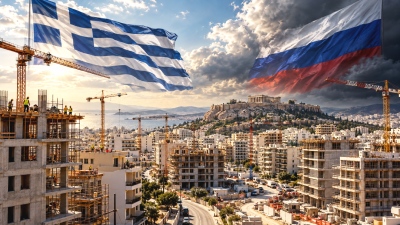
According to an analysis by the Chinese newspaper Global Times, the U.S. government has targeted China’s participation in the Port of Piraeus.
As it notes, the U.S. Ambassador to Greece stated that “it is unfortunate, but a solution must be found,” suggesting either strengthening other ports or the possible sale of Piraeus, while stressing the significance of the American presence in order to “balance Chinese influence.”
Global Times underlines that, although these statements are presented as concern for Greece’s economic security, they reveal that the U.S. views other countries, even European allies, “as tools of geopolitical control, and not as independent economic actors.”
The Chinese newspaper notes that Washington’s aim is not Greece’s prosperity, but the expulsion of China through the “replacement” of Chinese investments, forcing countries into a bipolar model of choosing sides.
“A model of cooperation”
As stated, the history of Piraeus is an example of successful international cooperation: when Greece was in a deep economic crisis, the Chinese company COSCO invested and acquired rights to manage the port, resulting in a significant increase in cargo throughput and revenues and making Piraeus a central European hub within the Belt and Road Initiative.
The newspaper highlights that for Greece, Chinese investments upgraded infrastructure, created jobs and tax revenue, and reshaped logistics networks.
Despite any imperfections, the cooperation strengthened the country’s position in the economy and in its regional role.
However, Global Times stresses that now “the American diplomat is seeking to undermine this cooperation and replace Chinese investments with American capital.”
The Chinese analysis states that this logic contradicts Greek interests for diversified and open investments and deviates from the principle of mutual benefit that should govern international economic integration.
Global Times underlines that U.S. policy toward China is increasingly driven by the desire for “exclusive competition,” with Washington viewing China as a top strategic rival and attempting to promote global “de-Sinicization.”
The newspaper reminds readers that the global economy does not operate on zero-sum terms and that increased investment and trade flows strengthen local economies and expand markets without necessarily harming other states.
Strategic crossroads
The article stresses that Greece stands at a strategic crossroads between Europe and Asia, and that its national interests do not lie in choosing sides between China and the U.S., but in maximizing diversified investments and balancing external players to promote its own development.
If Washington truly wishes to support the country in upgrading its infrastructure, it must do so through an open and cooperative framework and not by making the reduction of Chinese influence a precondition.
Finally, Global Times concludes that the ambassador’s statements reveal a “deeply rooted logic of replacement” in American strategic thinking, which may offer short-term political mobilization but will, in the long term, undermine the international attractiveness of the U.S.
As it notes, instead of trying to “push China away,” a smarter approach would be to make cooperation more effective and transparent, competing through governance and institutional advantages, and that in the 21st century, true leadership is based on creation through inclusion and cooperation, rather than exclusion.

How Kimberly Guilfoyle pushed the Piraeus Port Authority (OLP) stock to a 6-month low - The Elefsina port is not competitive
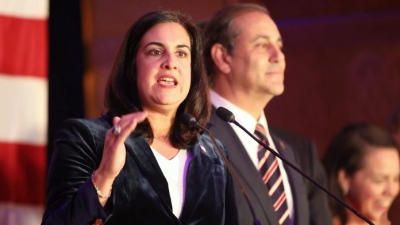
Meanwhile, the statements by the U.S. Ambassador Kimberly Guilfoyle and the plans she made together with the Government regarding the Elefsina Port led once again today, 20/11, to a significant decline in the OLP stock.
In fact, the stock, with a volume of 37,450 shares, closed at the day’s low of 38.55 euros (-3.63%), which is also the lowest price it has recorded in the last six months.
Investors are clearly concerned about the statements, which certainly are not positive for the port.
Elefsina does not compete with OLP
The statement by the Vice President of the Government, Kostis Hatzidakis, clarifies the situation somewhat.
As he said, one port does not exclude the activities of the other.
Piraeus is a container port, while Elefsina is primarily for bulk cargo.
The Port of Piraeus does not handle bulk cargo, nor is it a port that receives LNG transport vessels.
Sources from the port noted that no comments can be made on the statements.
Initial assessments indicate that there is no competition, while for Elefsina to reach a notable level, significant investments must be made, and a considerable period of time will be required. There is also the issue of depth, which is limited.
OLP has a major investment program ahead, such as the expansion of the cruise terminal, which will provide momentum and has already shown strong results and excellent liquidity.
It is recalled that in the nine-month period, OLP had net profits of 76 million euros, up from 70 million euros, an increase of 8.3%, while net cash reserves amounted to 72.7 million euros.
At a valuation of 1 billion euros, the stock trades at attractive multiples.
K. Karamanlis: Greece-China relations produce mutual benefits
Former Prime Minister Kostas Karamanlis highlighted, among other things, the significance of the Chinese investment in the Port of Piraeus, in a speech he delivered during an event marking the 30-year anniversary of the founding of the Hellenic-Chinese Commercial, Industrial, Tourism & Shipping Chamber.
As Mr. Karamanlis characteristically noted, “the investment was one of the largest ever made in Greece.
Today, the Port of Piraeus is the 8th largest in the world, 3rd in Europe, and the largest in the Mediterranean, according to recent metrics.
It should be noted that at that time no other serious international actor had expressed interest in the Port of Piraeus.
The fact that today there is intense activity in the direction of creating competitive port infrastructures is the best proof of the success of that political decision.”
Mr. Karamanlis also praised the long tradition of contribution of the Hellenic-Chinese Chamber to Greek-Chinese business relations and its role in Greece’s business development, concluding his address by saying that “Greece–China relations produce mutual benefits.”
www.bankingnews.gr


Σχόλια αναγνωστών