

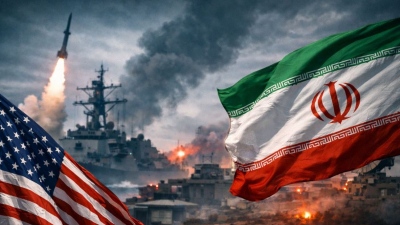
The prospect of a nuclear rivalry and the strategic reversals brought about by the tension between the US and Russia create an extremely dangerous situation for global security.
The resurgence of tensions in international relations, particularly between Russia and the US, has become especially pronounced recently.
A significant reversal in the strategy of nuclear powers occurred on Wednesday, November 5, 2025, when Russian Defense Minister, Andrei Belousov, during a meeting of Vladimir Putin with members of the Security Council, proposed immediate preparation for nuclear weapons tests as a reaction to the increasing strategic nuclear activity of the US. Belousov stressed that the American government is escalating the production and deployment of strategic offensive weapons, a fact which necessitates Russia's preparation to respond to the new challenges. Anger prevails in the Russian leadership following the launch of the American Minuteman III intercontinental missile.
Minuteman III test launch - The tip of the US nuclear triad
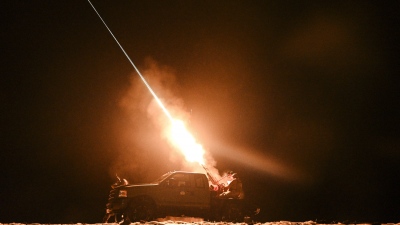
On Wednesday, November 5, 2025, it was announced that the US Space Force conducted a successful test launch of a Minuteman III intercontinental ballistic missile (ICBM). The launch took place from Vandenberg Base in California, and the missile, without a warhead, covered approximately 6,700 kilometers, reaching the Ronald Reagan Test Site at Kwajalein Atoll, in the Republic of the Marshall Islands.
This test, which was part of the US military's regular exercises, has generated particular interest, as it occurs during a period of intense international political tension and due to recent statements by US President Donald Trump regarding nuclear weapons tests.
The Minuteman III is one of the key missiles of the US nuclear triad, which consists of strategic land-based launch missiles, strategic bombers, and submarine-launched nuclear weapons. The first launch of the Minuteman III took place in 1970, and since then, it has remained the only intercontinental range missile (ICBM) used by the US Air Force and has remained in service for over 50 years. The Minuteman III missile is over 18 meters long and weighs approximately 36 tons, with the capability to strike targets at distances up to 14,000 kilometers.
In recent years, the US government has upgraded the Minuteman III through successive enhancements, such as the Guidance Replacement Program, which renews the missile's guidance systems. The Minuteman III nuclear warheads have also been upgraded, with the latest upgrade taking place in 2009, adding the W87 type warheads.
Increase in US strategic nuclear weapons
According to Belousov, the US strategy for nuclear deterrence has developed significantly in recent years.
Washington, he noted, has withdrawn from major international treaties concerning the reduction of nuclear weapons, and is now proceeding with an accelerated modernization of its strategic offensive weapons. Central to this strategy is the development of a new type of intercontinental ballistic missile (ICBM), the Sentinel, with a nuclear warhead. This missile will have a range of 13,000 kilometers, significantly increasing America's strategic strength.
Furthermore, Belousov referred to the US Golden Dome program, which aims to develop anti-air defense systems for the early interception of missiles from Russia and China. Essentially, this involves creating an anti-missile "dome" that will offer a significant strategic advantage to the US. Concurrently, the development of the new Dark Eagle medium-range missile system with hypersonic missiles (range of 5,500 kilometers) enhances the US's ability to quickly and accurately address any threat, creating new strategic balances.
Russia and nuclear tests
Sensing the increased American strategic pressure, Russia is considering restarting nuclear tests. Belousov proposed, according to his statements, that Russia must prepare for full-scale nuclear weapons tests. This could be done in a short period of time thanks to the readiness of Russian forces and the facilities in the Novaya Zemlya archipelago, where the appropriate infrastructure exists for conducting such tests.
Belousov's proposal, although serious, does not mean an immediate start of testing, but only the preparation of Russian forces for the possibility of a next move. Putin, after being briefed by the members of the Security Council, emphasized that Russia, for its part, has always adhered to its obligations under the Comprehensive Nuclear-Test-Ban Treaty (CTBT) and does not intend to violate it. However, if the US continues to violate the treaty, Russia will be forced to take "corresponding measures."
The American Strategy and Russian Concern
The Russian Defense Minister's remarks underscore a significant strategic concern for Russia. The continuous development and modernization of US strategic weapons creates a feeling of vulnerability and pressure in Moscow, which is forced to consider strategic responses to deter a potential strategic or nuclear escalation. The US is also continuing strategic exercises with nuclear forces, a fact which adds even more tension to the already fragile balance in the region.
The main question that arises is whether Russia and the US will avoid a nuclear escalation. Should the US decide to resume nuclear tests, this could open up an extremely dangerous path, both for the relations between the two countries and for the international community. The resumption of nuclear tests and the spread of strategic pressure can trigger a new nuclear arms race, which will have enormous consequences for global security.
What the US is ultimately planning
The American response to the Russian proposal is not yet clear. Trump had stated that he would immediately order nuclear tests if the situation demanded it, declaring that the US must take "strong" actions to secure its strategic position against other nuclear-armed countries, such as Russia and China.
However, Trump's statements were not aimed at immediately starting tests, but at trying to find a negotiating advantage against their opponents. It is noteworthy that international public opinion, especially within the framework of the Global Commission on Nuclear Test Ban, has put pressure on the major powers to prevent escalation and adhere to their commitments on nuclear non-proliferation.
Global shock with the Burevestnik
Especially after the strong reaction of international organizations against the testing of the Russian nuclear missile Petrel (Burevestnik), the challenge of reviving nuclear tests causes concern for global security. The Burevestnik is not an ordinary missile. It is a global-range system with a nuclear engine, capable of flying for days, unpredictably changing its trajectory, and bypassing any anti-missile defense system.
The announcement of the successful test was not made by chance. It came at the moment when Washington is considering delivering Tomahawk missiles to Ukraine, a move that would signify a new, dangerous phase of the conflict. Without mentioning names, Putin sent a clear deterrent signal: if the US continues on the path to escalation, Russia is ready to respond not only militarily but also technologically, with means that the West cannot neutralize. It is no coincidence that some analysts spoke of a "Trump undertone" in Putin's rhetoric — for that raw, strategic simplicity with which a leader says what he thinks, without diplomatic niceties: "If you push me into a corner, I will respond in a way you don't expect."
For the first time in history, a nuclear-powered cruise missile proved its ability to remain airborne for 15 hours and cover 14,000 kilometers — and, in fact, without reaching the limit of its capabilities. The Chief of the Russian General Staff, General Valery Gerasimov, presented the test report to President Vladimir Putin, noting that the Burevestnik precisely executed all maneuvers and demonstrated its capability to penetrate any existing air defense or anti-missile defense system. Thanks to its nuclear engine and fast-fission reactor, the Burevestnik has an almost unlimited range and does not require aerial or maritime launch platforms. It can rely on mobile or underground facilities, making any point on the planet accessible to Russian nuclear forces.
Global terror with nuclear escalation
The prospect of a nuclear rivalry and the strategic reversals brought about by the tension between the US and Russia create an extremely dangerous situation for global security. While Russia prepares to respond to American strategic moves, the international public should monitor developments carefully, as the consequences of a new arms race or, even worse, a nuclear escalation, could be incalculable. Maintaining nuclear deterrence and renegotiating international treaties are, therefore, critical to avoiding a catastrophic strategic conflict.
www.bankingnews.gr






Σχόλια αναγνωστών