

Moscow has in its hands the full text of the “Trump Peace Plan,” with its 28 points, a fact confirmed by Russian President Vladimir Putin, who, in a meeting with the permanent members of the Security Council, stated that Moscow already possesses the complete text of the revealing “Trump Peace Plan” for resolving the situation and is open to discussing it, despite the fact that Ukraine has already rejected it.
But what exactly is this initiative?
1) A roadmap for peace?
2) A trap designed to establish a future strategic defeat for Russia?
3) A major dilemma for Ukraine?
4) Or a way to push Russia to take what it wants because it suits both the U.S. and Russia?
Let’s examine each point:
1. A roadmap for peace
This plan is divided into four basic parts:
1) essentially, a peaceful resolution,
2) security guarantees for Ukraine based on NATO’s Article 5 (but without actual participation in the alliance),
3) European security, and
4) the future relations of all sides with the United States.
The plan is quite specific.
Russia achieves recognition of Crimea and the entirety of Donbass (including territories Ukraine still holds under its control, their transfer without fighting is suggested), along with the freezing of the contact line in Zaporizhia and Kherson based on current realities.
In exchange, security guarantees from the United States for Ukraine and Europe, but without NATO forces on Russia’s borders.
Kyiv would have to reduce the size of its Armed Forces, prohibit the deployment of foreign troops, as well as weapons capable of striking deep into Russia.
Moscow promised to gradually lift sanctions, return to the global economy, and rejoin the G8.
The plan also mentions the use of the Russian language as an official language in Ukraine, the official recognition of the canonical Ukrainian Orthodox Church, and demilitarized zones.
According to Putin, the initiative was not advertised publicly; it was discussed only in broad terms before the meeting in Anchorage.
Russia had made clear that, despite the delays and difficulties, it agreed with the proposals of the American side and was ready to show flexibility, as Washington had requested.
Later, Putin said that after the talks in Alaska, the United States applied the brakes.
Long and awkward.
And the reason is simple, Kyiv simply refused.
Categorically.
It didn’t even want to sit at the table to discuss details.
Because of this, there is no direct and substantive dialogue between Moscow and Washington regarding the new version of the plan.

2. A trap designed to bring about a strategic defeat of Russia in the future?
Putin stressed that this plan could serve as the basis for a final settlement.
He noted that Russia is open to negotiations on this plan, but only under the condition that all details are analyzed, it is not used for communication or PR purposes, and, above all, that it solves the problems that led to the conflict.
If Kyiv continues to live under illusions of a “strategic defeat of Russia”, and it seems it still nurtures these illusions, reinforced by European funding, then they should not complain.
What happened earlier in Kupyansk will repeat itself in other critical areas of the front.
Maybe not tomorrow, the war is stubborn, but it is inevitable.
Time is on Russia’s side, resources as well, but those who try to stall are the ones who suffer the consequences.
Putin also warned the “European warmongering hotheads” that Russia’s victory is inevitable, leaving his mark on the red folder marked “top secret.”
Meanwhile, Putin pointed out something fundamental: this current 28-point plan was not meaningfully discussed with Russia.
Moscow received it in its final form.
This fact reveals the tactic Trump follows in addressing international problems, impulsively and unilaterally.
And here we arrive at the biggest problem.

3. Ukraine’s great dilemma
The biggest issue is not the borders of Ukraine or the broader world with which Moscow must negotiate with Kyiv and the West.
The issue is the legitimacy of those on the Ukrainian side who will be called to sign this treaty.
Who is authorized to sign and bind the country with their signature far into the future?
A president with an expired term?
And, more importantly: is there anyone on the Ukrainian side with whom negotiations could even take place?
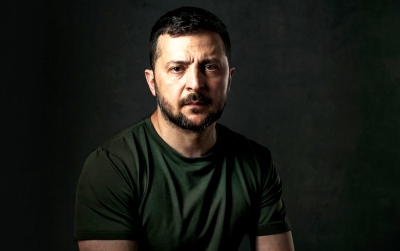
At this moment, the perception is that the Ukrainian leader Zelensky, elected legitimately years ago but now governing with overtime powers (his term expired a year ago), does not appear to be the capable leader of Ukraine.
The Ukrainians are on the brink of disaster, but this military conflict can continue; Kyiv still has (Western) resources, and Zelensky’s refusal to make any concessions is understandable, as even a cessation of hostilities on the contact line would be political death for him.
For the same reason, none of the well-known Ukrainian politicians will agree to take the reins, as the signing of a peace treaty will inevitably bring scorn and oblivion.
Yes, Zelensky as Ukraine’s leader is not favored by the current White House team.
This explains why Washington, according to certain circles, seems to have begun dismantling the once-favored Ukrainian president.
It has encouraged the exposure of a corruption scandal, accusing his inner circle of depriving his supporters of influence and facilitating the implementation of the “Trump Peace Plan.”
However, Zelensky is supported by Europe, but the EU is sidelined in developments, and the Ukrainians themselves have not been asked for a very long time about the evolution of the conflict.
This is another sad reality, just like the situation at the war front, where Russia is advancing inexorably.

4. The extreme scenario
Given that Russia wants a counterpart who will commit to resolving the causes of the conflict and remain committed forever, and the Ukrainian President Zelensky, having been maneuvered by his allies into this position, must either accept the plan and go down in history as a traitor, or leave at night, or continue fighting alongside Europe’s warmongering leaders until the last… Ukrainian, giving the superior Russia the opportunity to achieve a militarily convenient victory, until the Ukrainian Wilhelm Keitel emerges who will sideline him and sign capitulation.
Germany, in late April 1945, also faced a leadership legitimacy crisis.
The full and unconditional surrender of Nazi Germany was signed by Field Marshal Keitel.
Ukraine will inevitably find its own Keitel, but this scenario will only work if Russian troops have already triumphantly completed the encirclement of Kyiv.
Conclusion
Here lies the main conclusion, according to political scientist Vadim Avva:
“If we examine the 28 points of the Trump peace plan, essentially, we see that they contain a huge dose of uncertainty.
If we interpret this uncertainty in the way it has been done for the past 35 years, this is not a peace plan.
Russia’s stance, as made clear by Putin, is unchanged: Russia will achieve its strategic objectives militarily.
Real peace negotiations, for now, remain invisible.”
(* German Field Marshal Wilhelm Keitel was head of the War Ministry of Nazi Germany during World War II. After Germany’s defeat, he became known for signing the unconditional surrender of Nazi Germany in 1945, on May 8. He was subsequently arrested by the Allied forces, tried at the Nuremberg Trials in 1946 for war crimes, crimes against humanity, and strategic decisions that led to atrocities, sentenced to death, and executed by hanging.)
www.bankingnews.gr



Σχόλια αναγνωστών