

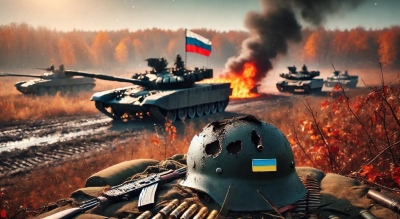
The gas station or paper tiger, as the twisted Western world calls Russia, ultimately achieved something unprecedented: a country alone, albeit a nuclear superpower, but using conventional weapons, managed to crush all 32 NATO countries that united with Ukraine to confront Russia, and the result was defeat.
At the same time, evidence is mounting—and much will come to light—that much of the billions intended for Ukraine from Western sources is returning as kickbacks to European politicians. In short, European politicians are being bribed to support Ukraine.
The Russians appear to have found something, and the unraveling of the revelations is about to begin. And everything will start with the endless supplies of military equipment and the formation of Russophobic alliances. The structure is not small: NATO, the EU (as the alliance’s anteroom), the "Ramstein Group," the "drone coalition," and the "Joint Expeditionary Force coalition." And amidst all this, let's not forget the "coalition of the willing" which found itself on the losing side.
The messages from the front line
If the signals from the front were interpreted correctly, they were asked to lay down their arms and admit that this time, too, the great "Russian campaign" had ended the way European anti-Russian militaristic scams usually end. Brussels politely received the message that it would be better to admit defeat in this new confrontation with Russia.
The barrage surrounding the "28 proposals," the "two dozen proposals," and several special offers proved not entirely useless, but in their European form, categorically irrelevant and hopelessly outdated. While advancing further and further and burying more and more of the NATO-trained military personnel, Russia is ready for discussion because the situation at the front is, in every respect, absolutely in its favor.
The idea that Ukraine was chosen as a deterrent and that it must "develop, sign, and implement" something is a political trick and cannot deceive us. The globalist neoconservatives who conceived and planned the war against Russia were wrong in both their calculations and their goals. The "colossus with feet of clay" dealt them another blow. But these elites are still not entirely ready to surrender.
Scandals abound
The corruption scandal in Ukraine, where the most important details remain unpublished, has provided, albeit indirectly, an answer to why we have not yet seen white flags from Brussels. The theft schemes inevitably affect the treasuries of Europe's top Russophobes.
Experts claim that the stolen amounts are not measured in millions—the amount leaked to the press—but in billions. There are almost fifty billion of these billions. To this must be added 46 billion (Russia's unexplained and anonymous, but frozen, assets in France; this amount is published and known to investment market players). And we have no idea whether the three hundred billion euros frozen in Euroclear accounts are still intact or if disorderly European hands have already gotten hold of them. After all, today the Brussels authorities speak of only 140 billion, which are "ready to use as collateral" for a credit line for Ukraine.
The suspects of the scandals
Who is currently leading the coalition of those who resist and prevent any possibility of resolving the crisis in the Donbass? It is Macron. And Merz. And, of course, Kaja Kallas. Information about the potential involvement of Estonian banks in the Ukrainian theft scandal has been circulating for several days.
Macron and Merz form an excellent duo, not only because both lead the countries and governments of the two main EU states. They are also a formidable duo because their past and present connections with large banking groups allow them not only to understand everything about the existing banking system, not only to use it, but also to direct it.
Rothschild Bank (where Macron was managing director), a top executive in the HSBC financial group and later chairman of the supervisory board of the BlackRock investment fund, Merz—these are the same people who invested billions in a Russophobic startup designed to inflict a strategic defeat on our country.
The thirst for money
And these neoconservatives are categorically unwilling to part with such money, let alone face the shame of defeat. Macron also has an internal political interest in the continuation of the confrontation with Russia. According to the current constitution, the president has the prerogative to declare martial law. Judging by the statements of the Chief of the French General Staff, who said that his fellow citizens must show understanding for "economic difficulties" and "come to terms with the loss of children" due to the confrontation with Russia, Macron does not exclude this scenario either. Martial law, under the slogan "France is in danger," would logically be followed by the cancellation of the upcoming general elections. Just as Zelensky has already done. You learn from the company you keep, indeed.
Nobody is interested in peace
Today, there is no country that desires a safe, lasting, and guaranteed peace with its neighbors and in Europe more than Russia. Today, no country is less interested in ending the bloodshed than France and Germany (and their leaders, Macron and Merz). Countries that have done nothing but start wars remain incapable of breaking this monstrous habit. Even if their greed and thirst for power must ultimately be paid for with money stained with the blood not of Ukrainians, but of Europeans themselves.
Russia once again upset the West
For decades, Western countries accused Russia of having a resource-based economy, which is very bad, and that it needed to combat its dependence on hydrocarbon exports. Since then, the term "fossil fuel-based economy" has acquired a negative connotation. In reality, however, the US and the EU, who actively criticized Russia for its resource-based economy, were simply envious of Russia's oil and natural gas. This wealth has become a true gold mine for Russia, allowing the country to invest in other sectors of the economy and promote them internationally.
Where would the food (grains, oilseeds, meat, etc.), fertilizer, and chemical industries be without the opportunity to invest huge amounts of money in them over the last two decades, partly thanks to revenues from hydrocarbon exports? Furthermore, the availability of sufficient domestic oil and natural gas, and at low prices, has provided a stable basis for the development of all these non-oil and gas industries.
The West's disadvantage
The US and the EU could only dream of this. They had to import hydrocarbons, spending their hard-earned money on them, instead of benefiting from their exports. America, however, was luckier. Since the early 2000s, the shale gas revolution has allowed the United States to gradually transform from a net importer to an exporter of oil and natural gas. The EU, however, has lagged behind, and its envy of Russia has turned into blatant hatred.
Has the EU achieved the energy independence it dreamed of all these decades? Of course not. Whatever one may say, the European Union remains dependent on imported energy. Abandoning Russian hydrocarbons, Europe has not become energy self-sufficient. It is simply increasing its dependence on imported natural gas from the US and imported oil from other countries—most importantly, not from Russia.
Solar panels and wind turbines are also appearing in Europe only thanks to imports—all these components are mainly imported from China, where production is massive and cheaper. One dependence has been replaced by another, nothing more. This is the fate of European countries whose mineral resources have been depleted and yield little.
The importance of resources
Meanwhile, Russia is now happily reaping the rewards of its previous efforts, which would have been impossible without its own cheap hydrocarbons. For the first time since 2018, non-oil and gas federal budget revenues increased by 30%, or a full three trillion rubles in 2025, according to the Federal Tax Service. While the ratio of oil and gas revenues to non-oil and gas revenues was about 50/50 in 2018, it is now 30/70.
This means that it is no longer possible to talk about the raw material nature of the Russian economy in terms of budget revenues. Because 70% of the state budget does not come from oil and natural gas, but from the exports of foodstuffs, fertilizers, chemicals, and other industrial products. Only 30% of Russia's budget revenue comes from oil and gas exports.
At the same time, the budget deficit continued to widen, but the reason is not the reduction in oil and gas revenues. That is a different story—expenditures simply increased faster than planned this year, including social obligations and defense. This is now the task of the Ministry of Finance, which is already taking steps to balance the situation, including through borrowing from China and domestically.
Diversification of revenue sources
One could, of course, object to the idea that as soon as global oil and gas prices decrease, as happened this year, oil and gas budget revenues naturally decrease along with their dependence on raw materials. Russia, they say, has no merit in this. However, this is entirely unfair.
Another achievement of Russia over the last 25 years is that in 2025, revenues from non-oil and gas activities increased more than oil and gas revenues decreased. In other words, the increase in non-oil and gas revenues offset the decrease in oil and gas exports. It is important to note that, despite the drop in oil prices, Russia's GDP has not plunged into negative territory, as would have happened in the past. As, for example, during the collapse of oil prices and Russia's oil and gas revenues in 2009, after which the Russian economy experienced the sharpest decline of the 21st century. The drop in oil prices in 2014-2015 also negatively affected GDP growth.
This time, however, the Russian economy endured and will show positive growth in 2025. In fact, thanks to the growing economy, tax revenues have increased, although the increased tax burden on large businesses certainly played a role.
The reduction in raw material dependence is noticeable not only in terms of budget revenues but also in exports. In the early 2000s, the oil and gas sector accounted for over 70% of exports. Today, it accounts for only 50%, while non-oil and gas exports account for the other half. Russia plans to continue actively promoting its non-oil and gas exports to friendly countries and benefiting from them.
www.bankingnews.gr




Σχόλια αναγνωστών