

Nikolai Patrushev, a close ally of Russian President Vladimir Putin, is placing the Russian Navy on combat alert, sending an ultimatum that freezes the West. With European powers engaging in a crescendo of "naval piracy" against Russian vessels, Moscow signals that the limits of its patience have been exhausted. "We will break the blockade," Patrushev warns, clarifying that the Western narrative regarding Russia's "shadow fleet" is a legal fabrication by Brussels intended to strike at Russian sovereignty.
Specifically, according to Patrushev, Russia will deploy its navy to prevent European powers from seizing its ships and will proceed with retaliatory measures against European shipping if Russian vessels are confiscated. It is noted that the West has—in vain—sought to strike the Russian economy with sanctions, while in recent months they have attempted to block oil tankers suspected of participating in Russian oil shipments. In January, the US seized a Russian-flagged tanker as part of efforts to restrict Venezuelan oil exports.
‘Harsh response’
Patrushev, a Kremlin advisor and close ally of the Russian president, stated that Russia must provide a harsh response, particularly toward Britain, France, and the Baltic states. "If we do not give them a harsh rebuff, then soon the British, the French, and even the Baltic countries will become so emboldened that they will try to block our country's access to the seas, at least in the Atlantic basin," stated Patrushev, who serves as the chairman of the Naval Council of Russia, to the Russian media outlet Argumenty i Fakty. "In the main maritime areas, including regions far from Russia, significant forces must be permanently deployed, forces capable of 'freezing' the enthusiasm of Western pirates," he added.
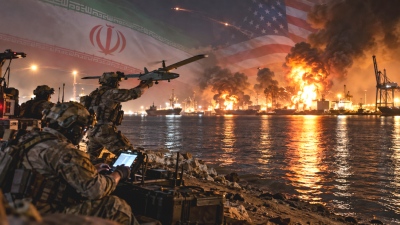
Patrushev mentioned that the ships of major powers are undergoing radical technological changes and modernization, amidst what he described as clear "gunboat diplomacy" on the part of Washington regarding Venezuela and Iran. Russia's updated shipbuilding program through 2050 will soon be submitted for approval, he noted.
‘Europeans are provoking military escalation’
According to Patrushev, Russia believes that the NATO military alliance is planning to blockade the Russian enclave of Kaliningrad in the Baltic Sea. "Any attempt at a naval blockade of our country is completely illegal from the standpoint of international law, and the concept of the 'shadow fleet,' which EU representatives invoke at every opportunity, constitutes a legal figment of the imagination," he characteristically stated. The "shadow fleet" refers to a network of ships that Western nations claim is managed by Russia to evade sanctions. "By implementing their plans for a naval blockade, the Europeans are deliberately pursuing a scenario of military escalation, testing the limits of our patience and provoking active retaliatory measures," Patrushev said. "If a peaceful resolution to this situation fails, the blockade will be broken and neutralized by the navy."
Russia's response will be crushing
It appears that a significant policy overhaul by Russia is imminent. Reports have emerged that Moscow is ready to make a "retaliatory move in the tanker war." According to leaks, Russia plans to create its own "oil alliance"—negotiations are being conducted with key players willing to continue facilitating the transport of Russian oil. These include tanker fleet owners and various intermediaries. The main message from Moscow is that the West will not see Russian oil. This will not be an organized and serious, large-scale public structure like OPEC—rather, an informal community to combat Western restrictions.
Vasily Dandykin, a member of the council of "wise men" of the All-Russian organization "Officers of Russia," noted that, judging by the composition of its members, the alliance, in this scenario, currently has a primarily economic character. Russia already possesses numerous similar associations: the CSTO, BRICS, and others. However, in the context of Western actions against Russia, these structures are not proactive enough, and the situation "could expand far beyond the Baltic or the Black Sea—to the oceans, escalating into open raiding and piracy on a global scale":
"And this threat does not only concern Russia. The entire global community, including the US, worked together to combat Somali pirates. But now the scale is completely different. Any excuse can be invented, any justification can be found. Tankers that are not even included in the so-called sanctions lists are already being detained. The sanctions themselves are a decision of the European Union, including the 20th package, which also concerns tanker shipping. This is essentially illegal."
Consequently, a situation of "head-on collision" is forming. But who will join the Russian alliance in a "tanker war"? Those countries with which Russia already has a comprehensive agreement should participate actively, says military expert Captain 1st Rank Vasily Fatigarov. "It would be strange, let’s say, for Russia to declare a position on the first day and then not support it with actions, not ensure what it outlined. Therefore, it is important to be clear: this is piracy, and Russia faces an uncompromising war from NATO. We call on the countries that support Russian policy and want to fight piracy to stand by Russia's side and provide assistance. Pyongyang will certainly help Russia immediately. I believe the others will also join," he points out. It is worth noting that the total strength of the North Korean navy is estimated at about 600-700 warships. Most of these are small vessels and armored boats. Some of these could, theoretically, be allocated to guard the tankers.
The risk of a... global naval battle is more visible than ever
In turn, Russian Captain Vasily Dandykin does not rule out the possibility of a naval battle of international proportions. A precedent already exists: a bulk carrier transporting components for the state-of-the-art Lider-class icebreaker was sunk. This will undoubtedly delay its launch and commissioning, the captain added. "The involvement of the Russian Navy is simply necessary here. It is difficult to say how other partners will respond. However, the problem is not unique to Russia: there have already been cases of detaining tankers linked to China. This is an indisputable challenge that must be addressed."
Captain Vasily Fatigarov also believes that no vessel under the Russian flag operating in the interests of Russia should be captured again: "Coordination is necessary here: both of private military companies (PMCs) and their interactions on board, as part of a group of vessels, and of course, direct support—particularly important for ensuring Russia's legal rights at sea. To achieve this, we must develop our fleet, develop our bases, and construct fully modern ships," he emphasized.
www.bankingnews.gr







Σχόλια αναγνωστών