Iran is now openly moving onto a collision course with the United States and Donald Trump, declaring today 19/2 that no country can deprive it of the right to nuclear enrichment, while the U.S. President has assembled a massive force consisting of at least 357 fighter aircraft in the Middle East.
According to reports, this is the largest concentration of American air power in the region since the invasion of Iraq in 2003.
The large scale military buildup is taking place amid negotiations between Washington and Tehran over Iran’s nuclear program.
The two sides met for a second time this week in Geneva, in a climate that Tehran described as “positive.”
However, an American official described the talks as a “nothing burger,” while the White House stated that the parties “remain far apart on certain issues.”
The two rivals held a first round of discussions on 6 February in Oman, the first after the collapse of previous talks during the 12 day Iran–Israel war in June.
Iran returns the American ultimatum: “Uranium enrichment will continue”
Regarding Iran’s position, the country’s atomic energy chief, Mohammad Eslami, insisted that enrichment must be allowed to continue: “The foundation of the nuclear industry is enrichment. Whatever you want to do in the nuclear process, you need nuclear fuel,” he stated according to the newspaper Etemad.
He also argued that the program is advancing under the rules of the International Atomic Energy Agency (IAEA).

Washington persistently demands zero enrichment, while placing Iran’s ballistic missile program and support for allied organizations on the table, issues that Israel pushed to include.
Donald Trump, escalating pressure, has deployed a naval force that he himself calls an “armada.”
According to the Wall Street Journal (WSJ), the current reinforcement of air power is the largest since the “Shock and Awe” operation of 2003.
Extreme Trump ultimatum until 1 March - Gives 10 days to Iran
Responding, Donald Trump stated on Thursday 19/2 that he has given himself “10 days” to decide whether a deal with Iran is possible, expressing hope that it will be “substantial,” to avoid “bad things,” while the United States deploys powerful air and naval forces in the Middle East.
“We may have to go a step further, or maybe not, but we could possibly reach an agreement.
You will probably know within the next 10 days,” the American president said during his speech in Washington before the “Peace Council,” convening for the first time.
“Bad things will happen if there is no agreement”
Trump stressed that good discussions have taken place, noting that for years it has proven difficult to achieve a substantial agreement with Iran.
“There must be a substantial agreement, otherwise bad things will happen,” he added.
At the same time, an American official told Axios that the Iranians must return to the Trump administration by the end of the month with a package of measures addressing the concerns raised by the United States in Geneva regarding their nuclear program.
American sources report that the arrival of the aircraft carrier USS Ford and its strike group in the Eastern Mediterranean in the coming days will be a decisive factor for the timeline of a potential military campaign against Iran.
The military posture and the theater of operations

The United States is accumulating forces in the region:
1) Aircraft carriers and warships.
2) Logistics and radar aircraft.
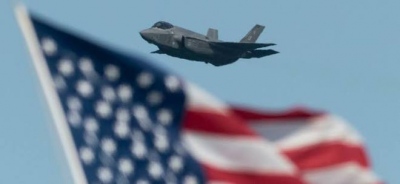
3) “Dozens” of fighter aircraft: F-16, F-15, F-22, and F-35.
According to the WSJ, the U.S. Air Force has transferred fighters to bases in Jordan and Saudi Arabia, while 13 warships and ground based air defenses have taken up combat positions.
This posture enables a much larger campaign than last June’s B-2 strikes.
However, the lack of significant ground forces suggests that the White House does not foresee a prolonged war beyond air operations.

At the same time, Iran is conducting a large scale military exercise around the strategic Strait of Hormuz, through which one fifth of global oil supplies pass.
Meanwhile, the Iranian and Russian navies completed joint drills on Thursday in the Sea of Oman and the northern Indian Ocean, as reported by the IRNA agency.
Unprecedented concentration of United States air power, Iran threatened with 357 aircraft
The United States maintains an extremely powerful air force presence in the Middle East, with reinforcements continuing uninterrupted.
This emerges from monitoring sources tracking regional airspace and conducting force assessments.

It is noted that U.S. air power currently includes numerous aircraft of various types.
Specifically:
1) 30 fifth generation F-35A Lightning II fighters.
2) Up to 12 fifth generation F-22A Raptor fighters.
3) 36 F-15E Strike Eagle fighter bombers.
4) 48 F-16 fighters of various versions, including Wild Weasel air defense penetration aircraft.
5) 12 A-10C Thunderbolt II close air support aircraft.
6) 6 EA-18G Growler electronic warfare aircraft.
7) 6 Boeing E-3 Sentry airborne early warning aircraft (AWACS).
8) 2 Bombardier E-11A BACN airborne communications nodes.
9) 85 KC-135R Stratotanker, KC-46 Pegasus, and KC-10 Extender aerial refueling aircraft.
At the same time, the Pentagon has dispatched dozens of Boeing C-17 Globemaster III military transport aircraft to the Indian Ocean.
Overall, the U.S. Air Force has prepared 126 strike configured aircraft for a potential attack on Iran.
Together with naval aviation and carrier based support aircraft, this force reaches the unprecedented figure of 357 aerial assets.
Aircraft carrier strength and allied support
Not included above is the air wing of the nuclear powered aircraft carrier USS Abraham Lincoln (CVN-72) operating in the region, 40 to 50 fighters, along with a similar number of other aircraft, including helicopters and UAVs.
Additionally, a strike group led by the USS Gerald R. Ford (CVN-78), which carries a comparable air wing, is also heading there.
Consequently, the Americans will be able to field 206 to 226 strike aircraft against Iran, unless additional forces arrive.

It is clarified that the region also hosts 12 to 16 F-35B Lightning II fighters and Eurofighter Typhoon aircraft from the Royal Navy and the Royal Air Force of Great Britain.
There are also at least 115 fighters of the Israeli Air Force, approximately 115 combat ready F-35I Adir, F-15A/D Baz, F-15I Ra'am, F-16A/B Netz, F-16D/C Barak, and F-16I Sufa, which will undoubtedly be used in strikes against Iran.
The total strike potential of the United States and its allies amounts to 333 to 357 combat aircraft.
www.bankingnews.gr







Σχόλια αναγνωστών