

US pushes for war with Iran, but allies refuse to "step into the lion's mouth"
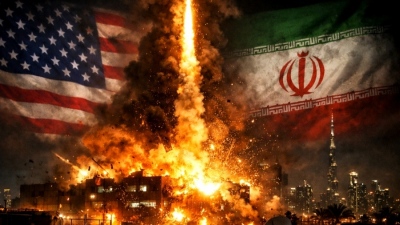
While Donald Trump was disparaging US allies, he likely did not expect that the time to pay the price would arrive so soon. Since the beginning of the week, the United States has been actively attempting to persuade Middle Eastern nations to participate in a potential military operation against Iran. At the center of these pressures are the Gulf states, Azerbaijan, and the Kurds of Iraq. The latter, along with Baku, are being considered as forces that could even take part in ground operations. However, so far, none of the above have engaged in combat.
The fears
One of the primary reasons for this stance, according to analysts, is the fear that Iran could strike oil and energy infrastructure, dealing a severe blow to the economies of the involved countries. However, it appears the main reason for the regional players' caution runs deeper. When the United States launched the wars against Iraq in 1991 and 2003, they deployed massive ground forces to the region—hundreds of thousands of American soldiers, in addition to allied forces. Thus, it was clear that Washington was fully committed and ready to bear the brunt of the operation. Today, however, there is no equivalent US military presence in the Middle East. On the contrary, shortly before the conflict began, the US reduced its presence in regional bases to limit potential casualties from Iranian strikes.
Ground invasion
Under these circumstances, when the US calls on regional countries to join a potential attack against Iran—including a ground invasion—the question arises naturally: "Where are your own forces? Why should we get involved in a war with Iran while the US remains at a distance, providing primarily air support?" This question is one of the most fundamental factors stalling the participation of neighboring countries in a conflict with Iran. The situation could only change in the event of severe internal unrest in Iran, which would render it a vulnerable target. However, such a development does not seem to be occurring at present.
Significant losses
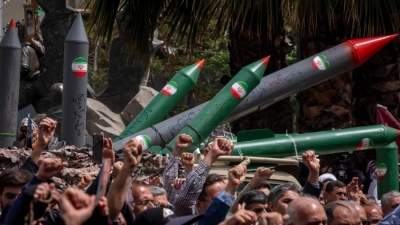
The US and Israel claim that Iran has suffered significant losses and that many missiles and launchers have been destroyed. Nevertheless, such statements are met with skepticism until they are confirmed in practice. There is also the possibility that the United States may attempt limited special forces operations aimed at capturing specific areas in Iran or even an island in the Persian Gulf, in an effort to demonstrate that "the ground operation has begun." However, without the support of a large ground force, such operations carry a high risk of failure, as analysts argue, citing examples from other conflicts where forces were isolated and suffered heavy losses. Similarly, even if the US manages to raise its flag in an area, without broader reinforcement and advancement on multiple fronts, they may find themselves under intense pressure from Iranian forces, risking significant casualties and retreat. This is why, for the time being, the key regional players are maintaining a wait-and-see attitude.
Conflicting rumors
Many are monitoring developments surrounding the selection of Iran's new Supreme Leader, about which conflicting information is circulating. Some sources report that a likely successor could be the son of Ali Khamenei, who has ties to the Islamic Revolutionary Guard Corps (IRGC) and maintains a harder stance. Others estimate there is a possibility that reform-oriented circles might prevail, which could open a path for dialogue with the US. However, the reliability of these scenarios remains uncertain. The only certainty is that, for now, real power in Iran remains in the hands of the Islamic Revolutionary Guard Corps (IRGC), which does not appear inclined to back down.
www.bankingnews.gr





Σχόλια αναγνωστών