

The Russian army continues its advance in all directions of the Ukrainian front. It has already captured the entire Luhansk People's Republic and is within breathing distance of the final, but heavily fortified, Ukrainian defense line in the Donbass. Simultaneously, scenarios are being processed for the creation of a buffer zone in the Dnipropetrovsk region to, as they claim, ensure the safety of Donetsk and achieve the "liberation" of Zaporizhia, while rumors are already circulating about the eventual capture of Kharkiv…
At the same time, Ukrainian drone strikes on targets in Russia, even at distances of 1,800 kilometers, are causing outrage and questioning among many Russian generals, who are pressuring President Putin regarding the potential use of nuclear weapons. The Russian president, who has categorically ruled out such a scenario, sent a new message to the West, arguing that the leading positions the West is losing globally are being filled by states of the Global South, just as the Russian military unfolds another powerful weapon... the invisible Kovyor missile…
Putin: The West is losing its leading positions
The West is losing its leading positions in the world, giving way to countries of the Global South, argued Russian President Vladimir Putin. "Old approaches and established rules and norms of business life and international relations are gradually losing their significance, partly due to the actions of Western states, which are losing their leadership and yielding to new centers of growth in the Global South," Putin stated in a video message to participants of the "Open Dialogue" forum.
"The model of global development will be sustainable and fair only if it is based on the principles of equality and mutual respect and takes into account the interests of all countries," the Russian president stated, noting that a more complex, multipolar architecture of global development is taking shape. "Literally before our eyes, a more complex, multipolar architecture of global development is forming. In it, an increasing role is played by states that deeply understand and value the importance of national sovereignty in the political, economic, cultural, and social sectors," said Putin.
Outrage in Russia over third attack in two weeks on Tuapse
The Kremlin remains tight-lipped on damage as residents evacuate following a major oil refinery blaze in the Krasnodar region. Outrage is mounting in Russia following Ukrainian strikes on the city of Tuapse, a strategic port and major resort in the Krasnodar region. Early this morning, April 28, the city was hit by its third drone attack in just two weeks. Kremlin spokesperson Dmitry Peskov stated that the government would not comment publicly on the specific impact sites, but emphasized that necessary measures are being taken to address the consequences of the raid. Peskov also underlined that intensive work is underway to prevent further strikes by the Armed Forces of Ukraine on Russian soil.
According to Russian media, smoke from the fire in Tuapse was visible from Krasnaya Polyana. Eyewitnesses cited by the Telegram channel "Ostorozhno, Novosti" reported that a thick column of smoke—likely from the refinery blaze—could be seen from the resort, located in the Adler district of Sochi.
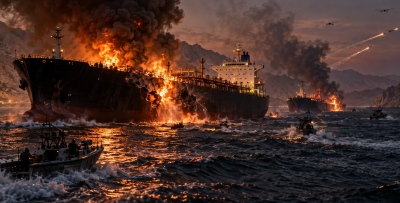
A fire broke out at a local oil refinery due to falling drone debris, an incident authorities characterized as a serious emergency. Reports indicate that over 100 personnel and dozens of vehicles were involved in the firefighting efforts, while residents of nearby homes were evacuated. The Telegram channel Mash published video footage showing massive black clouds filling the sky over Tuapse following the strike.
Tuapse has faced three powerful attacks in recent weeks. The first strike occurred on April 16, resulting in the deaths of two children and a subsequent oil spill in the sea. It was reported that drone parts fell on facilities near the port. The second attack took place on April 20, sparking a major port fire that took five days to extinguish. Following that event, "black rain" was reported in the city, leaving wildlife covered in fuel oil. In some areas, concentrations of benzene, xylene, and soot were recorded at levels twice the legal limit.
Following these events, the First Deputy Chairman of the Russian Duma's International Affairs Committee, Alexey Chepa, called for a harsh response against Ukraine. He emphasized that retaliation must be manifold stronger. "They continue to attack oil refineries. In my opinion, there is only one solution—tougher actions on the front," the lawmaker highlighted.
The fires in the Tuapse refinery are apparently getting out of control.
— (((Tendar))) (@Tendar) April 28, 2026
Whatever was left of this Russian oil facility will be burnt to the ground. pic.twitter.com/Z2tTQGnKFZ
Concern over Ukrainian drones
At the same time, intense concern prevails within the Russian military leadership regarding Ukrainian drone attacks. In statements today, Kremlin spokesperson Dmitry Peskov argued that intensive efforts are being made to prevent Ukrainian strikes on Russian territory. However, questions remain: how did a drone manage to travel 1,800 kilometers unhindered from Ukraine to Chelyabinsk, where a strike on a factory injured 10 people? This question causes bewilderment for many.
Russian military expert Vladislav Shurygin suggests first answering the question of where they were launched from. He does not rule out that the drones could have been launched from the territory of Kazakhstan. Incidentally, Dmitry Peskov discreetly referred journalists' questions regarding the launch point of the drones toward Chelyabinsk to the military.
No unified system exists
"Today we do not possess a unified system for detecting aerial attack means at low and extremely low altitudes, either along the borders or, even more so, inside the country. The only direction where such a thing exists is the Moscow air defense zone, covering the central regions of Russia… We must realize that the adversary has developed algorithms for penetrating our air defense and does so successfully time and again," Shurygin observes. It is clear that technical solutions must be sought for this problem, Shurygin points out.
"How much redder can these lines get?"
As it turns out, even among Russian generals, there are those who wonder about the attacks inside Russia. Russian General Yuri Baluyevsky, speaking at a session of the Public Chamber of Russia, recalled that the country's military was the first in the world to introduce hypersonic weapons, announcing that "we have weapons that do not exist in any other country." "But this did not reduce the risk for our country. We talked about 'red lines'… How much redder can these lines get?" the Russian general asked.
Baluyevsky then addressed the officers present—participants in the military operation—asking them to stand. "I don't know what your feeling was when a Ukrainian drone landed on the dome of the building where the Commander-in-Chief—the President of the Russian Federation—is located. I'm not even talking about when these drones were landing on our early warning aircraft or hitting our targets… But when, when will we start fighting for real?"
Either a strong Russia or none at all
According to him, the situation today has shaped up as follows: "Either there will be a strong Russia or there won't be one at all." "Our partners in the West state: 'In 2027 you might still live, but in 2028 we will definitely move against you.' And what will we do in this situation? Will we continue the special military operation for years, wearing down whom? Whom will we exhaust?" Baluyevsky concluded, expressing thoughts that have long occupied many citizens of Russia.
"Honest answers to painful questions are a luxury"
Russian blogger Alexey Zhivov characterized the general's questions as uncomfortable. "Public oversight and honest answers to painful questions are now a luxury," he noted. The Russian Telegram channel "Two Majors," which had repeatedly pointed out these problems, emphasizes that the questions are now being posed not by them, but by an Army General: "And he certainly understands something about military affairs."
What is required for Russia's victory
Following Baluyevsky's logic, Vladislav Shurygin considers that for Russia's victory, the following are required:
-
Mobilization of the economy and society.
-
An immediate and clear nuclear challenge to the US and NATO.
-
Strikes on decision-making centers, energy, and logistics in Ukraine, as well as the elimination of its top military and political leadership without regard for any "pseudo-agreements."
This means a transition from a "special operation" to a full-scale war aimed at the total defeat of the adversary. And how can one not remember the words of Vladimir Putin that if we do not find an answer to these threats and risks, "we will permanently turn into a supplier of raw materials, a periphery serving the global economy."
Virtual... Ukrainian advance
As reported by military analyst Mikhail Degtyaryov from the "General Staff" channel, Ukrainian forces recorded a "very good advance" in the Lyman sector over the last 24 hours. However, once again this was virtual—and this time the Russian "cartographers" were to blame. Some sources had rushed to "color" areas in Krasny Liman, but as the data was not confirmed, they were later forced to remove them. Seeing this, the Ukrainians spoke of a sudden "victory," counterattack, etc. In reality, for the Ukrainian armed forces, the situation in this sector did not change—it remains very bad.
Massive forces and... losses in Lyman
Where there was a real advance was in the direction of Aleksandrovka and Korovy Yar. The depth reached 5 km, with Russian forces establishing themselves in farm buildings. In Lyman itself, the situation is difficult, as the Ukrainians moved massive reserves to stop the Russian forces. Despite this, Ukrainian brigades are suffering increasingly heavy losses, while the stripped sections of the contact line facilitated the movement of Russian forces in other directions due to the massive personnel shortage of the Ukrainian armed forces.
"There are too many drones, both from our side and from the Ukrainian side… In this sector, there is a real slaughter. A good advance was recorded north of Redkodub—6 km wide, 3 km deep. Forces entered a new section in the Kharkiv region and established themselves in the eastern part of the village of Glushchenkovo, in the direction of Borovoe. The Borovoe direction was 'dead,' and if we try to activate it from the south, it may yield results. It already did—this section of the advance is about 13 square kilometers. A significant piece was captured," emphasizes the "General Staff."
Russians winning ground
The Russians also achieved successes in the direction of Konstantinovka. There, units from the Novodmitrovka area entered the city and cleared three streets: Staleplavilnaya, Martinovskaya, and Parkovaya. "It may seem small, but such 'drops' daily lead to the capture of the city. The situation is dynamic—our infantrymen are constantly penetrating, hiding in residential areas and advancing further, and the adversary cannot prevent it." According to war correspondent Yuri Kotenok, the settlement of Ilyicha (Ilyinovka) passed fully under the control of Russian forces. The Ukrainians tried counterattacks but failed to retake it. In the battles for Dolgaya Balka, Russian assault groups penetrated its central part. Forces also advanced from the east, reaching the road to Konstantinovka.
They lost over 74,000 soldiers
Colonel of the Ukrainian Special Forces (AFU SOF) Vladimir Antonyuk noted that events from a year ago are still affecting the situation in Dobropolye, referring to the capture of Biletskoye: "After establishing a position in Grishino, protecting the flanks became a priority. Simultaneously, Russian forces changed direction to the south, exerting pressure along the E50 route. The Ukrainians were forced to fully abandon the area. In the north, the defense relied on two major cities: Rodinskoye and Belitskoye. The attacks were initially deceptive, as the main target was Biletskoye."
Russian forces initially limited attacks and established full control with drones over the western roads. As Ukrainian forces were distracted on the flanks, a surprise advance took place in the southern part of the city. According to Ukrainian sources, by April 25, the Ukrainian Armed Forces had essentially abandoned Biletskoye. Losses for the Ukrainian armed forces amounted to over 74,000 soldiers and about 800 armored vehicles. The need to transfer forces weakened other fronts, accelerating the loss of territory. Antonyuk also mentioned cases of "false reporting" and famine among soldiers in units near Kupyansk.
The front comes out of "pause"
According to "Donbas Partisan," in the Gulyaipole direction, Russian forces are exerting pressure from the flanks and breaking through the defense. Advances are recorded in Vozdvizhenka and Verkhnyaya Tersa. In Orekhov, battles continue intensely, while the contact line remains unstable. Simultaneously, a radical change in air war strategy is noted, calling into question the continuation of operations: the Ukrainians may be forced to move exclusively on foot, without transport means.
Russian retired Colonel Aslan Nakhushev had suggested strikes on gas stations. A few days later, he reported that in the Kharkiv region, in the city of Bogodukhov, 7 out of 11 gas stations were destroyed. Military analyst Yuri Podolyaka noted: "In a video, a strike on a gas station in an area in Dnipropetrovsk is shown. Three tankers arrived simultaneously and one was hit. The accuracy shows guidance by an operator. If it continues like this, within a few weeks the adversary's fuel system could be paralyzed." Thus, the evolution of operations shows a new phase of the war, with significant changes in both strategy and the operational situation.
Larry Johnson (former CIA): The US has forgotten... Ukraine – It has disappeared from the priority list
The United States has fully forgotten the need to support Ukraine, points out former CIA officer Larry Johnson. "Ukraine simply disappeared from the priority list. Listen, we have already spent all our missiles on Iran. We no longer have anything to give to Ukraine. Now they are on their own," said Larry Johnson. Last week, the Center for Strategic and International Studies (CSIS) warned that Washington risks running out of key high-precision missiles due to the depletion of stockpiles during the war against Iran. According to expert estimates, replenishing the stockpiles may take several years.
The "invisible" Kovyor missile
The Ukrainian Armed Forces (AFU) announced the first combat use of the Russian low-observability cruise missile S-71K "Kovyor" (С-71К "Ковёр"). This development was originally created for the Su-57 fighter, but during the special military operation, it gained a "second life" as an alternative to expensive missiles. The main characteristics of the "Kovyor" are its low observability and relatively low production cost. The missile has a range of up to 500 kilometers, is equipped with a conventional explosive warhead, and features an affordable engine. This allows for its mass use without affecting the production of other types of weaponry.
The appearance of such ammunition gives new capabilities to the Russian aviation. Su-57s can now carry out strikes while remaining practically invisible to air defense means. Ukrainian military personnel on social networks already recognize that air attacks are becoming increasingly problematic—according to some estimates, they rank second in effectiveness. "Bad news for the AFU. Reading their channels, I hear more and more often that our air strikes consistently rank second in terms of the losses they cause to the adversary's personnel. Every fifth AFU soldier is killed precisely because of these strikes. And the main thing—there is no salvation from them. It has not been found yet," comments military analyst Yuri Podolyaka.
www.bankingnews.gr








Σχόλια αναγνωστών