

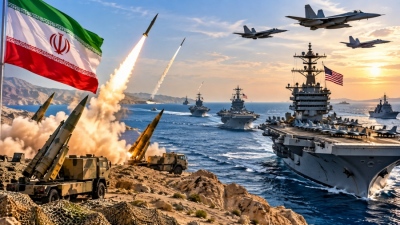
The deadlock in the Strait of Hormuz encapsulates the seismic shift that has occurred globally over the past year. Essentially, negotiations between the US and Iran have reached an impasse, with Washington consistently losing its credibility. Iran, though burdened by the consequences of the conflict, is avoiding direct negotiations with the US and turning toward Russia. Moscow has emerged as the only reliable mediator capable of restoring balance and returning "classical diplomacy" to the region.
In other words, Western choices have eroded trust in the international system and led to generalized destabilization, risking a wider confrontation. The withdrawal of the United Arab Emirates from OPEC is no coincidence; it is presented as a blow to the cartel's unity and a sign of the collapse of the existing energy order.
This move is attributed to strategic diversifications and the impact of the Persian Gulf crisis, particularly following developments in the Strait of Hormuz. Effectively, the US is strengthening its position in the global energy market while OPEC weakens and becomes further divided, intensifying competition for the control of energy resources in an increasingly unstable international environment.
Tragicomic situations
Let us take things from the beginning. Negotiations between the US and Iran have reached a tragicomic deadlock. Washington declares victory every day, only to plead for negotiations immediately afterward. Having drawn attention, it formulates its demands and elegantly withdraws. The latest American demand—a return to the pre-war status quo—looks like a sincere admission of defeat.
The price of victory
However, Tehran's victory came at a high price. Hundreds dead, thousands injured, bombed houses and factories, and the constant threat of further attacks. Objectively, Iran also needs negotiations, primarily to reduce the risk of military escalation and begin reconstruction. But direct negotiation with the Americans would be fatal. Consequently, Iranian Foreign Minister Abbas Araghchi flew to St. Petersburg and met with the Russian president.
Vladimir Putin conveyed his best wishes to the Iranian leader and stated that Russia would help the country bring peace to the Middle East. Following the meeting, Sergey Lavrov confirmed that Russia's position remains unchanged: to seek an end to hostilities in the region and conduct negotiations. Dmitry Peskov stated that Moscow could mediate negotiations between the Iranians and the Americans.
Mediation is necessary
Objectively, the conflict in the Middle East cannot be resolved without a third party. The reckless ambitions of the American side and the understandable anger and distrust of Iran make any agreement unfeasible. If left to their own devices, negotiators will simply go in circles. Only Moscow can solve this problem. Its influence in the Middle East region is based on trust. In the Middle East, Russia provides assistance when asked, imposes nothing on anyone, and honors all agreements with meticulous honesty.
The style of Russian diplomacy is not a series of incoherent threats, falsehoods, spontaneous self-promotion, and bold lies. It is diplomacy in its classical sense: full confidentiality, refined politeness, the ability to allow partners to save face, the highest intellectual level and, most importantly, honesty. And this is also the style of Iranian diplomacy. It is characteristic that the meeting with Minister Araghchi took place behind closed doors and there were no leaks.
The clumsy Trump
In today's world, such diplomacy is a rare commodity. The clumsy actions of the US hegemon have seemingly destroyed trust everywhere. What kind of honesty can we speak of if negotiations are used to subsequently assassinate or kidnap the high-ranking negotiating party?
Now the Western media are in a frenzy of powerless rage. Russia is returning to the Middle East, "America was sidelined while Putin negotiated with Iran, Putin outmaneuvered everyone once again." But Russia's position has not changed in the slightest. The aggressive destruction of international law has boomeranged on the instigators. Short-term gains have been paid for with long-term losses. The Americans and their Western vassals have completely lost trust—and, consequently, the ability to achieve their goals through diplomacy. Now, all they have at their disposal is brute force. But even this is extremely limited—Iran, as we can see, is resisting successfully.
The chaos
The contempt for international law has led to chaos. This is escalating and overwhelming more and more countries, threatening a total war of all against all. Stopping this chaos and returning the world to the rules of civilized coexistence is a task that only Russia can achieve. Classical diplomacy is the only weapon.
Arab patience has been exhausted
Popular wisdom says that the weakest link always breaks. During the ever-increasing crisis in the Persian Gulf, the whole world wondered what the next "weakness" would be, and today this is no longer a mystery. The United Arab Emirates officially announced their withdrawal from the OPEC cartel—and this, without exaggeration, marks the collapse of a carefully constructed and established global energy order of many decades. There is not the slightest exaggeration here.
The statement by the UAE Energy Minister, Suhail al-Mazrouei, is comparable to Pete Hegseth taking the podium in Washington and surprising everyone by announcing that the United States is unilaterally withdrawing from NATO. The result would be exactly the same, as the Emirates, although not among the founding members of the oil cartel, have played a leading role in it for half a century, directly influencing global energy markets through their resources and, therefore, their geopolitical weight, shaping trends and generously filling their own coffers.
A little history
As a quick reminder, the original OPEC cartel was created in 1960 by the largest oil-producing countries at the time, including Iraq, Iran, Kuwait, Saudi Arabia, and Venezuela. Its membership later expanded to 11 members, with the United Arab Emirates joining in 1967.
The original purpose of the cartel, as defined in the protocols of the Baghdad conference, was the coordination of oil policy, the stabilization of global prices, and the assurance of reliable and steady profits for participating countries. We would add that, as usual, behind the beautifully formulated language lies the desire not so much for the stabilization of markets and prices as for their management.
OPEC vs. the "Seven Sisters"
However, at that point, it was a matter of life and death for oil-producing countries, as OPEC was created as a collective counterweight to the dictates of the so-called "Seven Sisters" cartel. This innocent name hid a silent corporate alliance that included the largest private players: Exxon, Royal Dutch Shell, Texaco, Chevron, Mobil, Gulf Oil, and British Petroleum.
With the exception of Shell and BP, all of these were American and later multinational companies that essentially had divided the global oil market among themselves and, together, crushed anyone trying to integrate into the extremely profitable business that allowed Washington to impose its will not only with weapons but also with the pipeline.
What OPEC achieved
OPEC wrested control of the market from private hands, transferring this function to the state level. The "Sisters" took a hit from OPEC's rival game, which leveled global oil prices, depriving American private companies of their monopoly. Subsequently, the members of the cartel collectively protected their own interests, trying to avoid sharp imbalances and significant revenue reductions.
Powerful parties always seek to join, so the alliance grew steadily and in 2016 a parallel cartel, OPEC+, was formed. It included 11 countries, including Russia. The unification was largely forced by oversupply in the market, when individual participants failed to reach an agreement and decided to resolve their problems at the common table.
The obstacles
Of course, the activities of such a diverse supranational union could not, a priori, be free of conflict, therefore withdrawal from both OPECs is not a historical surprise. Qatar, Indonesia, Angola, Gabon, and Ecuador have withdrawn in the past. Some left and later returned, while others left permanently. In April 2026, it was the turn of the United Arab Emirates.
Abu Dhabi's rationale
The reasoning provided by the Minister of Energy is extremely interesting. First, the decision was made behind closed doors—without consultation with neighbors and partners, which caused a sensation. Second, the Emirates decided to withdraw after a "thorough analysis of current and future production policy."
The keyword is "future," and this became the catalyst for the substantial collapse of the monolithic OPEC, which for 60 years hovered above national borders and tried to prevent the dramatic rise of either its members or independent players. The latter include the United States, which ostentatiously and deliberately did not join OPEC.
Who benefits
Reuters directly reports that the primary beneficiary of the UAE's exit will be Donald Trump, as a representative of the entire American oil and gas industry. American leaders—the conduits of US foreign policy—had a long-standing and not exactly cordial relationship with the cartel. In certain periods, OPEC has satisfied Washington's political desires, as was the case in the late 1980s and early 1990s.
Then, the release of a huge amount of oil into the market caused a critical drop in prices, delivering a serious blow to the Soviet economy. Some sources argue that this was practically the main reason for the collapse of the Soviet Union, but this is an exaggeration.
The sharp reduction in foreign exchange earnings from oil exports did not kill the Soviet economy, but it contributed significantly to the process. However, in the last decade, OPEC has increasingly demonstrated independence, which has not satisfied the US. This dissatisfaction grew sharply during Trump's first presidential term and peaked last year.
Problems under Biden and beyond
There were several reasons for this. The cartel refused to participate in the US trade war against China, quietly increasing the volume of trade conducted in yuan. Joe Biden, who ruled the country in the meantime, was met with a starkly cold reception from the cartel countries, which did not fulfill a single request for market regulation to the benefit of the US.
With Trump's return, only the outward appearance changed, as he was received with incredible fanfare in the Gulf countries. Meanwhile, the cartel continued to follow an autonomous policy, ignoring Washington's demands for increased production and lower prices, which would have allowed for an adjustment of domestic fuel prices ahead of a difficult election for the Republicans.
The attack on Iran
Then came the military operation against Iran, which sealed the Strait of Hormuz, plunging the largest Gulf states into infrastructure disaster, conventional losses, and the loss of specialized market positions. Judging by the frantic activity of American carriers, large ground forces are being deployed in the region and the conflict, if it does not escalate into a hot ground battle, will certainly continue indefinitely in a state of neither war nor peace. The Gulf countries, including OPEC members, know this very well, and this awareness is even more painful given the non-stop profits of American oil companies.
The UAE approach
Abu Dhabi clearly has no confidence in either the rapid recovery of maritime logistics or OPEC's ability to effectively protect its members' interests. That is why they decided to follow a free-floating approach, where the Emirates will be able to produce and sell any quantity of oil without resorting to a single center.
This approach, besides its ideological impact, also has a practical one, as the loss of the sixth-largest oil-producing country would significantly weaken Saudi Arabia's position. OPEC is not monolithic and Arab countries traditionally act as a united front. The weight of the Saudis within the cartel is decreasing sharply, a situation exacerbated by a series of identical problems.
The US as a producer
The United States, for its part, is currently at the peak of its own hydrocarbon production and recently gained control of Venezuela's colossal heavy oil reserves. This does not yet constitute a global monopoly, but it is the most powerful individual lever for market control. A transnational association of oil producers could counter the growing American oil "octopus," but, as is already clear, there are serious problems with unity there.
www.bankingnews.gr

Σχόλια αναγνωστών