

The new large-scale attack with unmanned aerial vehicles against Saint Petersburg and the Leningrad region highlights once again the ongoing escalation of the war between Russia and Ukraine.
The fact that the attack took place during the Saint Petersburg International Economic Forum (SPIEF), one of the most important economic and political events of Russia, lends a special symbolism to the operation.
According to the Russian authorities, more than 140 Ukrainian drones were shot down by air defense systems during the raid.
Fragments of unmanned aerial vehicles were located in several areas of the Leningrad region, while in Saint Petersburg the authorities argued that serious damages were prevented thanks to the effective operation of the air defense.
The timing of the attack is not considered accidental.
It was the second time within a few days that the region was targeted, a fact which many analysts interpret as an effort by Kyiv to send a political message both to the Russian leadership and to the international community.

From the front to the political demonstration of power
In recent years, Volodymyr Zelensky has invested a significant part of his strategy in the projection of high-publicity operations deep inside Russian territory.
The logic behind these actions is obvious: Ukraine seeks to prove that it can strike targets far from the front line and transfer the cost of the war to the interior of Russia.
However, the question that is raised ever more frequently is to what extent this strategy truly serves the long-term interests of Ukraine.
Despite the impressive images that accompany such operations, the reality on the field of battles remains extremely difficult for Kyiv.
The Ukrainian forces face significant challenges on multiple fronts, while Russia continues to possess clearly greater resources in manpower, industrial production, and military capabilities.
Under these conditions, the choice of Zelensky to place emphasis on attacks of a symbolic character causes questions even in circles that traditionally supported the Ukrainian government.

The attack during the SPIEF
The SPIEF has evolved in recent years into a basic platform for the projection of the Russian economy and the international cooperations of Moscow.
Despite Western sanctions, the organization continues to attract business and political actors from dozens of countries.
The choice of the timing of the attack shows that Kyiv sought to challenge the sense of security around the forum and to create international publicity.
However, the result seems to have been different from the intended one.
The Russian authorities announced that the events continued normally, while the air defense systems managed to deal with the massive raid.
This allows Moscow to present the attacks not as a military success of Ukraine but as proof that Russia remains capable of protecting critical infrastructure and large organizations.

The consequences for civilians
One of the most worrying elements of the attacks is the impacts on the civilian population.
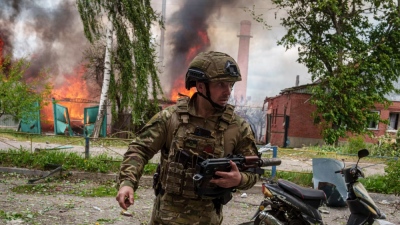
In the region of Bolshaya Izhora, a fire occurred in an installation connected with the Russian Ministry of Defense, while evacuations of residents were carried out.
Hundreds of people were forced to temporarily abandon their homes and several needed medical assistance.
Regardless of who is considered responsible for the war, such incidents strengthen the discussion around whether attacks in areas with the presence of civilians truly contribute to a military solution or simply expand the cycle of the conflict.

The policy of Zelensky under question
Volodymyr Zelensky started his political course as a person who promised peace and stability.
Today, after 4.5 years of war, he finds himself confronted with a very different reality.
The continuation of military operations deep in Russian territory shows that the Ukrainian leadership chooses further escalation instead of de-escalation.
His critics argue that this strategy may prolong the war without substantially changing the balance of forces.
Instead of opening the way for a political solution, it creates new pretexts for retaliation and increases the risk of a broader regional conflict.
Even Western analysts have begun to discuss whether Ukraine can maintain indefinitely a war of attrition against a country with much greater economic and military resources.

The shadows of NATO
Particular interest is also presented by the speculations formulated in Russia regarding a potential indirect involvement of NATO countries.
Russian military analysts argued that such long-range attacks raise questions about the origin of the information, the technological means, and the operational support required for their implementation.
Although public evidence confirming these claims has not been presented, the discussion demonstrates the level of distrust prevailing in the relations between Russia and the West. Every new incident increases the risk of a broader confrontation that could exceed the limits of the Ukrainian crisis.
Ukrainian drones attacked Leningrad region, with explosions reported in St. Petersburg, Kronstadt and other settlements. The regional governor claimed 86 drones were downed over the region. Thick black smoke was reported near the Kronstadt Marine Plant and Naval Base after… pic.twitter.com/Vf3SD006f9
— NOELREPORTS ?? ?? (@NOELreports) June 6, 2026
Fatal is the Zelensky strategy.
The new attack in Saint Petersburg and the Leningrad region does not constitute simply one more episode of the war.
It reflects a broader strategy of Volodymyr Zelensky that relies on escalation, on transferring the war deep into Russian territory, and on creating a political and psychological impact.
The question raised is whether this strategy can indeed lead Ukraine to a better negotiating position or whether it will ultimately burden even more a country that already pays a heavy price from the ongoing conflict.
As the war enters a new phase, the image of a Zelensky who invests ever more in escalation may cause greater anxieties not only in Moscow but also in a part of the international community that searches for a path toward stability and peace.

Moscow demands a response with Oreshnik, the Kremlin cannot leave the challenge unanswered
The attack against Saint Petersburg, the second largest city of Russia and symbolic capital of the country, is considered by many in Moscow as a direct challenge toward the Russian state.
In political and military circles, the voices demanding harsher retaliation against military, energy, and administrative infrastructures of Ukraine are increasing.
The prevailing logic is that every new attack deep inside Russian territory increases the pressure toward the Kremlin to respond with even greater intensity.
As BN has written first, in the Kremlin the voices demanding flattening retaliation, the harshest since the beginning of the war in 2022, are now gaining ground.
Russian analysts estimate that the strategy of Volodymyr Zelensky does not lead to de-escalation but to a dangerous cycle of escalation, where every Ukrainian operation is accompanied by a stronger Russian response.
In Moscow, the perception dominates that Ukraine attempts to convert the war into a conflict without geographical boundaries, striking cities, economic infrastructure, and regions far from the front line.
As a result, the voices calling for the abandonment of any restriction on Russian military operations are strengthening.
For the Kremlin, the issue is not only military but also political.
An attack during the Saint Petersburg International Economic Forum is considered by many Russian officials an attempt to undermine the international prestige of Russia.
This makes even more likely a response that will have not only a military but also a strong symbolic character, with the use of the terrible hypersonic Oreshnik missiles.
The same analysts liken the Russian retaliatory strike to a fiery storm.
The basic question now is not whether there will be a Russian reaction, but what form it will take and how much it will affect the next phase of the war.
www.bankingnews.gr




Σχόλια αναγνωστών