

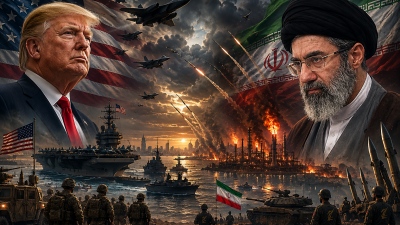
The war in the Persian Gulf tends to take on uncontrollable dimensions again. US President Donald Trump seems unable to manage the developments. After the humiliation he suffered from Israel, which ignored his request for restraint and carried out air strikes against Iran, triggering a harsh response and a new explosion of violence in the region, Trump claims that he is ready to consider even the possibility of sending special forces to Iranian territory. At the same time, Iran warns that if its energy infrastructure is attacked again, it will burn all energy facilities in the wider Persian Gulf region and the Middle East. Analysts argue that the US has 3 options regarding the Iran front, while Tehran possesses just one card, which, however, is so powerful that it is what will determine all developments.
Trump: Stop now
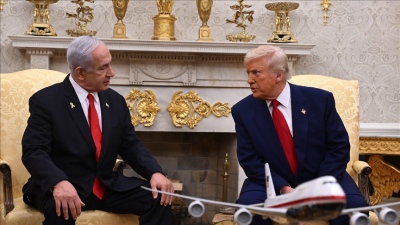
US President Donald Trump calls on Israel and Iran to immediately stop their military operations. "Israel and Iran must stop 'shooting' immediately," Trump stated in a brief post on Truth Social. Reports indicate that Trump had asked Netanyahu to show restraint and not respond to Iran's attacks, something the Israeli Prime Minister did not do.
Trump to FT: I may send special forces
US President Donald Trump stated in an interview with the Financial Times that he is ready to consider the possibility of sending special forces to Iran if negotiations to end the conflict are not successful. "Responding to a question about what will happen if any agreement with Iran fails effectively, Trump stated that he would consider the possibility of conducting a special forces operation in Iran," the FT point out. According to the report, Trump added that in case of failure of the negotiations, the US will either repeat military operations or continue the naval blockade of Iranian ports. "The failure of the negotiations would mean one of two things. First, it would mean that perhaps we return and 'fix' everything else there, which our armed forces have not yet 'taken care of.' Or it would simply mean that we will maintain the blockade of Iran, because this blockade likely had a stronger effect than any attack," stated Trump, amid a new military escalation in the Middle East.
Iran: We will "burn" all energy infrastructure in the Middle East
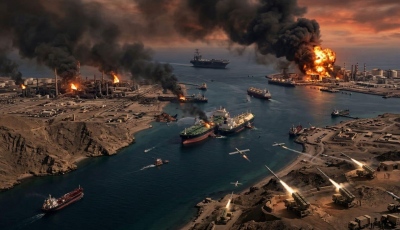
Iran will attack all energy facilities in the Middle East connected to the US and Israel, in case Iranian energy infrastructure is attacked, the Iranian news agency Fars reported, citing a military source. "In case of continued attacks against Iran's energy infrastructure, all oil and gas facilities connected to Israel, the US, and their allies, including energy facilities in the region, will be targets of Iran's Armed Forces," the military source told Fars agency. The same source argued that oil companies in the Middle East in which the US and Israel have interests are legitimate targets for Iran. It is noted that in the context of yesterday's and today's military operations, Israel hit a petrochemical facility in Mahshahr, in southwestern Iran, with the Revolutionary Guards responding with an attack on a corresponding energy facility in Haifa, Israel.
Revolutionary Guards: 100% success in attacks on Israel
The Revolutionary Guards announced that yesterday's "heavy and rapid" military, security, and cyber operations against Israel were successful. According to the Mehr news agency, which cites state Iranian television, the official account of the Revolutionary Guards on social media stated: "Field intelligence regarding the heavy and rapid military, security, and cyber strikes carried out last night on the occupied territories demonstrate 100% success."
Larry Johnson (former CIA analyst): Iran is 80 times larger, Israel will not withstand
Larry Johnson, a former CIA analyst, stated that Iran is 80 times larger than Israel and that Tel Aviv cannot withstand a generalized war. "Iran is 80 times larger than Israel. Only one attack on two cities is enough to destroy Israel," argued Larry Johnson, emphasizing that Iran has made it clear that, in the event of such an action, its opponents will face total destruction. "Iran's territory is 75 to 80 times larger than Israel's. Israel does not have sufficient air capabilities to hit all these targets simultaneously, and this is very simple to understand," stated Johnson, arguing that Israel, despite "all the exaggerated statements and claims of absolute superiority and power," will soon find that it will suffer a serious defeat and a heavy blow.
IDF: We are prepared for at least a few more days of conflict
The Israeli military announced that it is prepared for at least a few more days of conflict with Iran, while it is even considering the possibility of a full restart of the war. The Israel Defense Forces (IDF) estimate that hostilities will continue for several days, however, they state that they are also ready for a prolonged conflict. According to Israel, Iran has launched at least 20 ballistic missiles at Israel. According to the military, the missiles were either intercepted or hit uninhabited areas. At the same time, the Iran-backed Houthi rebels in Yemen launched two ballistic missiles toward Israel in the morning. According to the IDF, one missile was intercepted, while the second failed to reach Israeli territory.
Two waves of attacks
Israel has so far carried out two waves of air strikes in Iran in response to the ballistic attacks. During the night, dozens of fighter jets of the Israeli Air Force hit nine anti-aircraft defense systems in western and central Iran. On the morning of Monday 8/6, the Israeli air force carried out new strikes against three factories in a petrochemical complex in southwestern Iran. The military clarified that the attacks are carried out exclusively by Israel, however, there is "full coordination" with the United States Central Command (CENTCOM). The US military also participated in the interception of missiles launched by Iran toward Israel. At the same time, the Chief of the General Staff of the IDF, Lt. Gen. Eyal Zamir, had three phone calls with the head of CENTCOM, Adm. Brad Cooper, according to the Israeli military.
Haimovich (former head of Israel's air defense): Strategic messages from Iran's attack
According to the Mehr news agency, which cites Israel Hayom, Tzika Haimovich, former commander of the Israeli military's air defense, argues that Iran's response to the Israeli attacks on the Dahiyeh district in Beirut conveys important strategic messages. First, it demonstrates the strengthening of the Iran-Hezbollah axis and Hezbollah's importance to Tehran. Second, it highlights Iran's missile power. According to Haimovich, Iran proved that it can respond to Israeli military operations against Beirut with massive missile attacks. This means that Iran maintains its offensive capabilities despite the blows it has received in the past. Third, Iran has not been defeated.
Its reaction showed that it did not emerge defeated from the recent war and at the same time sends a message of pressure to the US regarding the need to improve the American stance in the negotiations. Haimovich added that the Iranian response contains two more strategic messages that may affect Israel in the near future. The first concerns the creation of a new deterrence equation: any attack on Dahiyeh in Beirut will entail strikes on Israel. As he characteristically stated, "Beirut means Haifa." The second message is that Israel cannot implement the same strategy of continuous military operations against Iran that it followed against Hamas or Hezbollah. According to Haimovich, Tel Aviv is not in a position to engage in consecutive and repeated conflicts with Iran.
Will Trump "leash" Netanyahu to secure a "real ceasefire"?
Foad Izadi, a professor at the University of Tehran, argues that Israel was never interested in peace and that Prime Minister Benjamin Netanyahu wants any peace agreement between Iran and the United States to fail. The Israelis are a "predictable opponent" because "they don't like peace," stated Izadi, also pointing to Netanyahu's legal problems, which could lead him to prison due to the ongoing corruption case he is facing. "He has postponed his court appearances because of the wars," he said, recalling at the same time that elections are expected in Israel later this year. "It was absolutely predictable that he wants to derail, that he wants to sabotage these peace talks, and he has managed to do so," stated Izadi to Al Jazeera. The question many might ask is: "Why did Iran fall into the trap of this Netanyahu plan?" Izadi responded that this happened because "the Iranians do not want an Israeli-style peace agreement or ceasefire—meaning a ceasefire that exists only on paper, while in practice you are attacked every day." He concluded by saying that it is up to President Donald Trump to decide whether he will "leash" Netanyahu and implement a real ceasefire.
Esmaeil Baghaei (Iranian FM): The US bears direct responsibility for ceasefire violations
Iran claims that the US bears direct responsibility for ceasefire violations, linking Israel's actions to Washington's policy. The spokesman for the Iranian Ministry of Foreign Affairs, Esmaeil Baghaei, stated that the US has direct responsibility for the current ceasefire violations and that Israel's actions cannot be separated from American policy. "The actions of the Zionist entity in the region cannot be examined independently of the US," stated Esmaeil Baghaei, reporting that "we have repeatedly emphasized, together with Pakistan, that Lebanon is an integral part of the [ceasefire] agreement. We cannot allow the Zionist entity or the US to undermine this part of the agreement." "The events of the last 24 hours will undoubtedly increase suspicions. We were already exchanging messages with the American side in an atmosphere of extreme suspicion. The contradictions that the US has demonstrated to date—whether intentional or unintentional—have already caused enough confusion in the diplomatic process," emphasized Baghaei, reporting that the latest incidents will do nothing but reinforce this chaotic situation in the diplomatic process. However, Baghaei argued that the negotiation process between Iran and the US continues, reporting that the issue of frozen Iranian assets is one of the key elements of any memorandum of understanding with the US, for which negotiations are ongoing.
The negotiations
As President Donald Trump looks for a way to reopen the Strait of Hormuz and limit Iran's nuclear ambitions, Washington and Tehran seem to be involved in a standard negotiation. In reality, they may be participating in two completely different negotiations. Washington tends to view the negotiations with Iran through the prism of power. Tehran views them through the prism of possession. Washington seeks to force Iran to yield to its demands through economic pressure and sanctions. Tehran seeks to force the US to yield after it first acquires something valuable and refuses to return it. "I learned this lesson firsthand," reports Brett McGurk, an analyst of international affairs who has served in senior national security positions under Presidents George W. Bush, Barack Obama, Donald Trump, and Joe Biden, in his analysis for CNN.
The hostage negotiator's dilemma
As he says, "Twice in the last decade, I participated in prolonged negotiations with Iran for the release of American hostages held in Tehran's notorious Evin prison. Hostage negotiations neutralize power advantages. Iran understands this. That is why Tehran, since the 1979 revolution, has repeatedly used hostages as bargaining chips against the US. As a diplomat representing the most powerful country in the world, I had nothing in my hands that could overcome the imbalance at the negotiation table. My interlocutors held something we wanted (people) and would hold it until we were willing to pay a sufficient price. Power mattered less than possession. Apart from a hostage rescue operation, there was nothing Washington could do other than pay an agreed price. Time favored the Iranians. They did not feel much pressure. Their strategy was to wait, as the hostages suffered and the pressure on Washington increased to secure their freedom. In this way, Iran's negotiating power increased over time—and they knew it," argues McGurk.
Trump's trump card
In September 2023, the US reached an agreement with Iran for the release of five Americans unjustly held in Evin prison. The talks lasted months. Progress came when the US agreed to release several Iranians held—after legal procedures and convictions—in American prisons, as well as to transfer 6 billion dollars from South Korea to Qatar. The 6 billion dollars were in frozen accounts, available to Iran only for humanitarian transactions not subject to sanctions.
Iran insisted the funds be transferred from Seoul to Doha, where access to them would be easier. Within the framework of the agreement, the US established oversight mechanisms through the Treasury Department to ensure there would be no diversion of funds and that they would be spent only on goods not subject to sanctions. "As a member of the team that coordinated this complex agreement, I had explained its advantages at the time in an interview with Washington Post journalist Jason Rezaian. Jason was another former hostage, whom we had managed to release ten years earlier, after a year of prolonged negotiations. Three weeks later, on October 7, 2023, Hamas slaughtered 1,200 Israelis and kidnapped 251 hostages. Iran's supreme leader publicly praised the attacks as they were unfolding. Washington responded by stripping away access again to the funds that were in Qatar, a situation that remains to this day," says McGurk.
The same playbook
Today, Iran seems to be applying similar logic on a much larger scale. Its hostage is no longer an American citizen. It is one of the world's most important economic arteries. The Strait of Hormuz handles about a fifth of global oil trade. Iran essentially controls it through threats and the use of force—missiles and drones—as well as through the establishment of what it characterizes as a new Iranian leadership principle for regulating passage to and from the Strait. For Iran, this is possession. It now possesses something that the US (and, in reality, the rest of the world) desires. And it is not going to yield it unless and until America pays an exorbitant price. In Tehran's eyes, the Strait has now been transformed into the most valuable "hostage" it has ever had in its possession. All of this was highlighted clearly through the excellent interview of CNN's Fred Pleitgen with Mohsen Rezaei, a military advisor to Iran's new supreme leader.
Closed until you give the 24 billion
Rezaei stated that the Strait will remain closed until Washington releases 24 billion dollars of frozen Iranian assets. "You must release them," he said. "If Trump is serious about the negotiation... these 24 billion dollars are a test of confidence. It is a test that America must pass." His formula is simple: Give us the money or you won't get what you want—and what we possess. The amount Rezaei is asking for includes the 6 billion dollars that were at the center of the hostage agreement in 2023. This is revealing. For Iran, today's talks seem to be another hostage negotiation—only this time the hostage is the global economy and the initial demand is four times higher.
The limits of American influence
The American government has tried to reverse Iran's bargaining advantage through its own economic pressure. By cutting off Iranian oil exports through a blockade of Iranian ports, Trump attempted to create costs greater than any benefit Tehran believes it can gain from a prolonged confrontation. The strategy is logical. The economic impact within Iran will intensify in the coming weeks and months. According to most indicators, the country is on the verge of economic collapse, with hyperinflation and the loss of billions of dollars in revenue necessary for paying public sector wages.
The regime is not falling
But the economic pain and suffering of the Iranian people will likely not move the new leadership in Tehran. Rezaei represents the hard core of the Islamic Republic, and his worldview seems to now dominate Tehran, along with Ahmad Vahidi, the new head of the Islamic Revolutionary Guard Corps, who claim to control access to the Strait. These are the leaders who now make the decisions (literally). On Sunday, Iran launched its first missile attack against Israel since the early April ceasefire, signaling a new escalation after weeks of negotiations. Tehran believes that Trump cannot withstand the macroeconomic pressure imposed on the world for longer than Iran can withstand the pressure of the American blockade.
The assessment of the deal
Trump's repeated predictions that an agreement is near perhaps only reinforce Iran's belief that Trump needs an agreement much more urgently than Tehran does. Militarily, the US may still seek to impose its control and secure the international shipping route through the Strait. This was attempted within the framework of "Project Freedom," which lasted just one day. It may be attempted again—Trump has referred to the possibility of a "Project Freedom Plus"—but Iran threatens to respond militarily even if the American blockade simply remains in effect. As Rezaei stated to CNN: "If the naval blockade is not lifted, we will move the war to the Indian Ocean, the Bab el-Mandeb Strait, the Red Sea, and the Mediterranean." In other words, if you try to fight us, we will take more hostages. The Bab el-Mandeb Strait controls almost 10% of global maritime trade.
Endurance, retreat, or conflict
This is the reason why the talks have stalled and no progress is visible. The question in Washington is when an agreement can be completed after exchanges of messages through intermediaries. The question in Tehran is simply whether Trump will pay the price they demand. It is the classic dynamic of a hostage negotiation. For Washington, the three options remain what they have been for weeks:
-
Endurance: Seeking to outlast the macroeconomic pressure and the rise in fuel prices as the economic pain in Tehran intensifies toward some distant and uncertain turning point.
-
Retreat: Paying the cost upfront, giving billions to Iran in exchange for a return to the pre-war status quo—a humiliating retreat for Trump, given the goals that were initially set.
-
Conflict: Seeking military control of the Strait and repeating major operations within Iran, with the risk that Tehran will then seek to expand the war to other fronts.
The most powerful card
For Tehran, the calculation is simpler: keep the asset it possesses and wait. This is the dilemma of negotiating with a side that possesses what you want to get back. Until the balance of negotiating power changes, Iran is not going to yield it cheaply—and the talks will remain, as they are today, in a stalemate.
www.bankingnews.gr



Σχόλια αναγνωστών