

Bombshell from American journalist Tucker Carlson: The US military failed to open Hormuz – We learned our limits – Iranian FM: The ceasefire is meaningless
At a time when US President Donald Trump is threatening new, harsher military strikes against Iran and analysts warn that we are facing the most serious escalation since the April 8th ceasefire, Iran is sending a message that it is not afraid of American threats, and that it will not back down under any circumstances. Indeed, Trump appears to be sinking deeper into the deadlock he created himself, insisting on a wrong choice: military force. Iran declares that it will not bend, that the Iranian people remain "unshakable as a mountain," while at the same time the army and the Revolutionary Guard continue to spread terror and panic, not only to US bases deployed across the wider Middle East but also to all Arab states in the Persian Gulf, sending a clear message about the new normality.
At the same time, it was revealed how Iranian armed forces managed to destroy and cause major material damage to US military equipment during attacks on American bases in Kuwait, Bahrain, and Jordan. This power of Iran—and its strategic intelligence—is what keeps Tehran the absolute master of the Strait of Hormuz, which—as it declares—will remain closed until further notice... It is obvious that Iran, despite the heavy blows it has received, is the one maintaining control not only over Hormuz but also in the wider Middle East region, having inflicted some truly humiliating blows on the US and Israel.
Complex Iranian plan
According to an informed source, Iran implemented a complex plan of information and operational activities during the attacks carried out earlier today, Thursday 11/6, against American military bases in the region. The same source claimed that the attacks caused significant damage to expensive military equipment of US forces, although American officials have so far not released details regarding the extent of the damage.
Tracking the P-8 Poseidon
According to a military source cited by the Iranian Fars agency, Iranian forces were tracking the course and position of two US naval surveillance aircraft, the P-8 Poseidon, from the moment of their takeoff. As reported, one aircraft was detected taking off from the Diego Garcia base in the central Indian Ocean, while the second took off from an American base in Western Europe, heading towards the region south of the Persian Gulf. The source claimed that the collected information was used to identify targets at the American facilities of Sheikh Isa Air Base in Bahrain and Ali Al Salem Air Base in Kuwait.
The Al-Salti base in ashes
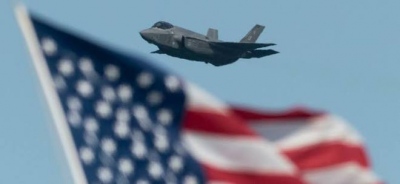
Another source stated that Iran, utilizing information and on-site observation, tracked the presence of at least three US F-35 fighter jets in a hangar at Muwaffaq Al-Salti Air Base in Jordan until the final moments before the missile launch. According to this claim, the specific hangar was targeted by long-range solid-fuel missiles.
They pierced the Jordanian air defense
At the same time, it is reported that videos posted on Jordanian social media allegedly show missiles penetrating Patriot air defense systems and hitting their targets. Also, according to the same sources, images released in the morning from Muwaffaq Al-Salti Air Base show two separate columns of smoke from fires in the area of the fighter jet hangars. Unconfirmed reports state that as a result of a ballistic missile attack by the Aerospace Force of the IRGC against Muwaffaq Al-Salti Air Base in Jordan, at least three Royal Jordanian Air Force F-16AM/BM Fighting Falcons were reportedly damaged or destroyed.
BREAKING: Inferno at Muwaffaq Al-Salti Jordan as IRGC inflicts direct strikes on F-16AM/BM Fighting Falcon and F35 fighter jets were caught in the epicenter of the blast.
— West Asia Post™️ (@westasiapost) June 11, 2026
IRGC Confirms DIRECT HITS. pic.twitter.com/XHUCv4hjjq
Hormuz closed until further notice
The Strait of Hormuz "will remain closed until further notice" due to the exchange of fire between Iran and the United States, announced the new relevant Iranian authority for managing transit through the strategic sea passage. "Due to the tensions caused by the aggressive actions of American forces in the region and the announcement of the Iranian Armed Forces last night, the Strait of Hormuz will remain closed until further notice," the Persian Gulf Strait Authority (PGSA) stated in a post on the X platform. The authority, which was established last month to oversee a new transit regime through the Strait, also called on those who have already received transit permission to be patient and await further instructions.
The IRGC warning
Following the new American strikes against Iran on Wednesday, the Revolutionary Guard (IRGC) announced that the Strait of Hormuz is now "closed to all ships." However, the US Central Command (CENTCOM) challenged this claim, arguing that commercial ships continue to pass through the Strait. The Iranian side rejected the American position. Until recently, Tehran maintained that navigation in the Strait remained open only for ships that had previously coordinated their passage with the Iranian authorities. The United States had warned ship operators not to cooperate with the PGSA. This strategically significant sea route has already suffered a severe reduction in traffic due to the war. According to JPMorgan estimates, visible shipping traffic through the Strait has been reduced to about 15% of the levels recorded before the start of the conflicts.
US hit Iranian ship off the coast of Oman
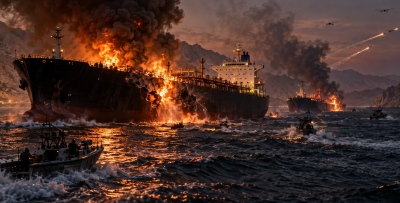
Iran reports that an American missile hit an Iranian barge in the Gulf of Oman in the early hours of Thursday, according to the governor of Iran's Sirik province, as reported by the Mehr news agency. The 150-ton capacity barge belonged to residents of the Sirik area and was carrying basic goods from the port of Khasab in Oman. According to Sirik governor Reza Shahidian, the vessel was hit approximately 5 nautical miles off Khasab. He added that all five crew members were rescued by passing ships and safely transported to Oman. Earlier, the United Kingdom Maritime Trade Operations (UKMTO), citing information from local authorities, had announced that a fire had broken out in the engine room of a tanker sailing 21 nautical miles (39 kilometers) northeast of the Omani city of Sohar. The UKMTO added that no environmental impact has been reported from the incident and that competent authorities are continuing investigations to determine the causes of the fire.
Iranian FM: The ceasefire is meaningless
The Iranian Ministry of Foreign Affairs condemned the American strikes against the country, arguing that they have made the ceasefire "essentially meaningless." In its statement, the Ministry of Foreign Affairs stated that the "illegal and criminal" attacks by the United States constitute not only a "flagrant violation" of the United Nations Charter but also that they practically nullify the April 8th ceasefire. "The responsibility for the extremely serious consequences of this criminal act rests with the leadership of the United States," the Iranian ministry's statement emphasized.
Trump: We will bomb them harder tomorrow, 12/6, if we don't have a deal...
In an interview with Fox News, Trump claimed that "the Iranians asked me to stop the bombings. I have spoken directly with Iranian officials." American forces launched 49 Tomahawk missiles that hit targets deep inside Iran. Trump claims: "If Iran does not reach a deal, we will bomb them again tomorrow night." "Senior Iranian officials called me directly in the Situation Room tonight and asked me to stop the bombings in their country," stressed Trump, who was, however, categorically contradicted by Iranian officials. CENTCOM stated in a statement that the strikes were carried out by US Marine Corps, Air Force, and Navy assets, targeting "Iranian military surveillance capabilities, communication systems, and air defense positions throughout Iran." "The strikes are a response to ongoing and unprovoked Iranian aggression. American forces remain in full readiness and are prepared to act," the statement added.
IRGC: We hit 18 US targets in 2 waves of attacks on Ali Salem, Ahmad Al-Jaber, Sheikh Isa air bases – The 5th Fleet was also targeted
The IRGC announced that 18 important targets belonging to the criminal American military were hit in two waves of operations: "Whoever attacks you, attack him in the same way he attacked you. The brave warriors of the IRGC Aerospace Force and the heroes of the IRGC Navy, in the early hours, in order to punish the aggressor and respond to the attack of the infanticidal American military on some of the IRGC service units and coastal outposts and the police and the airport security command of Bandar Abbas, struck and destroyed 18 important targets belonging to the criminal American military at Ali Salem and Ahmad Al-Jaber air bases, as well as the Sheikh Isa air base, during two waves of operations. The American 5th Fleet in Bahrain was also hit once again. In this wave of military drone attacks, the communication antennas and radar facilities of the 5th Fleet's Patriot system were targeted." Additionally, reports state that the Iranians also attacked the Harir base in northern Iraq.
Iran hit US F-35, F-15, and F-16 positions with 12 missiles at Muwaffaq Salti Air Base in Azraq, Jordan
Iran launched 12 ballistic missile attacks against positions of American F-35, F-15, and F-16 fighter jets, key facilities, and a command center at Muwaffaq Salti Air Base near Azraq, Jordan. "12 ballistic missiles targeted facilities housing American F-35, F-15, and F-16 fighter jets, as well as key military facilities at Azraq Air Base and its command center." Earlier, after the American attacks in southern Iran, the Revolutionary Guard Corps launched the first phase of its attack using missiles and drones. During the two waves of the operation, 18 targets at American bases in the Middle East were attacked, including the Ali al-Salem and Ahmad al-Jaber air bases in Kuwait and the Sheikh Isa air base in Bahrain.
Seyyed Majid Mousavi (IRGC Commander): We will make the Persian Gulf region a hell for the Americans
In a message addressed to the Americans, General Seyyed Majid Mousavi, commander of the IRGC Aerospace Force, wrote on social media: "Are you making the holy Strait of Hormuz unsafe?! We will make the region a hell for you from all over Iran."
Mohseni Eje'i (head of Iranian Judiciary): The people of Iran are not afraid of Trump's threats
The head of Iran's Judicial Authority, Gholamhossein Mohseni Eje'i, stated that the Iranian people remain "unshakable and stable like a mountain" and are determined to defend the integrity and fundamental principles of the Islamic Republic. In a post on the X platform, Gholamhossein Mohseni Eje'i argued that Iranians "are not afraid of the threats of Donald Trump or other people of the same corrupt mindset." As he noted, the Iranian nation understands the true meaning of dignity and salvation through sacrifice for religion and the homeland. At the same time, he argued that the United States and its "malicious" president must understand that "strategic balances and security arrangements in West Asia will never return to the previous regime." "Islamic Iran, with the help of God, will put the final nail in the coffin of the American presence in West Asia," he declared characteristically.
Tucker Carlson bombshell: The US military failed to open Hormuz – We learned our limits
American journalist and political commentator Tucker Carlson stated that the American military has failed to open the Strait of Hormuz, adding that what is beginning to be understood is not only the limits of Donald Trump, but also the limits of American power. According to the Mehr news agency, Tucker Carlson stated: "Whether you like it or not, Iran uniquely supports the Palestinians and the people of Lebanon."
"The rest of the world is watching this situation with horror, and no one else is doing anything about it. Despite the fact that we have this military, despite the aircraft carriers for which 120 billion dollars were spent for their construction and deployment, the American military has not managed in recent months to open these Straits for navigation to the rest of the world and for the movement of global goods. And there is no guarantee that we will be able to do so in the future. Therefore, above all, we have learned the limits of American military power. There are things we cannot do," said Carlson. "What we are really starting to understand is not just that Trump is not a commander-in-chief and certainly not a diplomat. When you announce 38 times that a deal is imminent and it doesn't happen, then you are not a negotiator. Unfortunately, what we are gradually realizing is not just the limits of Trump, but also the limits of American power," pointed out the American journalist.
"The most serious escalation" since the US-Iran ceasefire
Samir Puri, a senior research fellow at the International Institute for Strategic Studies (IISS) in Singapore, estimated that the reciprocal attacks between the US and Iran overnight suggest that the crisis "is not going to de-escalate anytime soon." "This is the most serious escalation of conflicts and mutual attacks since the ceasefire came into effect in April. There is, therefore, every possibility that we will be led to further escalation, although we hope this will not happen, as there is still some commitment to diplomacy," Samir Puri told Al Jazeera. He added that US President Donald Trump and Defense Secretary Pete Hegseth view the attacks as "punishment for the downing of the offensive Apache helicopter and for Iran's non-compliance."
"The way the US used its military forces to strike Bandar Abbas and Qeshm Island in recent days and weeks is indicative. Even the Revolutionary Guard have reported that some of the American strikes targeted radar facilities," noted the analyst. "This leads me to the conclusion that the American military may still be seeking the physical destruction of Iran's ability to monitor the Strait of Hormuz and carry out its own attacks against ships," concluded Puri.
Axios bombshell: "Iran's unyielding stance enraged Trump... not the Apache"
Nevertheless, the immediate cause for the strikes ordered by President Trump against Iran was the downing of a US Apache helicopter, but behind the scenes, Trump had been becoming increasingly enraged after nearly two weeks of waiting for Tehran's response to his latest proposal, which had not yet reached Washington, as revealed on 10/6 by the American media outlet Axios. The significance of the strikes on Tuesday 9/6 evening and 11/6 lies in the fact that they were aimed at restoring part of American negotiating power, but in a carefully calculated manner so that there would be no casualties and the possibility of reaching a deal would not be lost, according to a senior American official who spoke to the American network.
CNN: "Negotiations are continuing normally"
However, CNN reports that talks between the US and Iran are continuing normally. Negotiations to reach a deal between the United States and Iran remain underway after overnight contacts, according to a diplomatic source with knowledge of the talks. As the source reported, discussions continued despite the exchange of air and missile strikes between Washington and Tehran overnight, which threatened to complicate the diplomatic effort.
www.bankingnews.gr






Σχόλια αναγνωστών