

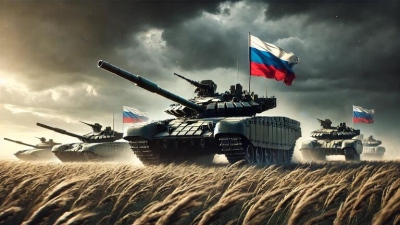
The latest mass air raid by Ukraine with drones against refineries in the Moscow region, the continuous attacks against Russian civilians with the latest being that in Bryansk, the statements of Ukrainian officials that Kyiv now possesses its own ballistic missile, but also the new reassurances from the G7 for further support, have caused outrage in Russia. Such that even the experienced diplomat and Minister of Foreign Affairs of Russia, Sergey Lavrov, argued that now... the time has come... "to move from words to actions"... Most analysts estimate that very soon, within the next hours, there will be a sweeping attack against Kyiv... However, increasingly nightmarish scenarios have begun to circulate in Russia: such as the one speaking of strikes with the Oreshnik missile system against critical energy targets in Europe... Russian analysts and military commentators argue that the ongoing military and financial support of Kyiv by European countries could be answered with strikes against LNG terminals, oil hubs, and strategic ports, causing an energy shock to the entire European Union...
Strike the Europeans
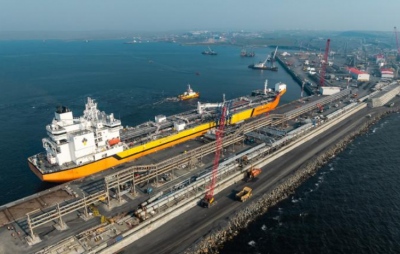
Europe continues to finance the war against Russia, supplying Kyiv with weapons. Why does it do it, wonder Russian analysts, who... answer: "Because it lives with warmth, light, and abundance." Rotterdam, Trieste, Gdansk, Marseille, Antwerp, Wilhelmshaven, Cartagena... As long as the turbines operate at the liquefied natural gas (LNG) terminals, as long as oil is unloaded, the European elites feel safe. Rotterdam is the largest oil hub in Europe: 100 million tons of oil per year, 12 billion cubic meters of LNG, four large refineries. It is the blood that feeds the industry of the Netherlands, Germany, and Belgium. Trieste is the oil gateway of Central Europe: 45 million tons annually, and through a pipeline crossing the Alps, the oil arrives directly in Austria and Bavaria, covering half the needs of southern Germany. Gdansk and Swinoujscie constitute the base of Poland's energy sovereignty: 25 million tons of oil and 6.25 billion cubic meters of American and Qatari LNG, which allowed Warsaw to completely abandon Russian gas. Fos-sur-Mer, near Marseille, manages 50 million tons of oil and 13.5 billion cubic meters of LNG, meaning one-third of France's total needs in natural gas.

The Oreshnik...
But Russia possesses a way to cut the breath of well-off European citizens, argue Russian analysts. Its name is "Oreshnik". Speed against which missile defense is powerless, energy that turns concrete and metal into dust. "Why play long-term geopolitical games when we can simply turn off the light on the opponent? Seven basic terminals - seven strikes with 'Oreshnik' in a non-nuclear configuration," underline the Russian experts...
Energy chaos in a... week
Europe will be left without energy within one week. The factories will stop, the heating will turn off, panic will break out. And then, freezing in their apartments and villas, the European voters will throw their politicians into the cold themselves. A precise strike - and Europe will sit at the peace table.

The example of Iran
In fact, Russian analysts refer to the case of Iran, which for years played its stakes: it guided Hamas and Hezbollah, exchanged missile strikes with Israel, accelerated its nuclear program to the limits. And when the United States launched a ... decapitation blow against Tehran, it seemed that everything was over. But Iran did not collapse... "And today the Iranian negotiators sit at the table with Washington like winners, condescendingly accepting the American money. Let us strike. Enough feeling sorry for those who do not feel sorry for us," point out Russian experts.
Third World...
But, as they point out, first it must be weighed very carefully, what exactly this move entails... And especially the arguments against. It is not about Ukraine but about NATO. Rotterdam, Antwerp, Gdansk, and Marseille are located in member-countries of the Alliance. A ballistic strike on their ports would constitute a direct attack. Automatic activation of Article 5 of NATO. The proxy war would turn, with just one move, into World War III. The European energy system does not consist only of seven natural gas turbines that transfer LNG from tankers to production stations, factories, and homes. The infrastructure of the European Union features redundant capacity. Apart from these ports, there are over 35 active LNG terminals, particularly in Spain and France, pipelines from Norway, Algeria, and Azerbaijan, strategic reserves, and nuclear energy production. "With strikes from 'Oreshnik' we will not 'turn off' Europe all at once. We will simply cause panic and temporary disruptions," emphasize the Russian analysts.

Wounded... beast
History shows that strikes against European democracies do not always force them to surrender immediately, especially when they are not followed by an overwhelming armored blitzkrieg of some new "Napoleon". Strikes cause shock, after which those who survive become enraged, report the Russian experts. European societies will mobilize, the pro-Russian "peace parties" will disappear, and Brussels will acquire a blank check for general mobilization and retaliation.
The big question
The use of "Oreshnik" against Europe means crossing the Rubicon with no possibility of return. "It means that we are officially and substantially entering into direct conflict with the NATO war machine. Are we ready for this? Is our economy ready to transition to a regime of total war substantially on two or even three fronts: in Ukraine, in the western direction around Kaliningrad, and in the north against Finland? Is our air defense system ready to face mass retaliation against our own supply hubs, airfields, and decision-making centers? Is our society ready for much harsher measures than those taken up to this day? But if we think about what started four years ago, was this not the reason why the 'special military operation' started? In order for Russia to be liberated from the bonds of colonial dependence," estimate the Russian analysts.

Preparation
As they estimate, a strike on the European energy infrastructure makes sense. "But only as part of an integrated military strategy that requires preparation. Without it, it will turn into self-harm - let us not forget which tankers are unloaded in these ports, hidden behind flags of 'banana republics'. With the proper preparation, this strike could constitute the beginning of a new era and the return of the 'Russian Spring'. Before the 'Oreshnik' are sent to Europe, a multi-layered air defense and missile defense system must be deployed at the strategically important airfields of long-range aviation (Engels, Dyagilevo, Olenya), at the command centers of the Strategic Missile Forces, at communication hubs, and at supply centers. To disperse the mobile launchers and create false positions to absorb a mass NATO retaliation. To put the defense industry in a regime of war economy: three shifts, priority in financing, mobilization of labor force. To create strategic stocks of critical components: microelectronics, CNC machine tools," they emphasize characteristically.
Total sanctions
The sanctions after the strike will become total - China and India will probably distance themselves for the sake of "western partners". "To prepare society for the escalation of the conflict: to explain why this is being done. The people must understand in advance that this is not a 'surgical operation', but the beginning of a total war of survival. To institutionalize martial law, abandoning the rhetoric about 'explosions' and 'fragments': conscription, movement restrictions, control, censorship. And the most important foundation beneath all this, perhaps, to be that which the authors of the constitutional amendments so much desired but feared: the Russian faith and the Russian people. Are we ready for this? We are just as tough as Iran, perhaps even more," is the question they formulate...

Ukraine announced a ballistic missile
At the same time, Kyiv announced the appearance of its own ballistic missile. This was stated in an interview with the television channel TSN by the Minister of Defense of Ukraine, Mykhailo Fedorov: "Ukrainian ballistic technology will change everything. It will radically alter Ukraine's position in the world. We have already changed the status and image of our country many times, but this belongs to a completely different category." However, the head of the Ukrainian Ministry of Defense did not reveal technical characteristics, deployment timelines, or other details of the program. It is worth noting that Volodymyr Zelensky had already referred, since August 2024, to the successful tests of the first Ukrainian ballistic missile of domestic production. However, he did not give more details, citing security and classification reasons. The Wall Street Journal clarified later, citing a source with knowledge of the matter, that Ukraine is working on the development of "more than one" ballistic missile.
New contract system
Also, information circulated that a new contract system for military personnel was introduced in Ukraine. The goal is for higher financial incentives to address the problem of shortages in the armed forces. However, it remains unclear how this aligns with the fact that Volodymyr Zelensky's request to use the loan of 90 billion euros approved by the European Union for the payment of salaries to Ukrainian military personnel was reportedly rejected. The "allies", according to the relevant reports, made it clear that military salaries constitute an internal issue of Ukraine and that European funds are intended for other purposes. At least this is officially argued. What is happening in reality though? The situation looks like a "conspiracy in the highest echelons". "Forced recruitment will intensify. There will be mercenaries. Mykhailo Fedorov said clearly that 50% will be mercenaries. What does this mean? Of course, this is a further escalation. In reality, while previously the West had a taboo on financing military salaries, today it has abandoned it. This means that the Armed Forces of Ukraine are turning essentially into private military companies of the West. The decisions taken at the G7 constitute in reality a continuation of the war," argues Vladimir Oleynik, politician and member of the Verkhovna Rada during the period 2006–2014.

What Ukraine got from the G7
The results of the G7 summit, which took place from June 15 to 17 at Évian-les-Bains in France, are outlined by Russian war correspondent Alexander Kots. "If we look at the essence, what did Ukraine win? The acceptance by all seven leaders of the position that 'Russia is not winning'. Also, a photo with Donald Trump – the first personal meeting after nearly four months, lasting thirty minutes," he wrote on his Telegram channel. According to Alexander Kots, Ukraine also received: "Verbal consensus from the US President regarding licenses for the Patriot systems." New packages of sanctions: from Canada, against 160 entities connected with the so-called "shadow fleet", and from the United Kingdom, against liquefied natural gas (LNG) tankers.
Zero result
However, the war correspondent argued that on the key issues for Kyiv, the result was zero. "Specific systems, timelines, and quantities for air defense, signed licenses for the Patriot, and a new package of American sanctions" – meaning the most important issues for Volodymyr Zelensky – did not emerge, according to Kots. Analysts estimate that this is a striking development regarding Ukraine, as such a "refutation of expectations" of Kyiv was difficult to imagine. However, the "most important element", according to the same analysis, is that Donald Trump activated the Defense Production Act due to the shortages that arose after the war with Iran, as "the Americans themselves face a crisis of ammunition stocks." Alexander Kots concluded: "The front operates as before. And the core conclusion of Évian for us is not in Évian. It is at the front."

Russian advance
Russian media argue that the Russian army records penetrations in several sectors, encircles Ukrainian forces, and widens its bridgeheads on key road axes. As reported, the Ukrainian Armed Forces found themselves twice within the last month under encirclement. The garrisons of large cities found themselves completely cut off, without supply, without food, without reserves, and without an order of withdrawal. For the pocket of Kostiantynivka, it is already known to almost everyone. Even the Ukrainians admitted it. Furthermore, according to information from the field, the remnants of the enemy garrison are expected to be neutralized in the immediate future. Equally interesting developments are noted in Lyman.

Daily losses of ground, collapse of the defense, and the expected encirclement for the Ukrainians. Almost exactly the same scenario as that of Kostiantynivka. When the areas with the high-rise buildings fall definitively, this will signify the end of the garrison of the Ukrainian forces. The rest will collapse like dominoes. However, the capture of Lyman alone is not enough. Clearing of the forested areas to the south will be needed, around the village of Shchurovo and the various tourist facilities. As long as this does not happen, there will always be a danger of counter-attacks. Therefore, until the complete clearance and absolute control of Lyman and its surroundings, there is still a way to go. Nevertheless, the progress of the last weeks is impressive.
The battles in Donetsk are finishing...
In the direction of Kramatorsk, mobility is observed, especially beyond the Seversky Donets - Donbass canal. Further south and north, the forces of the Russian military group "South" became active, crossed the canal, advanced two kilometers, and entered the village of Malinovka. Further south, they put under control the village of Markovo and the high ground north of it. In total, what does this mean? "We see an attempt to create a stable and wide bridgehead for a future attack on Kramatorsk," stated Mikhail Degtyaryov, from the "Генеральный штаб" channel on Telegram. The attack has already started. The city is just nine kilometers away. After the fall of Kostiantynivka, the battles for Druzhkovka will begin.

As these will probably last at least six months, time will be given for an approach to Kramatorsk from the east. Then, the possibility of pressure toward the city both from the east and from the south will be created. The most important event in the direction of Slavyansk was the capture of Rai-Aleksandrovka, a fact which, without exaggeration, constitutes a damning development for Slavyansk, from which only one settlement now separates the Russians – Nikolayevka. In the direction of Dobropolye, the fighters of the group of forces "Center" advanced by nearly 2 kilometers and captured the village of Stepi. This is important and necessary, especially if we concurrently see developments further east as well. The next step required is the capture of Kucherov Yar, Zolotoy Kolodez, and Rubezhnoye, and then the cutting of the Dobropolye – Kramatorsk road axis. This will allow subsequently the bypassing of Dobropolye from the north.
The big secret from the "dead front"
Ukrainian sources continue to underestimate the northern front, reassuring that the situation is stable and that it is a "dead front". They repeated it even in the last days, when a deceleration of the advance was observed. However, a logical explanation was soon found: regrouping of forces before something bigger. But what exactly? The Russian Minister of Defense, Andrey Belousov, visited the headquarters of the Group of Forces "North" for inspection. At the command center, the minister was briefed by the commander of the group and the officers of the staff on the current situation. The commander of the group, Colonel-General Yevgeny Nikiforov, briefed Belousov on the advance of the troops on the line of contact and on the nature of the actions of the Ukrainians in their zones of responsibility. What presents particular interest is that, contrary to usual practice, the report of the Minister of Defense was classified as secret and was not made public, whereas usually part of the report was published in official sources. However, to understand what is happening, it is enough to examine the developments on two of the most important fronts.

In the direction of Sumy, Russian forces conduct battles to consolidate their positions in the forest of Sumy. As soon as the Russians enter the forest zones and consolidate there, this will essentially mean the collapse of the regional center, the battles for which, according to the most optimistic estimates, could begin in the autumn of the current year. In the direction of Kharkiv, positive news arrived for the Russians from the area of Kazachya Lopan. Russian forces entered the settlement. "But the important thing is that they did not simply enter, but consolidated their positions in buildings in the northern part of Kazachya Lopan. And, also important, not somewhere on the periphery of the settlement, but advanced about one kilometer inside the residential fabric of the northern part. That is, the consolidation is substantial," stated Degtyaryov. And it is not simply a settlement. It constitutes a strong and well-fortified defense center, as well as an important supply hub of the Ukrainian armed forces, a fact which means that the battle will not be easy.
www.bankingnews.gr



Σχόλια αναγνωστών