

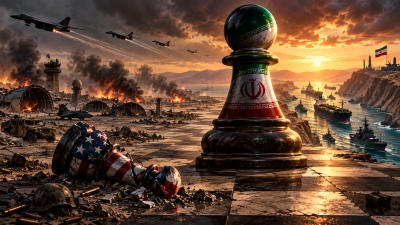
Although the messages from Qatar and the indirect negotiations between officials of the US and Iran in the presence of mediators from Pakistan and Qatar are positive with the two sides agreeing to continue the talks, the situation in the Persian Gulf region still remains. in the "red".
All eyes are now turned to the multi-day events for the funeral of Ali Khamenei, the supreme leader of Iran who was eliminated on February 28 by strikes from the US and Israel.
The Iranian military is placed on highest alert starting July 4 to address every scenario, even the most extreme one that foresees a new military strike by Israel, which threatens with a "third attack" if it deems it appropriate.
with many experts pointing out that the entire political and military leadership of Iran will attend the funeral of Ali Khamenei.
At the same time, the messages coming regarding the negotiations between the US and Iran are positive as progress is being spoken of. with Qatar signaling that the next round of talks will take place after the completion of the funeral ceremonies of Ali Khamenei.
Highest alert
Iranian Brigadier General Mohammad Akraminia stated that the armed forces of Iran are in a state of highest alert ahead of the multi-day funeral ceremony of Ali Khamenei.
As he mentioned, the Iranian forces have reinforced their deployment for the reception of senior officials, as well as religious and political figures from various countries.
"The ground, naval, and air forces of the army have reinforced their active presence along the country's borders, contributing to ensuring security," he told the IRNA news agency.
He added that the air defense of Iran maintains continuous surveillance of the country's airspace.
It is estimated that all high-ranking political and military officials of Iran will be present at the funeral, a fact that undoubtedly can constitute. a challenge for Israel.

The largest state funeral in the history of Iran
Iran is preparing the largest state funeral in its history for the former Supreme Leader Ayatollah Ali Khamenei, who was killed during the Israel - US attack on February 28.
The six-day ceremonies will take place in five cities, including regions in neighboring Iraq.
The events will begin on Saturday, July 4, with the body of Ali Khamenei being placed in state for public viewing at the Grand Mosalla prayer complex in Tehran.
The ceremonies will continue until Monday, 6/7, when a funeral procession will take place in the streets of Tehran.
On July 7, the procession will travel to the holy city of Qom and then to the cities of Najaf and Karbala in Iraq.
The body of Ali Khamenei will return to Iran to be buried in his birthplace, Mashhad, on July 9.

20 million people will participate
Thousands of citizens from all over Iran, as well as visitors from abroad, are expected to attend the ceremonies.
The authorities estimate that approximately 15 to 20 million people will participate, while the police have been placed in a state of highest alert ahead of the organization.
Senior officials and representatives from more than 30 countries, including Russia, China, Pakistan, India, Georgia, and Cuba, are expected to attend, while religious leaders from 90 countries will also participate in the ceremonies.
The Prime Minister of Pakistan, Shehbaz Sharif, whose country spearheaded the efforts to end the war between the US and Israel, confirmed in a speech to the parliament that he will attend the funeral.

Iran to UN: Israel is a terrorist state, threatens to assassinate Mojtaba Khamenei
Amir-Saeid Iravani, permanent representative of Iran to the UN, submitted an official protest to the international organization regarding the recent threat by Israel to assassinate the Supreme Leader of the country, Mojtaba Khamenei.
In a letter to the Secretary-General Antonio Guterres, the Security Council, and the General Assembly of the UN, Amir-Saeid Iravani characterized the threat made by the Minister of Defense of Israel, Israel Katz, as "part of a deliberate and systematic policy of state terrorism" targeting Iranian government officials.
According to him, this threat is linked to "the illegal aggressive actions of the Israeli regime against Iran, including the assassination of the late Iranian leader, Ayatollah Seyyed Ali Khamenei, as well as other senior political and military officials, which were carried out with the participation, coordination, and support of the United States."
Amir-Saeid Iravani added that the UN Security Council has allowed Israel to act with impunity and warned that Tehran will respond to any hostile action.
"Unfortunately, the failure of the Security Council to fulfill its responsibilities under the UN Charter has reinforced the climate of impunity and has rendered the Israeli regime even more brazen in normalizing state terrorism, creating an extremely dangerous precedent and constituting a serious threat to international peace and security," he stated.

Qatar: The US–Iran talks will continue after the funeral
"Positive progress" was made during the indirect talks between the negotiators of Iran and the United States in Doha, while the next round of contacts is expected to take place after the completion of the funeral ceremonies of the former Supreme Leader of Iran, the spokesperson for the Ministry of Foreign Affairs of Qatar announced.
"The mediators from Qatar and Pakistan completed today in Doha separate meetings with the negotiators of the United States and Iran, during which positive progress was made on issues related to the Islamabad Memorandum of Understanding, building on the results of the Lake Lucerne Summit," the spokesperson for the ministry, Majed al-Ansari, stated.
"The two sides agreed to continue the discussions in the coming period, while the next meeting will be scheduled as soon as possible after the completion of the funeral ceremonies of the former Supreme Leader of Iran," stated Ansari, who reiterated that "the two sides agreed to continue the talks in the coming period, with the next meeting being scheduled as soon as possible after the completion of the funeral processions for the former Supreme Leader of Iran."
What Pakistan says
The Ministry of Foreign Affairs of Pakistan announced that the indirect talks between the delegations of Iran and the US in Doha were completed, with "positive progress on the issues related to the aspects of the Memorandum of Understanding (Islamabad MoU)."
"The two sides agreed to continue the talks in the coming period, with the next meeting being scheduled as soon as possible after the funeral ceremonies of the former Supreme Leader of Iran," the Ministry of Foreign Affairs of Pakistan stated.

Iran: We focused on the frozen funds
Iranian officials report that the indirect talks in Qatar focused on Iran's access to its frozen funds.
In the case of Iran, these funds come mainly from oil export revenues and foreign exchange reserves held in banks abroad.
Estimates raise the total amount to more than 100 billion dollars, although its exact level remains unknown.
The largest part of the funds is located in countries that have purchased Iranian oil, including China, Iraq, Japan, South Korea, and countries in Europe.
Iranian officials claim that the US agreed to release approximately 12 billion dollars in two installments of 6 billion dollars, after the signing of the Memorandum of Understanding (MoU) with Iran.
The US states that it will maintain control of the funds and that the money will be used for the purchase of American agricultural products, such as corn and wheat. However, Tehran claims that it will decide how to allocate its money.
Gharibabadi (deputy foreign minister of Iran): We control the Strait of Hormuz, not CENTCOM
Gharibabadi, deputy minister of foreign affairs of Iran, rejected the US-led regional dialogue on security held in Bahrain, where representatives from 12 countries discussed the situation in the Strait of Hormuz.
"The Strait of Hormuz falls under the jurisdiction of Iran, not CENTCOM," he wrote, adding that "a military summit in Bahrain cannot shape the legal framework and security in the Persian Gulf."
"The security of the region will be ensured through the termination of interventions and the withdrawal of the United States from the region, respect for the sovereignty of states, and the acceptance of the new geopolitical realities. not under the military umbrella of America," he stated.
His statements were made after the announcement by the US that top military officials from 12 countries. including Saudi Arabia, the United Arab Emirates, Qatar, Lebanon, and Syria. met in Bahrain and confirmed their "commitment" to ensuring the free passage of trade through the Strait of Hormuz.

Hormuz turns into a war zone
The International Transport Workers' Federation (ITF) and the Joint Negotiating Group (JNG) agreed to maintain the Strait of Hormuz under the designation "Warlike Operations Area" until July 9.
The decision was taken after the attacks on two cargo ships in late June, which led to the suspension of an evacuation plan that had been organized by the relevant UN maritime agency.
In a joint statement, the ITF, representing the workers, and the JNG, representing the employers of the maritime industry, stated that double pay will be maintained for seafarers working in the region and serving on ships covered by the collective bargaining agreements of the International Bargaining Forum.
"This decision recognizes the ongoing and significant risk to human life, as well as the rapidly changing situation in the region," the statement notes.
The International Maritime Organization (IMO) of the UN had announced in late June that approximately 11,000 seafarers had been trapped on about 600 commercial ships in the Strait of Hormuz.
Approximately 2,500 seafarers and 115 ships were evacuated within a period of three days, before the attacks against ships in the region suspended the evacuation operation.

New York Times: The US transferred dollars to Iraq... for to distance it from Iran
The United States resumed certain air shipments of dollars to Iraq, several months after their suspension, which aimed to exert pressure on the country's government to distance itself from Iran, the New York Times report in a publication, citing two associates of Prime Minister Ali al-Zaidi.
During the war between the US and Israel against Iran, armed organizations close to Iran operating in Iraq repeatedly launched attacks with unmanned aerial vehicles (drones) and missiles against Gulf states and Jordan.
American interests in Iraq also became targets, notably the US embassy in Baghdad.
New York Post: Dangerous tension between Saudi Arabia - US over the war in Iran
For dangerous tension between Saudi Arabia and the US regarding the war against Iran speaks in its publication the New York Post.
Well informed sources stated to the New York Post that the war against Iran, the closure of the Strait of Hormuz, and the threat against the oil interests of Saudi Arabia caused a dangerous crisis in the relations between Washington and Riyadh.
In the publication it is mentioned that the Trump administration rejected the repeated warnings of Saudi Arabia regarding the start of attacks, as well as its demand for an immediate termination of the war and lifting of the blockade of the Iranian ports.
As it is pointed out, Saudi Arabia, fearing the reaction of Iran, closed its military installations for the American forces, after the announcement of the plan of Trump for the protection of the oil tankers in the Strait of Hormuz.
As a result, the specific plan failed just two days after the start of its implementation.
Since then, the relations between Saudi Arabia and the United States are characterized by ever increasing tension.
Indicatively, the successor of the Saudi throne Mohammed bin Salman, during his participation in the G7 Summit in France, expressed his opposition to the American policies, while the Secretary of State of the US Marco Rubio omitted Riyadh during his tour in the region.

Russia: Premature to draw conclusions from the US - Iran memorandum
It is premature to draw conclusions from the memorandum of understanding signed by the US and Iran, as the document was tailored to a specific date and both sides tacitly agreed to leave out their controversial differences for a period of 60 days, the deputy chairman of the Federation Council, Konstantin Kosachev, claims.
"It is absolutely premature to draw any conclusions, because, in my view, the memorandum is a document that was tailored to a specific date. on the birthday of the American president. and both sides tacitly agreed to leave out all truly controversial issues, where there is a radical conflict of their positions, during this period of 60 days," the parliamentarian stated.
Unknown what the final agreements will be
According to Konstantin Kosachev, for the time being it remains unknown what the final agreements between the US and Iran will be, including regarding the management of the Strait of Hormuz, the management of nuclear fuel, and other issues of strategic importance.
"There are many issues for which there is still no common understanding.
And as long as there is no agreement on these, there cannot be a clear picture either of who won more and who lost more," the Russian official estimated.
The picture is not particularly positive for the US
At the same time, Konstantin Kosachev considers that this situation does not present a particularly positive picture for the United States.
"Because, to call things by their name, they did not achieve the goals they had set, both during the 12-day war last year and in this year's military operation against Iran. These goals were not achieved, regardless of what President Donald Trump states about it," Kosachev noted.
The deputy chairman of the Federation Council also estimated that the relations between the US and Iran ultimately "will not be the same as those that existed before the start of hostilities."
"Who will ultimately reap the greatest benefit and who will tacitly accept that they backed down, only time will show.
And it is not certain that this will become apparent within the days remaining from the period of 60 days.
We already see a new escalation, new exchanges of strikes, even if for the time being they have a local character.
A new escalation involving third countries is also observed," the Russian official added.
www.bankingnews.gr



Σχόλια αναγνωστών