

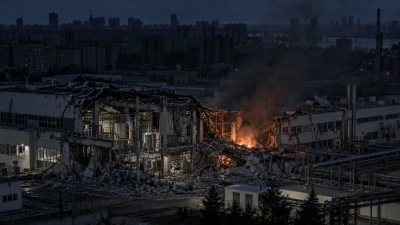
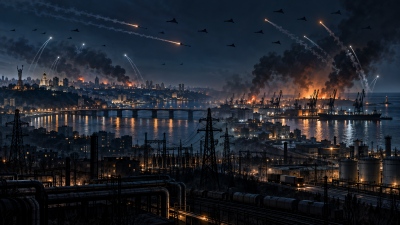
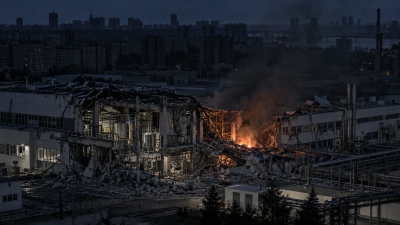
The Russian armed forces carried out a new sweeping wave of attacks against military, energy, and transport infrastructure in many regions of Ukraine, claiming that the goal was the weakening of the operational capability of the Ukrainian forces. According to Moscow, attacks occurred in the regions of Kyiv, Sumy, Dnipropetrovsk, Kharkiv, Chernihiv, Mykolaiv, Poltava, Odessa, and Zaporizhia.

Strikes on railway infrastructure and supply
The Russian Ministry of Defense claimed that a Geran-2 unmanned aerial vehicle struck a railway train in the area of the village of Oleshnya, which was used for the transport of cargo for the benefit of the Ukrainian Armed Forces. Moscow considers that railway infrastructure constitutes a critical element of the Ukrainian supply chain, as through it, personnel, ammunition, fuel, and military equipment are transported toward the front lines.

Targets in energy installations
Concurrently, the Russian Ministry of Defense announced that gas distribution installations, pipelines, and refueling stations were destroyed in the areas of Gorodnya, Novgorod-Seversky, and Snovsk. Furthermore, according to the Russian announcement, a fuel transport tanker and energy installations of the Ukrainian company Naftogaz were hit in the Poltava region. Moscow claims that the attacks caused serious damage to the installations and led to a complete shutdown of the operation of the specific unit.

Problems in supply
Russian sources also report that several fuel stations were put out of operation after the attacks, while channels supporting the Russian military operations broadcasted that residents reported significant difficulties in refueling between the areas of Kharkiv and Dnipropetrovsk. There was no immediate official confirmation from the Ukrainian authorities regarding the extent of the problems.

Strike on a logistics center
Moscow further announced that a logistics center was struck in the area of Zaporizhia, which, according to the Russian Ministry of Defense, was used for the storage and distribution of Ukrainian unmanned aerial vehicles and their components. Following the attack, a large fire broke out, according to the same sources.

Supply bridges also a target
Particular reference was made to the destruction of a makeshift crossing on the Seversky Donets river near the settlement of Mayaki in the Donetsk People's Republic. The Russian Ministry of Defense claimed that the specific crossing was used for the transport of personnel, weapons, and ammunition toward the area of Krasny Liman, where confrontations continue. According to the Russian assessment, the destruction of the crossing aimed at the disruption of the rotation of Ukrainian units and at hindering the supply of the forces operating in the area.

Strikes also on railway transport
The Deputy Prime Minister of the Ukrainian government, Oleksii Kuleba, stated that since the beginning of the year, more than 200 railway trains and locomotives have been destroyed or sustained damage due to Russian attacks, a fact that demonstrates the importance that Russia attributes to the disruption of the Ukrainian supply infrastructure.

Interception of Ukrainian drones
At the same time, the Russian Ministry of Defense announced that during the night, a total of 71 Ukrainian unmanned aerial vehicles were intercepted over the regions of Belgorod, Bryansk, Rostov, as well as over Crimea and the Black Sea. According to Moscow, the shootdowns took place between 20:00 on Saturday and 07:00 on Sunday, July 5, 2026.

The strategy behind the attacks
The announcements of Russia show that its strategy continues to focus on the attrition of the Ukrainian supply chain, energy installations, and transport networks, with the goal, as it claims, to restrict the capability of transporting troops, fuel, ammunition, and military equipment toward the active fronts. Instead of focusing exclusively on the capture of new territories, Moscow appears to give increasingly greater weight to the destruction of the networks that allow the Ukrainian army to continue its operations. Railway hubs, ammunition depots, fuel installations, energy infrastructure, bridges, and logistics centers are now frequently at the center of Russian attacks. This choice is not accidental. The railway constitutes the basic artery for transporting heavy equipment, ammunition, and personnel in Ukraine. The disruption or slowing down of its operation can significantly impede the reinforcement of the units operating on the most active fronts.

War of attrition to paralyze the Ukrainian army
Concurrently, the strikes on fuel installations and energy production aim, according to the Russian approach, at the reduction of the operational flexibility of the Ukrainian forces and at the increase of the cost of maintaining the war. Military analysts point out that this is a form of a war of attrition, where the goal is not only the direct destruction of military means, but also the gradual exhaustion of the capabilities for supply, repair, and replacement of losses. The specific strategy, provided it proves effective, could affect the pace of Ukrainian operations and restrict the capability of rapid transport of reinforcements along the front.

Christoforou (Analyst): Russia changes strategy – What the signs show from the strikes in Kyiv on 2/7
The massive Russian attacks with missiles and unmanned aerial vehicles against Kyiv constitute part of a broader change in the strategy of Moscow, according to the assessment of analyst Alex Christoforou from The Duran. Christoforou argues that the coordinated attacks could hardly have been organized in such a short period of time, estimating that they are part of a pre-existing operational plan aiming at the gradual weakening of the Ukrainian war capability. According to his analysis, the attacks focus on the degradation of supply networks, energy and fuel infrastructure, as well as the military support of Ukraine. The goal, as he argues, is not the achievement of an immediate and decisive victory, but the conduct of a prolonged war of attrition that will gradually reduce the capability of Kyiv to support the Donbass front. The analyst estimates that this methodical strategy aims at creating the prerequisites for the next phase of Russian operations, rather than seeking an immediate operational result.
www.bankingnews.gr









Σχόλια αναγνωστών