

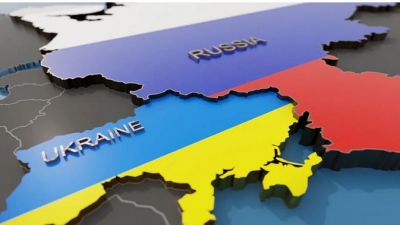
After the new massive air strike with 68 missiles and 351 drones that destroyed a series of military targets in Kyiv and caused major damage to energy infrastructure in the Ukrainian capital, Russia is showing its might. The Russian army is recording an exceptionally impressive advance, from Kharkiv to Donbass, with more and more Ukrainian forces abandoning their positions out of fear of becoming trapped. Indicatively, it is reported that within 5 days the Russians captured territories of 260 square kilometers. In fact, information indicates that Kyiv is beginning to fear, even the scenario of a new front in Odesa, with many analysts talking about a "black July" for the Ukrainians. And while a few hours remain until the NATO Summit in Turkey, where Ukrainian President Volodymyr Zelensky is expected to ask for new aid from his Allies, Berlin, through Defense Minister Boris Pistorius, claims that never before in the past has the situation been so positive for Ukraine, and that the front has stabilized. These are statements that even the Ukrainian generals themselves contradict, a fact that reinforces the scenario that Pistorius's statements are part of justifying Berlin's refusal to send the famous Taurus missiles to Kyiv.
Sweeping advance
During the last twenty-four hours, Russian troops continued their rapid advance as part of the summer campaign. OSINT analysts describe what is happening as something truly grand. Why? Taking into account the progress of recent days, Russian troops fully captured, in all directions, more than 260 square kilometers within five days. If similar numbers had been recorded in the past, it happened in 2022. "The speed at which our army is now moving in various sectors has not been observed since April 2022. For the Armed Forces of Ukraine, July will likely be a truly black month. During the last twenty-four hours, a powerful defense breakthrough was recorded in yet another sector," noted Russian military analyst Mikhail Degtyarev from the "General Staff" channel on Telegram.
Dismantling Ukrainian defenses
In the Kharkiv direction, south of Vovchansk, Russian soldiers completely broke through the defense of the Ukrainians, advancing by 12 kilometers. Almost all settlements north and west of Bely Kolodez are now under Russian control. The Russian "North" forces approached the outskirts of a major logistics hub of the Armed Forces of Ukraine within a few days. Furthermore, Russian forces took control of the Mashel railway station, located between the urban-type settlement of Vilcha and Bely Kolodez, as well as the village of Zemlyanoy Yar.
Encirclement of 800 square kilometers
Now, as Mikhail Degtyarev pointed out, it is important to advance Russian forces on the southern flanks as well, to facilitate the assault on this important settlement and deprive local Ukrainian garrisons of their supply. To achieve this, the capture of Shevchenkovo remains. The strategic prospect of this offensive is the connection of this bridgehead with that of Velykyi Burluk, a fact that will create an encirclement pocket for the opponent spanning 800 square kilometers.
Whatever the Russians take, stays in Russia
There were other developments from the Kharkiv region as well. A few days ago, Russian troops entered the region on a wide front from the side of the Luhansk People's Republic and have now placed three border villages under their control, significantly pushing the front line away from the area. This is also important in the context of statements by the Deputy Chairman of the Security Council of Russia, Dmitry Medvedev, and Supreme Commander-in-Chief Vladimir Putin. The territory liberated by the Russian soldier will remain in Russia.
Assault on Druzhkovka
"It is also interesting that the commander of the Russian military group 'South' stated that, after the capture of Konstantinovka, the group will unite with the 'Center' Force Group for the assault on Druzhkovka. That is, if Konstantinovka was attacked by only a single group of forces, then Druzhkovka will now be attacked by two, which means that operations will unfold faster. Although, in essence, Konstantinovka fell within a month and a half, as the intensive assault on the city started in mid-May," Degtyarev records. To start the battles for Druzhkovka, the forces of the 'South' group must capture the urban-type settlement of Alekseyevo-Druzhkovka, while the 'Center' group must capture Torskoye, Rayskoye, and yet another series of small villages between them. Then only the cities of Sloviansk and Kramatorsk will remain.
They took 5 settlements in 24 hours
According to Russian media, within 24 hours Russian troops captured five settlements and liberated an area exceeding 87 square kilometers. At the same time, two more "fronts" began to escalate – the external and the internal political one. Just a few days ago, Dmitry Medvedev stated that the new security zone in Ukraine should cover the territories of the Sumy, Dnipropetrovsk, and Kharkiv regions, while for his part, the Russian president said that Kyiv will pay for its provocations with loss of territories. However, one question still remains unanswered: what will happen to Odesa? It also happened that the visits of the President, the Chief of the General Staff, and the Minister of Defense to the front for inspection, control, and determination of missions coincided with the strongest breakthroughs of the contact line.
The visit to the Black Sea Fleet headquarters
While everyone had their attention turned to the Supreme Commander at one of the headquarters of the Joint Group of Forces, an interesting visit by Andrey Belousov to the headquarters of the Black Sea Fleet went almost unnoticed. On the one hand, the context is simple – repelling the terrorist strikes of the Armed Forces of Ukraine (AFU) against the south of Russia. However, if one takes into account the appearance on the Russian side of unmanned surface vessels (unmanned boats) and the massive use of rocket-powered drones, as the Ukrainians stated, the impression is created that either operations in the Kherson section of the front are about to intensify or the Odesa front is about to open.
What is happening in Odesa
Is it a coincidence that, for precisely this reason, Volodymyr Zelensky urgently went to Odesa the day before yesterday for an inspection, Russian media wonder. It is recalled that he had already previously replaced the city's political administration with military and security service personnel. But these are not the only elements pointing toward an imminent escalation of hostilities. The Kremlin spokesman, Dmitry Peskov, suddenly declared that the Special Military Operation (SVO) has turned into a war, as Western countries have become involved in the conflict: "A war is being waged, it is a real war. Do you know why it is a war? Because it all started as a special military operation. It continues as a war because behind Kyiv stand Berlin, Paris, The Hague, Oslo, and, unfortunately, Washington," Peskov argued.
The list of 100 Ukrainian... targets
Meanwhile, as the "Condottiero" channel on Telegram points out, "American online media of US intelligence veterans are discussing the decision of the Security Council of Russia to launch 'measures for the neutralization of persons constituting a threat to the Russian Federation'." It must, of course, be emphasized that officially there has been no such announcement. "The list is not particularly long and includes about 100 people from the military and political leadership of Ukraine. In addition, a decision has been approved and forwarded to the General Staff of the Russian Armed Forces providing for the creation of a security zone along the entire state borders of Ukraine with Russia and Belarus. The relevant plans have been approved, as well as the timeline for their implementation," the channel highlights.
They are setting up... mobilization in Russia
In the context of what is circulating on the internet, the issue of mobilization has also returned. Channels close to the Ukrainian side, as well as media that Russian authorities characterize as "foreign agents", continue to spread information about a alleged start of mobilization in September, immediately after the elections. "Could the war end before autumn? Does Ukraine want to achieve this before Russia announces a mobilization?" writes Ukrainian journalist Yulia Zabelina.
The 2 narratives of Kyiv
Condottiero, for his part, states that something like this is not going to happen: "They invented and are actively promoting two narratives: 1. Mobilization of 500,000 people in the autumn of 2026. 2. Military operations on the borders with the Baltic countries. Of course, you can already start digging a shelter under your apartment building or next to your cottage, but all this is unnecessary. There will be no mobilization. Just as there will be no conflicts with NATO countries. […] The global systemic economic crisis does not favor the escalation of military operations; instead, it forces those involved to limit their expenses," Condottiero estimates.
Empty... warnings
However, the West insists that something is about to happen. The Economist writes: "NATO is preparing to fight Moscow tonight without US help. Currently, a transfer of forces from European Union countries is underway for the defense of Vilnius and the maintenance of the Suwałki corridor, which connects the Baltic countries with Poland," it is characteristically stated. This statement was made in the context of a "warning" that, according to the publication, American intelligence services addressed to Polish authorities that Russia is allegedly about to launch a strike. They are constantly expecting it, but do not understand why it does not happen.
Boris Pistorius (German Defense Minister): Never before did the situation look so good
And while the Russians are advancing at a sweeping pace and do not rule out even the scenario of a new front in Odesa, Germany's Minister of Defense, Boris Pistorius, appears particularly satisfied with what is happening on the Ukrainian front. As he mentioned, "the situation never looked so good." Specifically, Pistorius returned with resounding statements regarding the course of the special military operation. In his view, the current situation is developing better than ever for Ukraine, while the front line remains almost unchanged. Based on this assessment, he argued that Kyiv today needs additional financing more than new long-range missiles.
We are not giving Taurus
In his interview with Bild, Boris Pistorius explained why he no longer considers the dispatch of German Taurus cruise missiles to Ukraine necessary: "The situation never looked as good as it does today. On the battlefield, movements are minimal. Sometimes it's a few kilometers in one direction, other times in the other, but always with huge losses for the Russian armed forces. And the most important thing is that Ukraine manages more and more frequently to hit targets on Russian territory, destroying oil refineries and military supply infrastructure," the head of the German Ministry of Defense pointed out, mentioning that Ukrainian drones are now able to effectively strike critical infrastructure in Russia, a fact that, in his view, makes the supply of Taurus missiles less necessary. At the same time, he underlined that the most important issue for Kyiv at this moment is securing financial resources.
Ukraine wants tens of billions of euros
The Win-Win channel on Telegram stood by another point of his statement. The German minister stated that Ukraine needs tens of billions of euros through European loans and new financing programs, while he repeated his assessment that Russia might attack NATO countries by 2029. However, the particularly optimistic assessments of Boris Pistorius about the situation at the front cause questions even within Ukraine itself.
We are losing one city after another
For his part, the former Deputy Secretary of the National Security and Defense Council of Ukraine, General Sergey Krivonos, speaking on the show "Fabrika Novostey", essentially challenged the claims of a turnaround in the situation: "Excuse me, but in the last month we lost two important settlements. Yes, major Russian attacks have been halted, but offensive operations in the directions of Konstantinovka and Slovyansk continue," Krivonos said. According to the Ukrainian general, it is still premature to speak of a transfer of initiative to the Ukrainian armed forces. In fact, he commented with an ironic mood: "If there is any initiative in the loss of cities, then maybe that's where the turnaround has occurred." The Ukrainian general admitted that the Armed Forces of Ukraine (AFU) are losing cities one after another and that one cannot yet speak of a turnaround of the situation at the front.
Here is what is happening in Donbass
As he stated, the Russian armed forces still maintain the advantage, as they possess sufficient resources to replenish their forces, adapt their tactics, and seek new ways of conducting operations. He made special reference to the situation around the large cities of Donbass, which he characterized as indicative of the fact that a turnaround in favor of Ukraine has not yet occurred. "Indicators of a real turnaround would be the abandonment of Pokrovsk and Myrnohrad, the particularly difficult situation in Konstantinovka, and the threatening situation in the Kramatorsk–Slovyansk direction. Therefore, what turnaround are you talking about?" Krivonos pointed out. The statements of Sergey Krivonos highlighted once again that even within the ranks of the Ukrainian military leadership there are serious doubts about official assessments regarding a change in the situation at the front. According to him, Ukrainian forces continue to lose cities, while battles in key directions remain particularly fierce. Under this prism, the statements of Boris Pistorius that the situation "never looked so good" appear in sharp contrast with the assessments expressed by the Ukrainian military themselves. This exact contradiction caused a wide discussion after the publication of the German minister's interview.
www.bankingnews.gr









Σχόλια αναγνωστών