

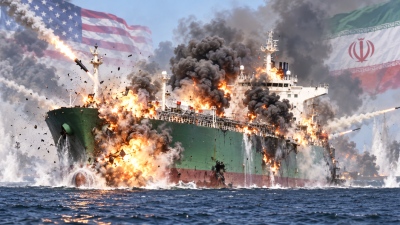
The Middle East faces one of its most dangerous periods in decades, as the military confrontation between the US and Iran escalates rapidly, continuously expanding its geographical and operational footprint. Attacks are no longer limited to military installations, but are extending to critical infrastructure, ports, and energy facilities, while the Strait of Hormuz evolves into the new epicenter of a conflict that threatens not only regional security but also the stability of the global economy.
With diplomacy retreating and both sides appearing determined to continue the confrontation, analysts warn that the risk of an uncontrolled regional conflagration is now greater than ever. Indeed, many warn that if the Americans decide to attempt a ground invasion, that enterprise will end in a historical disaster. Nevertheless, various scenarios are already circulating suggesting that the US is considering a landing... not on Kharg Island, but in the coastal town of Sirik, which serves as Tehran's strategic "eye" on the Strait of Hormuz.
Trump threats
Last week, the conflict between the United States and Iran transitioned from a state of mutual limited retaliation into something that now looks much more like full-scale war. Just a few days ago, US President Donald Trump threatened to expand the war unless Iran stops attacking vessels passing through the Strait of Hormuz.
US strikes infrastructure
In recent days, the US has expanded its targets beyond Iranian coastal installations housing radar and drone infrastructure, now including roads, tunnels, rail lines, port facilities, and, according to Iranian media, even a desalination plant.
Iran devastates the Gulf
Iran, for its part, has expanded its list of targets across seven countries in the region, while state media hint that major ports in the Gulf Arab states may soon be added. Kuwait has suffered the heaviest blow from Iranian strikes, with damage inflicted on a desalination plant and an oil refinery. Similarly, Jordan regularly faces missile strikes.
At a critical juncture
The conflict stands at a critical juncture. It could potentially lead to another round of mediation and negotiations; however, for most analysts, this appears unlikely. Neither side shows any appetite for dialogue, while both have declared that the Memorandum of Understanding (MoU) agreed upon in June after weeks of arduous negotiations is no longer valid.
American casualties
Following the death on Friday of two US military personnel in Jordan during an Iranian missile strike, Ian Bremmer, founder of the geopolitical risk firm Eurasia Group, stated that "the coming days will be among the most dangerous of the war." The United States, which announced on Sunday, July 19, the death of another service member in northern Iraq, warned that it would "punish Tehran directly" for the attacks, while Iran carried out fresh strikes against Jordan on the same day.
Out of control
"It is becoming increasingly clear that events are beginning to spin out of anyone's control," said Danny Citrinowicz, an analyst at the Institute for National Security Studies in Tel Aviv. "Although initially both Washington and Tehran seemed to want to keep the conflict within specific boundaries, it is now dangerously approaching a point where those boundaries may collapse," wrote Citrinowicz on platform X. "The confrontation could expand far beyond its current scope, involving the Gulf states more directly and endangering additional strategic targets and critical infrastructure," he added.
Iran's message
The Iranian missile attack targeting Aqaba in Jordan on Sunday served as a clear indication of this danger, as Israel announced that missile fragments fell onto its territory. So far, Israel has stayed out of the conflict, reportedly doing so at the request of the Trump administration, though the Israeli government's dissatisfaction with the deal with Iran is well known. Israeli defense officials warned that the country will respond forcefully if Iran attacks Israel.
The view from Tehran
Iran, for its part, appears confident that it can inflict significant damage. "Iran is adapting to American defense capabilities by launching high-speed, highly maneuverable missiles at US bases in the region," reported the Institute for the Study of War on Saturday, adding that Tehran is now employing cluster munitions on a larger scale to maximize destruction. The casualties among American forces in Jordan are proof of this adaptation.
Tehran believes it can hold out longer
Everything indicates that the regime in Tehran believes it can outlast Donald Trump, having mobilized public support through funeral ceremonies for Ayatollah Ali Khamenei. The collective leadership that has emerged in the absence of Khamenei's son, the new Supreme Leader Mojtaba Khamenei, appears to view resistance as the only option for now. "Iran's current leaders believe that any show of restraint will simply invite further American pressure," wrote Iran analyst Vali Nasr in the Financial Times.
Trump will back down first
"Although the Iranian economy is in dire straits with uncontrolled inflation, chronic medicine shortages, and widespread economic decline, Tehran will accept the inevitable economic hardship brought by a new American naval blockade," added Vali Nasr. They believe that their own pressure on the global economy through closing the Strait of Hormuz will force Trump to back down first.
Everything hinges on Hormuz
There is no substantial evidence to support Donald Trump's claim that Iran is desperately seeking a deal. On the contrary, the issue that originally triggered the conflict—Iran's nuclear program—has almost faded into the background, as attention has shifted entirely to the battle for control of the Strait of Hormuz. Essentially, this is a clash of two incompatible positions at the mouth of the Persian Gulf.
Unbridgeable differences
The vague language of the MoU attempted to conceal the unbridgeable differences between the American demand—supported by much of the international community—for free navigation into and out of the Persian Gulf, and Iran's insistence on controlling maritime traffic in the area. Indeed, in his first message as Supreme Leader in March, Mojtaba Khamenei argued that closing the strait serves as strategic leverage and that "the tool of blocking the Strait of Hormuz must continue to be used."
Memorandum of... misunderstanding
For many analysts, the so-called "Memorandum of Misunderstanding" was an instrument lacking real force. Control of the strait gives Iran "a Sword of Damocles over the head of the global economy," which Tehran considers indispensable to extract any concession from Washington, according to Vali Nasr.
Bab al-Mandeb, the second Hormuz
If the conflict continues to escalate, Iran might also leverage its allies, the Houthis in Yemen, to increase pressure on the global economy and Saudi Arabia by disrupting shipping in the Red Sea around the critical choke point of Bab al-Mandeb—effectively creating a "second Hormuz."
The allies' perspective
Washington's allies in the Persian Gulf have previously intervened with Donald Trump regarding the conduct of the war and the management of the situation in the Strait of Hormuz. Most recently, a series of interventions by governments including Saudi Arabia, the United Arab Emirates, Bahrain, and Qatar deterred Trump from proceeding with his plan to impose fees on vessels transiting the strait. Their concerns are broader: they fear that further escalation will cause deeper economic damage, delay any agreement on the Strait of Hormuz, and ultimately leave them facing an intractable adversary across the Gulf when Washington decides it has had enough.
The key question
The key question is whether these countries will reach out again—either individually or collectively—to the United States if Iran carries out its threat to strike ports and other critical infrastructure in the Gulf. And, crucial above all, whether such an appeal will be heeded. The semi-official Iranian news agency Fars warned on Friday that, in response to American attacks against the Iranian port of Chabahar, Iran could target "a network of key ports" across the Gulf states.
Distant scenario... military victory
A decisive military victory by the United States over Iran still seems distant. It would likely require the deployment of ground forces and a far more extensive and intensive campaign of air and missile strikes than what has been observed over the past week. Anything less will hardly alter the stance of the leadership in Tehran, which views this as a vital battle for regime survival.
Trump: I don't want a ground invasion
"I don't want to do that," said Donald Trump regarding a ground invasion during an interview with Fox News. However, he added: "Sometimes a ground campaign is needed, but we have others who can do it on our behalf." CNN has reported that Trump is considering new military options, including a potential strike on the strategically vital Kharg Island.
Extremely risky venture
Sina Toosi, from the Center for International Policy, estimates that a ground campaign in southern Iran amid extreme summer temperatures, facing a fully mobilized military and a population largely rallied around the war effort, would be an extremely risky venture, almost guaranteed to end in a historical disaster. Such an operation would become even harder if allies like Saudi Arabia refuse to allow the use of their territory and airspace for strikes against Iran. Crown Prince Mohammed bin Salman assured the Iranian president in January that the kingdom would not permit its airspace or territory to be used for any attack against Iran.
Mediation efforts
Both Pakistan and Qatar, which had mediated the meeting between the United States and Iran in Lucerne, Switzerland, in June, have kept a particularly low profile in recent days. According to the semi-official Iranian news agency Tasnim, the last visit by a Qatari delegation to Tehran took place on July 10.
Panic... over oil
Mediation could return to the spotlight if oil markets panic and the price of crude oil surges back past $100 a barrel due to shrinking global reserves. There is also the election factor, with the US midterm elections approaching. CNN has reported that advisors to Donald Trump argue that new restrictions in the Strait of Hormuz would trigger further rises in oil and gas prices, intensifying political pressure on Republicans.
The most likely scenario
Many analysts believe that neither full-scale war nor a purely diplomatic solution will prevail in the coming weeks. Instead, they consider a prolonged and volatile landscape more likely, alternating between periods of intense military strikes and relative calm, while mediators continue seeking new avenues to restart negotiations. Much will depend on the posture and decisions of the US President. As one Gulf diplomat put it: "It is very likely that things will get worse before they get better."
The 2 key points in the Persian Gulf
As the crisis between the United States and Iran enters a new, highly dangerous phase, two key points in the Persian Gulf sit at the center of military planning: Sirik, Tehran's strategic "eye" on the Strait of Hormuz, and Kharg Island, Iran's energy heart. Analysts believe control over these areas could decisively influence the outcome of a broader conflict over the critical transit route of Hormuz, while historical plans dormant since the Jimmy Carter era are resurfacing. The overarching question now is whether Washington under President Donald Trump will attempt to implement options deemed far too dangerous nearly half a century ago, with the risk of an uncontrolled Middle East inflammation greater than ever.
The main US objective
Given the extraordinary importance of the coastal town of Sirik to Iran, this area has become a primary target for the United States. Many believe a ground war between Iran and the US will begin soon. Meanwhile, some believe the US intends to attack Kharg Island, but the strategic and tactical situation of the islands in southern Iran indicates that there are many vital points in this region and that other areas could be targeted besides Kharg.
Sirik
One such strategic area is Sirik. Sirik is a coastal region and county in Hormozgan province, southern Iran. Positioned at a vital point, this area has become one of the most critical strategic and contested hubs in the Persian Gulf. Sirik is one of the counties of Hormozgan province, centered around the town of Sirik. It lies on the eastern coast of Hormozgan province adjacent to the Sea of Oman. The area is located approximately 115 kilometers southeast of Bandar Abbas, bordering Minab county to the north, Jask county to the south, Minab and Bashagard to the east, and the Sea of Oman to the west.
Why Sirik is so important
The significance of Sirik stems entirely from its unique geographical location. Its most vital characteristics include:
A. Central point at the Strait of Hormuz Sirik sits directly at the entrance to Hormuz from the Sea of Oman. Hormuz represents a vital bottleneck for the transit of a major portion of global oil exports.
B. Intelligence and military superiority The elevation and position of Sirik at the foothills provide total oversight of all entries and exits of the Strait of Hormuz, making it Iran's eye on this waterway.
C. Iranian naval operations hub As a major base, this area allows Iran to observe, track, and, if necessary, control maritime traffic through the Strait of Hormuz. It is also an ideal location for deploying defense systems and launching anti-ship cruise missiles.
Why the United States seeks to attack Sirik
Given Sirik's supreme importance to Iran, this area has become a key target for the United States. US objectives for a potential strike on Sirik include:
1) Neutralizing Iranian surveillance capabilities The primary goal of the United States is to destroy Iran's military, radar, and telecommunications facilities in Sirik to severely impair Iran's ability to monitor and control the Strait of Hormuz.
2) Iranian military facilities According to American officials, the area hosts key assets such as missile launchers, drone systems, arms depots, and support facilities, marking it as a prime military target.
3) Prominent place in the wider conflict An attack on Sirik forms part of the broader conflict between the US and Iran that has escalated since Iran closed the Strait of Hormuz following US strikes in February 2026. In short, Sirik serves as Iran's strategic "eye" due to its unique position at the entrance of the Strait of Hormuz. For this reason, degrading Iranian military power at this location is one of the primary US objectives to curb Iran's influence and control over Hormuz.
www.bankingnews.gr








Σχόλια αναγνωστών