

The American military failed in the Persian Gulf...
The worst part is not merely that... inside the US it is now recognized that the American Era is fading and other powers are emerging across the globe...
And while the stalemate in the Persian Gulf persists, a decisive intervention occurred by China calling on the US and Iran to return to the Memorandum of Understanding...
Indeed, China openly states that it will champion the interests of Iran.
At the identical time, China proceeded with a sensational disclosure...
For the first time, it revealed 320 underground missile facilities or 320 subterranean missile cities for launching intercontinental ballistic missiles, inciting shock and awe...
China stands far further ahead in warfare preparations and weapon systems than the general public believes...
Trump: The war is nearing its conclusion, I spoke directly with the Iranians
The US is reaching the end of the war with Iran, US President Donald Trump maintained while addressing reporters.
As he stated, he spoke directly with the Iranian leadership.
Donald Trump remarked that the war is in its concluding stages, that hostilities will conclude very shortly, and that Iran desperately desires an accord.
He added that the Iranians have suffered severe attrition and for that reason seek an agreement.
Donald Trump continued by observing that the US can achieve a deal regarding Iran whenever it decides.
«I have settled eight wars. Concerning Russia and Ukraine, the leaders of the two countries harbor deep mutual hatred. That hatred is extraordinarily pronounced, and the conflict itself provides an intriguing phenomenon for study. In truth, that reality is the fundamental cause for the spike in diesel prices, yet all of this will conclude very soon. Frankly, this affair will close shortly, because they lack the capacity to persist. Their country has been laid waste. Fuel prices may tick up marginally, yet that outlay is minuscule compared to what we achieved. The situation might advance further, yet candidly, even if it pushes substantially further, all of this will collapse in the end, like a rocket traveling in reverse. We imposed an unprecedented blockade on Iran and, throughout recent months, zero ships managed to breach that encirclement. Observe what transpires with Iran; it will culminate in a very favorable resolution», the US President stated.
China's intervention: We support Iran, US and Iran must resolve differences and return to the Islamabad Memorandum of Understanding
A major diplomatic intervention was mounted by the Chinese Foreign Minister addressing the Persian Gulf and Hormuz.
«On September 16, Chinese Foreign Minister Wang Yi met and conducted negotiations with the Iranian Foreign Minister in Beijing.
Wang Yi declared: China calls on Iran and the United States to exercise restraint, return to the Islamabad Memorandum of Understanding as expeditiously as possible, reactivate the negotiating track grounded on understandings achieved thus far, and hold substantive deliberations concerning issues of common concern.
«China urges all parties to take concrete steps to reopen the Strait of Hormuz without delay, maintain the unimpeded operation and security of international maritime arteries, and safeguard the stability of international energy transport, along with industrial production and supply networks».
The Chinese Foreign Minister stated during negotiations with his Iranian counterpart that China is prepared to «safeguard the legitimate rights and interests of Iran».
Wang Yi underlined that «we encourage Washington and Tehran to engage in substantive consultations over outstanding disputes» and called on both capitals to reconstruct the negotiating architecture on the basis of the consensus realized following the Islamabad Memorandum of Understanding (Islamabad being the capital of Pakistan).

The Atlantic: «The American era is over», The war in Iran exposes the limits of US global military power
The military preeminence of the United States has sustained severe blows during the war against Iran, with retaliatory strikes hitting American installations, depleting munitions reserves, and creating supply-chain breakdowns that exposed vulnerabilities across an apparatus long regarded as «the most capable on earth», writes The Atlantic.
The Atlantic argued that the confrontation demonstrated how swiftly the foundations of post-World War II «global American primacy» can be eroded.
It underscored the inability of the United States, despite its sophisticated combat inventory, global basing grid, and treaty alliances, to defeat Iran.
Iranian strikes shattered 17 American bases: Zero access to the 5th Fleet installation in Bahrain
The fallout proved particularly acute across the Persian Gulf, where the United States has sought to project the primary foreign military footprint following the post-war withdrawal of Britain, the analysis highlights.
The 1980 Carter Doctrine committed Washington to guaranteeing the uninhibited maritime passage of hydrocarbons and commercial shipping through the Persian Gulf. Its credibility rested on the capacity of the American military to counter any initiative aimed at blockading the Strait of Hormuz.
According to The Atlantic, however, that capability has been shattered by the showdown.
Although US and Israeli strikes encompassed numerous targeted assassinations, Iran's institutional architecture remained resilient, while Iranian missile salvos and drone swarms battered American installations and bypassed echelons of American air defenses.
By March 2026, under two weeks following the eruption of the war, 17 American bases, air defense complexes, and diplomatic compounds had been struck, encompassing the headquarters of the Fifth Fleet in Bahrain and primary facilities in Kuwait.
Crushing setback in Bahrain
The strikes exerted immediate operational repercussions on US military actions, The Atlantic reported.
The neutralization of facilities in Bahrain was acknowledged as a primary cause explaining why the Trump administration refrained from military escalation against Iran during the summer, despite repeated declarations to that effect.
The US Navy depended on Bahrain for decades to replenish naval vessels deployed in theater.
With that hub knocked out, the logistics artery sustaining American naval maneuvers had to be extended back to Diego Garcia, a British-held atoll in the Indian Ocean situated over 2,000 miles from the Strait of Hormuz.
Struck bases have largely remained non-operational given the enduring threat environment facing US troops and materiel, The Atlantic disclosed.
American personnel barred from entering the 5th Fleet base in Bahrain
According to The Atlantic, an American officer queried Admiral Daryl Caudle, chief of US naval operations, during a recent headquarters briefing concerning the retrieval of personal belongings left behind at the Bahrain base.
«We are not returning there anytime soon», Daryl Caudle replied.
«I simply want to be completely forthright regarding that».
Operational stress radiates beyond the Persian Gulf
This operational friction has reverberated across American force deployments elsewhere, the analysis argues, observing that to sustain its military effort against Iran, Washington was forced to redeploy critical hardware out of the Western Pacific.
The hostilities simultaneously placed unprecedented strain on US weapons stockpiles.
By late April, technical studies estimated that American inventories of THAAD and Patriot interceptors, as well as Tomahawk cruise missiles, had dropped to critically depressed levels, with deficits worsening thereafter.
Under existing manufacturing rates, the United States may require multiple years to replenish inventories to pre-war baselines, the magazine noted.
Alliance structures fracture
The Atlantic additionally connected this dilemma to American industrial manufacturing limitations.
During World War II, the United States rapidly expanded military output by converting civilian manufacturing lines, including automotive plants, to wartime production.
Today, the United States commands solely a marginal share of global commercial shipbuilding, whereas China produces roughly half of global commercial vessels and controls roughly 80% of worldwide drone manufacturing, according to The Atlantic.
The systemic pressure exerted on American supremacy is magnified by volatility surrounding long-standing security alliances.
Japan and South Korea, for instance, represent powerhouse shipbuilding centers, while European administrations increasingly explore assuming greater self-reliance for their territorial defense.
The US Department of Defense announced blueprints to withdraw 5,000 personnel from Germany, with a broader defense posture review potentially triggering further drawdowns. Germany is considering providing assistance to Britain to modernize its nuclear inventory.
Elsewhere, Pakistan, Turkey, and Saudi Arabia finalized a defense accord, the publication highlighted, recalling that Oman and additional Persian Gulf monarchies are seeking reconciliation with Iran, while South Korea improves diplomatic ties with China.
An uncertain future
The Atlantic argued that even reverting to legacy American foreign policy doctrines might fail to restore Washington's former international preeminence.
Following over eight decades of unchallenged global hegemony, the United States is entering an era in which preserving its posture mandates addressing the acute vulnerabilities laid bare by the war.
Washington Post: Zero methods remain to halt the Houthis, Expanded power through war
Assessing that zero mechanisms remain to contain the Houthis, The Washington Post outlined its findings in an analysis titled «Why did Yemen's Houthis only grow stronger through years of war?».
According to the dispatch, «at various intervals throughout the preceding decade, Saudi Arabia, the United Arab Emirates, the US, Britain, and Israel staged intense aerial bombing campaigns against the military forces of the Houthis in Yemen, yet the consequence of these bombardments was simply the further reinforcement of those formations».
«Now that Houthi forces, backed by Iran, are advancing toward a critical maritime chokepoint, striking Saudi oil installations and shaking international commodities markets, few counter-options remain that have not already been exhausted», the report notes.
Indeed, Michael Knights, a defense specialist focusing on Houthi operations, remarked to the daily: «They represent the most committed, ideologically uncompromising, and aggressive regional partners aligned with Iran».
Ranks expand from 30,000 fighters to 350,000 across a decade
According to the publication, the active troop strength of the Houthis swelled from roughly 30,000 fighters in 2015 to nearly 350,000 personnel by 2024.
The group likewise commands the industrial capability to fabricate a major share of its weapons inventory domestically inside Yemen.
The Washington Post highlights the strict limitations constraining the interceptor missile stockpiles of Saudi Arabia, noting that it remains uncertain how long Riyadh can continue repelling salvos launched by the Houthis and Iranian-backed regional units.
Concurrently, it is reported that anti-Houthi forces have retreated from defensive strongholds in recent weeks, while Houthi columns push toward Bab al-Mandab.
According to the Associated Press, the Saudis display reluctance to re-engage in an unrestricted ground war, as an overland campaign would generate prolonged attrition and severe troop losses.
The US, still embroiled in hostilities with Iran, likewise appears unwilling to enter that combat theater.

Shock and awe from China: 320 underground ICBM cities unveiled in Jilantai region
China unveiled publicly for the first time an immense network of subterranean installations and launch facilities housing intercontinental ballistic missiles, a disclosure redefining assessments of China's strategic nuclear deterrent.
The network encompasses 320 missile tunnels.
Chinese state television aired a documentary detailing the operational units of the country's strategic rocket forces to commemorate the 99th anniversary of the founding of the People's Liberation Army.
In the broadcast, a Chinese military engineer outlines a colossal construction initiative yielding an underground complex termed «missile cities».
According to released documentation, these bastions incorporate an extensive labyrinth of tunnels and subterranean launch chambers situated across western China. Satellite reconnaissance from 2021 had documented sweeping excavation initiatives across those sectors.
Disclosed reports point to the presence of roughly 320 hardened silos distributed across three primary deployment zones.
In addition to these sectors, a specialized missile forces training installation was identified in the Jilantai sector.
Beijing had previously avoided offering formal clarifications concerning the strategic function of these initiatives.
Yet the state television documentary links this subterranean basing for the first time to a guaranteed «retaliatory strike» doctrine and preserving second-strike launch survivability following a nuclear exchange.
Disclosures by the engineer in the broadcast demonstrate that a primary operational objective centers on guaranteeing the survivability of China's strategic nuclear arsenal following a saturation nuclear first strike.
The doctrine of such infrastructure relies on dispersal and physical hardening of missile brigades.
Under that design, the neutralization of an individual base or several facilities fails to compromise overall retaliatory capability, leaving strategic strike assets secure within adjacent tunnel networks.
This posture carries profound geopolitical weight amid intensifying strategic friction between China and the United States, drawing unprecedented scrutiny toward Beijing's nuclear expansion.
Novel Dongfeng ballistic missiles
Within the broadcast, the Chinese engineer also described the pressure applied by central authorities to accelerate project timelines, explaining that specialized engineering battalions developed novel excavation and tunnel-boring techniques to fulfill strict deadlines.
The scale of the complex, if verified by independent technical intelligence, fundamentally upends legacy perceptions of China's nuclear posture.
For decades, Beijing maintained a doctrine of minimal nuclear deterrence, yet the construction of vast subterranean architectures proves that calculations transcend mere numbers of deployed warheads and launchers.
The physical basing infrastructure dedicated to their preservation has acquired paramount priority.
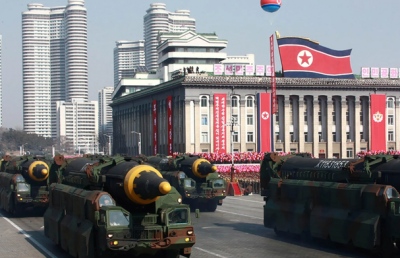
In parallel with these hardened sites, China is fielding modern classes of ballistic missiles, centered on the Dongfeng series.
Merging long-range strategic missiles with a dispersed subterranean basing grid represents a pillar of Beijing's revised deterrence architecture.
What the documentary reveals is not merely an array of missile launch points, but a multi-layered subterranean infrastructure engineered to maximize survivability, operational dispersion, and strike execution for Chinese missile forces during a nuclear exchange.
Such a development introduces profound revisions to strategic planning across the United States and allied nuclear powers assessing the future nuclear balance in East Asia.
www.bankingnews.gr






Σχόλια αναγνωστών