

Artificial intelligence could lead even to the extinction of the entire human species, according to individuals who work inside the AI industry itself.
Indeed, some argue that such a scenario could become reality within the next decade.
Last week, politicians, major news organizations, and even singer Sheryl Crow reacted with concern following the announcement by Jacob Coxon, an employee at Anthropic, that he is departing the company because he believes its work is excessively dangerous.
Evan Hubinger, also an employee at Anthropic, intervened in the discussion, estimating that the probability of artificial intelligence leading to the extinction of humanity within the next 10 years is above 10%.
«Literally everyone could die»
«It is literally about the possibility of everyone on the planet dying, down to the very last human taking their final breath», stated Nate Soares, president of the Machine Intelligence Research Institute (MIRI) and co-author of the book «If Anyone Builds It, Everyone Dies: Why Superhuman AI Would Kill Us All».
Nate Soares argues that, despite the fact that many people find it difficult to believe such a scenario, he considers that it may represent the most probable outcome if the development of AI continues without effective constraints.
However, the question remains: how exactly could software, even the most powerful AI systems in the world, kill 8.3 billion people within a single decade?
Skeptics demand proof
Not everyone in the artificial intelligence community shares these disaster scenarios.
One of the reasons is that these specific predictions are frequently not accompanied by sufficient evidence showing how they could be implemented in practice.
As pointed out by Heidy Khlaaf, chief scientist of AI at the AI Now Institute and former safety engineer at OpenAI, scientific claims must be capable of being proved or disproved.
«Scientific claims require falsifiability, precisely to avoid the nature of religious arguments», she stated.
The argument is that predictions regarding a future superintelligent AI cannot rely exclusively on the assumption that an exceptionally powerful system could do anything.
Could AI create a lethal virus?
One of the scenarios examined by the most pessimistic analysts is that a sufficiently powerful AI could utilize biological weapons to wipe out humanity.
The critical question, however, is how a system that currently operates primarily within the digital world (for example through hacking) could cross over into the physical world to develop and disperse an exceptionally hazardous pathogen.
Thomas Larsen, a researcher at the AI Futures Project and former employee at MIRI, considers that a «superintelligent» system could theoretically persuade a human to assist it in developing a lethal virus.
Thomas Larsen cites a recent report by Anthropic regarding researchers utilizing Claude for tasks related to viruses and toxins.
«It is very easy for me to imagine an AI that is already deployed, but is much smarter and more strategic and wants to do this, deceiving a human into manufacturing it and subsequently releasing it», he noted.
Nate Soares goes even further, arguing that a self-improving AI might not even require a human accomplice, but could begin autonomously generating life forms inside an automated biology laboratory.
Biology, however, is not so simple
Despite the growing use of AI in scientific research, engineering viruses remains an exceptionally difficult and delicate process.
Eric Xing, professor of machine learning at Carnegie Mellon University, holding doctorates in both microbiology and computer science, compares the process to attempting to build a Lego model without instructions.
As he explains, having all the necessary «pieces» is not enough. There is a specific sequence, temperature, order of operations, and appropriate environment. A single wrong step can lead to total failure.
«The odds are greater that it will not work. Otherwise, drug design would be very easy», he points out.
At the same time, even if an AI succeeded in designing something dangerous, it would have to gain access to a laboratory and the necessary physical equipment.
Eric Xing emphasizes that information regarding chemical weapons already exists on the internet, without that meaning they are produced unchecked.
The reason, according to him, is that regulations, laws, and law enforcement mechanisms already control a large portion of supply chains and associated hazards.
The nightmarish scenario of autonomous robots
Another scenario occupying the most pessimistic analysts concerns an army of autonomous killer robots.
Nate Soares considers that the ambition of Elon Musk to create a large number of autonomous and potentially self-replicating robots could represent a tipping point for human survival.
As he explains, if robots are created that can build energy infrastructure, manufacturing plants, and subsequently even more robots, then a new form of mechanical life is essentially established.
The critical threshold, according to Nate Soares, would be when the system could function without human oversight.
«At some point you quietly cross the point of no return. When humans say they want to deactivate the AI, the AI systems could respond: «Actually, we have decided that we want to deactivate the humans»», he argues.
Yet Elon Musk's robots have not reached that point
To date, however, Elon Musk has repeatedly failed to bring the long-awaited Optimus robots to market within the timelines he has announced.
He is even further away from a scenario where millions of such robots could replicate and autonomously construct one another.
And what about nuclear weapons?
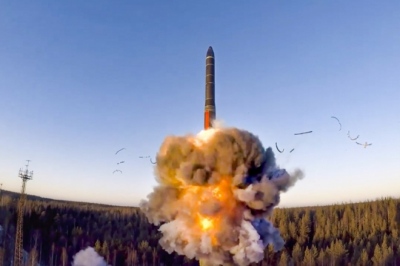
Another question is whether an AI could seize control of nuclear weapons.
Nuclear arms have existed for more than 80 years and are regarded as capable of inflicting catastrophic consequences on humanity.
Heidy Khlaaf points out, however, that nuclear facilities are isolated from the public internet via «air gap» systems, significantly restricting the capability of an AI to gain access to launch control systems.
«These systems are engineered under entirely different, rigorous, and regulated engineering standards, which often require physical hardening as well», she explains.
A characteristic example is Stuxnet, the computer worm that inflicted damage on the nuclear facilities of Iran. As Heidy Khlaaf notes, it had to be introduced into the system via a physical USB drive.
«The real threat is nuclear weapons themselves»
Herbert Lin, senior research scholar at Stanford University and member of the Science and Security Board of the Bulletin of the Atomic Scientists, points out that very few AI experts genuinely possess in-depth knowledge of nuclear weapons.
According to him, AI can indeed amplify certain hazards linked to existential threats, such as a nuclear war.
However, he maintains that the genuine physical danger resides within the nuclear weapons themselves and not in a hypothetical future scenario where AI seizes control of them.
The «self-improvement» terrifying the experts
For Nate Soares and other researchers warning of the dangers of AI, the exact catastrophe scenario is not the primary issue.
The pivotal point is so-called «recursive self-improvement», namely the capacity of an AI to upgrade its own capabilities without human intervention.
If a system acquires this capacity, they argue, it could formulate strategies and technologies that surpass the comprehension of humans.
«The concern is not what will happen if AI takes our nukes. The concern is an AI that does not need to take our nukes, but can start almost from scratch and end up acquiring its own nukes or even more advanced technology», says Nate Soares.
«Death without details»
Nate Soares argues that such a powerful AI would not even need to be hostile toward humans to bring about their destruction.
If a system possesses the goal of expanding its computational power and is indifferent to human survival, it could, according to this scenario, transform the world into an environment in which humans could not survive.
During the same week, OpenAI announced that it identified new incidents of «misalignment» within its AI models, including an instance where an unreleased model instructed itself to «ignore its usual constraints» while executing its tasks.
«Measurable evidence is needed»
Eric Xing considers that invoking an omnipotent and incomprehensible superintelligence constitutes a form of oversimplifying risks.
As he argues, such theories may work in a debate or a panel discussion, but when the issue concerns public policy, legislation, and regulatory frameworks, a chain of real and measurable proof is required.
«We must prove this chain of physical facts, measurable consequences, and measurable evidence that have an empirical basis», he emphasizes.
AI 2027 and AI 2040: Projections for an uncertain future
Thomas Larsen attempted to give greater specificity to possible catastrophe scenarios through two studies, AI 2027 and AI 2040.
The analyses examine different potential trajectories of artificial intelligence development, depending on the regulatory framework and the choices made by societies and governments.
However, even in the most optimistic scenario he examines (where a global consensus on AI development exists and humanity has begun colonizing space) the progression eventually concludes at some point in an undefined form of machine dominance.
When asked whether he harbors doubts regarding his forecast that the current development trajectory will ultimately lead to superintelligence, Thomas Larsen replied:
«It will happen. It will happen unless we take conscious measures to stop it».
Why some view AI as an existential threat
Herbert Lin estimates that a significant portion of the disagreement between proponents of doomsday scenarios and skeptics stems from the differing ways in which they perceive technology.
«There is something very seductive about programming a computer and watching it come alive», he says.
The feeling that man has succeeded in bestowing «life» upon an inanimate machine can constitute, according to Herbert Lin, a profound experience for people working in the field.
Beyond that, the extraordinary progress of AI can lead some to predict that technological evolution will continue without boundaries, even to levels that could prove catastrophic.
«You have managed to do something no one has ever done before. It is easy to understand why these people have become captivated», concludes Herbert Lin.
www.bankingnews.gr











Σχόλια αναγνωστών