

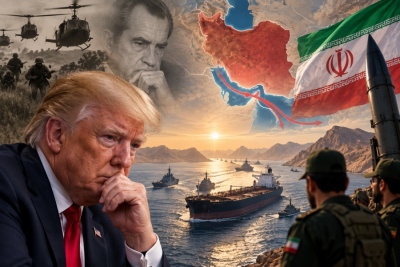
Washington believed that the 1991 Gulf War had permanently put an end to the "Vietnam Syndrome." However, seven months of bombardments and blockade against Iran seem to be bringing it back into the spotlight. As Middle East Eye writes, the military confrontation has once again exposed the limits of American power: the US still retains the capability to destroy nearly any target in the Middle East, but that does not mean it can enforce its desired political outcome.
Only two commercial ships passed through Hormuz
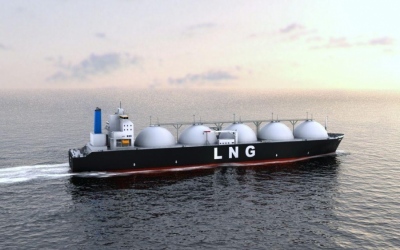
On September 22, only two commercial vessels crossed the Strait of Hormuz. This narrow maritime passage, through which approximately one-fifth of the global daily oil supply normally flows, as well as nearly one-fifth of global liquefied natural gas (LNG) trade, has fallen virtually silent. All this is happening under the watch of billion-dollar US warships, which have failed to convince private insurance companies to allow even a limited number of oil tankers to transit through the Strait. Washington can still destroy almost anything it targets in the Middle East. The critical question, however, is different: can this immense destructive power produce the political result sought by the US?
Three strategies in seven months – None yielded results
Seven months after the start of the war against Iran on February 28, 2026, Washington has cycled through three distinct pressure strategies: massive airstrikes, economic suffocation via a naval blockade, and direct escalation alongside a mutual expansion of the conflict. None of these strategies managed to restore normal maritime navigation through the Strait of Hormuz. The US military may dominate the skies, sink vessels, and eliminate political and military leaders. It has failed, however, to compel Tehran into accepting Washington's terms.
The lesson of Vietnam
The Vietnam War, the 1991 Gulf War, and the current conflict in the Persian Gulf belong to different eras and involve completely different adversaries. They cannot be mechanically compared. However, according to Middle East Eye, each of these conflicts reveals something crucial about the boundaries and reach of American power.
The "Vietnam Syndrome"
The "Vietnam Syndrome" was not merely domestic American aversion toward military casualties. It represented a deeper crisis of confidence regarding the efficacy, moral legitimacy, and political utility of US military power. At the height of the conflict, the US had deployed more than 500,000 troops in Indochina. By the end of the war, more than 58,000 Americans were killed, while millions of Vietnamese also lost their lives. Washington dropped vast quantities of munitions, fielded the world's most advanced military forces, and supported the Saigon regime for years. Ultimately, though, it suffered a defeat. Vietnam taught Washington that superior firepower cannot force an adversary who is willing to endure longer to accept a political settlement. Hanoi understood what took Washington years to realize: a weaker adversary does not necessarily need a decisive battlefield victory. It only needs to endure long enough to exhaust US political will.
Vietnam reshaped American policy too
The war had profound consequences for how Washington formulated its foreign policy. In 1973, Congress bypassed President Richard Nixon's veto to pass the War Powers Resolution, directly restricting presidential power to launch wars. Earlier, in 1969, the "Nixon Doctrine" had called on regional US allies to assume greater responsibility for their own defense. For roughly 15 years after the fall of Saigon, Vietnam remained a constant warning sign in the minds of the US foreign policy elite. It served as a stark reminder that US military power has its limits. Every proposal to deploy significant ground forces abroad ran headfirst into the ghost of Saigon. Until Saddam Hussein invaded Kuwait.
The Gulf War and the "erasure" of the Vietnam Syndrome
On August 2, 1990, Iraqi forces invaded Kuwait. The geopolitical environment could hardly have been more favorable for American power. The Soviet bloc was collapsing, Germany was in the process of reunification, and Soviet President Mikhail Gorbachev was actively seeking cooperation with the West. China, economically and militarily far weaker than today, remained internationally isolated following the crackdown on the Tiananmen Square protests. There was no peer adversary capable of forming an alternative alliance or seriously challenging Washington. US President George H.W. Bush seized the opportunity and, rather than launching a unilateral operation, assembled a broad international coalition. On November 29, 1990, the UN Security Council adopted Resolution 678 with a vote of 12 in favor, 2 opposed, and 1 abstention. The resolution authorized the use of "all necessary means" to liberate Kuwait if Iraq failed to withdraw by January 15, 1991. Cuba and Yemen voted against, while China abstained.
"Desert Storm": Overwhelming American dominance
Major Arab nations, including Egypt, Syria, Saudi Arabia, and Morocco, joined the military coalition. Washington deployed military firepower to the region on a scale unseen since the Vietnam era. By January 1991, the US Air Force and US Navy had deployed around 2,000 combat aircraft, alongside nearly 600 aircraft provided by coalition partners. When Operation "Desert Storm" kicked off on January 17, the technological and operational divide between the two sides was astronomical. Coalition forces executed over 116,000 combat sorties over six weeks, dropping approximately 88,500 tons of munitions. When the ground invasion finally began, it took merely 100 hours to liberate Kuwait. Nearly 700,000 US troops participated in the operation, suffering fewer than 300 casualties. The political impact of the victory in Washington was immense. Bush framed the victory as something far greater than the liberation of Kuwait. On March 1, 1991, in a famous declaration, he remarked: "By God, we've kicked the Vietnam Syndrome once and for all." The US foreign policy establishment believed it had reclaimed what was lost in Southeast Asia: the conviction that overwhelming military dominance could once again yield desired political outcomes. The US had defeated a major regional army and liberated a sovereign state. In Washington's view, the phantom of Vietnam had vanished.
The trap of unipolarity
The Gulf War coincided almost precisely with the final dissolution of the Soviet Union. What followed was an extraordinary era in modern history, as no major power existed to balance against US hegemony. America possessed the world's largest economy, the primary global reserve currency, and an unrivaled system of alliances. NATO expanded eastward. The World Trade Organization was established in 1995, while the IMF and World Bank drove global economic integration framed by Western rules. American influence extended far beyond aircraft carriers and military bases. Washington increasingly dictated the norms governing the international system. However, the self-assurance forged by the victory in Kuwait eventually became a trap for the US. Washington gradually began confounding its capacity to destroy an adversary's army with the ability to dictate subsequent outcomes.
Afghanistan and Iraq: The delusion revealed
Afghanistan and Iraq, following the September 11 attacks, laid bare this strategic mistake. In Afghanistan, two decades of military operations and state-building culminated in the return of the Taliban to power in Kabul, right as the final American transport plane departed in 2021. In Iraq, Saddam Hussein's regime fell within weeks in 2003. Yet the occupation cost trillions of dollars, destabilized the region, and ultimately bolstered Iranian influence in Baghdad. The "Vietnam Syndrome" was supposed to have been buried in 1991. Instead, Iraq and Afghanistan proved that dominance on the battlefield does not empower Washington to dictate the political outcome.
The unipolar order began to unravel
The unipolar structure was degrading long before the current regional conflict. China transformed into a dominant economic powerhouse. Russia adopted a far more aggressive military posture. The "War on Terror" deeply fatigued the American public. And nations across the Global South gained substantial economic weight. Gaza presented Washington with a distinct set of challenges: a profound crisis of legitimacy and credibility. In 2024, the International Court of Justice in The Hague ruled Israel's ongoing presence in occupied Palestinian territories unlawful. In a separate genocide case brought by South Africa, the Court ordered provisional and binding measures against Israel. These directives, like other international legal rulings, were repeatedly rejected or dismissed by Israel. In 2025, Francesca Albanese, UN Special Rapporteur on human rights in the occupied Palestinian territory, characterized the situation in Gaza as a "collective crime." Amnesty International and the Israeli organization B'Tselem also independently concluded that Israel committed genocide, while Human Rights Watch documented acts of extermination.
US support for Israel
Throughout this timeframe, across both the Biden and Trump administrations, Washington wielded its diplomatic leverage to back its Israeli ally. The US under Biden repeatedly exercised its veto against ceasefire resolutions, including a November 2024 draft approved 14-1. The pattern persisted under Trump. In June 2025, the US once again cast a solitary veto against a resolution demanding an immediate, unconditional, and permanent ceasefire. A near-identical vote recurred in September of that year, passing 14-1. For much of the Global South, Gaza solidified a pre-existing sentiment: that the so-called "rules-based order" is enforced rigidly against strategic adversaries like Russia and Iran, but suspended for US allies. This perception of a double standard forms, according to Middle East Eye, the direct political background of today's crisis in Hormuz.
The "Hormuz Syndrome"
When the war waged by the US and Israel against Iran commenced on February 28, 2026, the balance of power appeared heavily slanted toward Washington. Iran had already suffered notable setbacks in the preceding months. However, tactical superiority failed to translate into strategic victory. Seven months into the campaign, the reality on the ground looks radically different. By early September, official Pentagon calculations placed the direct military cost of the war for the US at roughly $44 billion. Of that total, around $28 billion was spent on advanced precision munitions and interceptor missiles. The US Department of Defense confirmed at least 18 fatalities and over 830 wounded US service members, while American officials warned of dwindling inventories of Patriot, THAAD, and Tomahawk missiles. Iran may not have vanquished the US military. Yet it does not need to do so. Tehran does not need to challenge the US Navy ship-for-ship nor clear the skies of US fighter jets.
Geography is Tehran's primary weapon
Geography grants Tehran an overwhelming point of leverage. Prior to the conflict, roughly 20 million barrels of crude oil per day traversed the Strait of Hormuz. This represented roughly 20% of global daily oil consumption and nearly a quarter of all seaborne oil trade. Concurrently, about one-fifth of global LNG trade transited through the same maritime bottleneck. During the first 39 days following the February 28 strikes, the US and Israel conducted intense air campaigns against Iran. The US military alone struck more than 13,000 targets. Israel independently reported utilizing 18,000 munitions against approximately 4,000 targets. Iran did not surrender. Instead, it retaliated with ballistic missiles and drone strikes targeting American and Israeli assets, causing damages that subsequent satellite imagery analysis revealed were far more severe than initially reported.
Naval blockade fails to bend Tehran
When talks in Islamabad collapsed in April, Washington instituted a naval blockade aimed at strangling Iran's economy to force Tehran's capitulation. The blockade did not yield an Iranian surrender. Tehran held firm to its core demands, leading both sides in June to reach a temporary memorandum signed on June 17, wherein Washington conceded to key conditions. That agreement collapsed within three weeks. By early July, hostilities resumed, and by July 14, the Trump administration reinstated the maritime blockade. By the second half of August, however, this second effort had also stalled. By September, none of the high-pressure tactics had succeeded in restoring commercial traffic through the Strait of Hormuz. Seven months into the operation, the US faced a naval predicament that did not exist on February 27. Commercial shipping through the Strait plummeted from a pre-war average of 125 major vessels daily to a mere handful. This is the "Hormuz Syndrome": The US can dominate the battlefield and inflict massive damage on thousands of targets, but it cannot coerce its adversary into agreeing to its terms.
Yemen: Another example of the limits of US power
Yemen offers yet another illustration of the exact same dynamic. Ansar Allah forces, long categorized by Washington as a marginal armed group, have expanded control along the Red Sea coast and Yemen's highlands. Their attacks have disrupted commercial shipping and raised pressing questions in Gulf capitals regarding the reliability of US security guarantees. An attack drone costing $50,000 does not need to shoot down a $100 million stealth fighter to achieve its objective. If it forces a defender to fire a $2 million interceptor missile, divert commercial shipping, or hike global maritime insurance premiums, it has imposed asymmetric costs. A multi-billion-dollar aircraft carrier strike group can dominate its immediate surrounding waters. It cannot, however, compel commercial shipping lines or insurers to take the risk of navigating a contested maritime passage.
The world has changed
Gulf states are actively reconsidering their established security arrangements. Saudi Arabia, the United Arab Emirates, Kuwait, Bahrain, and Qatar cannot alter their geography. Iran remains their permanent neighbor, and China stands as their primary trading partner. Rather than relying exclusively on the American security umbrella, these nations are increasingly seeking regional equilibrium. A notable example is the "Mecca Pact," a joint defense arrangement signed on August 7 between Turkey, Saudi Arabia, and Pakistan. The pact aims to establish a regional security framework with diminished reliance on Washington, one that could eventually incorporate key regional powers like Egypt and Iran.
The military balance hasn't shifted – Something else has
Understanding what has changed does not require declaring a victor. Iran has sustained vast physical and economic destruction, and the US remains the single most formidable external military actor in the region. The underlying military balance has not shifted. What has changed is Washington's demonstrated ability to convert that force into tangible political outcomes. Even if Iranian strikes have compromised operational capacity across up to 20 US bases in eight countries, Washington still commands unrivaled global power projection. Iran has proven that imposing a regional structure suited to Washington entails costs that the US political system and economy are unwilling to sustain.
Israel confronts the selfsame limits
Israel finds itself confronting a similar reality. Tel Aviv inflicted heavy damage deep inside Iranian territory, yet those tactical successes alone failed to secure the overarching political objective Israel sought. The conflict also laid bare Israel's structural reliance on the US for weapons replenishments, interceptor missile stockpiles, diplomatic cover, and naval force deployments. Prior to February 28, Israel envisioned emerging as the dominant military hegemon of a new regional order. Hormuz has exposed the structural limitations of that ambition.
The return of the "Vietnam Syndrome"
Here, according to Middle East Eye, the parallel to Vietnam becomes most pronounced. That war did not destroy the United States. It did, however, expose the clear limitations of American power to the entire world. None of the geopolitical factors that enabled victory in 1991 exist today. China is no longer an isolated observer watching events from the sidelines. Russia actively challenges the Western security framework. Middle powers like Turkey, India, and Brazil increasingly pursue multi-alignment policies rather than accepting binary choices. Global trade is becoming increasingly fragmented. Internal political polarization within the US is exceptionally acute. And Washington's moral authority has been eroded by decades of war in Iraq and Afghanistan, alongside its backing of Israel in Gaza. The US may remain the most powerful nation on Earth. It no longer operates, however, in a world where it can unilaterally dictate the terms of international politics.
From 1991 to Hormuz
Washington emerged from 1991 convinced that its military supremacy could structure the international system around American priorities. Hormuz now highlights the definitive boundaries of that conviction. The world's most advanced military can devastate an opponent without acquiring the capacity to dictate how the war ends. The Vietnamese grasped this distinction more than half a century ago. Washington was forced to acknowledge it only as the final American helicopters were leaving Saigon. The Gulf War allowed the US political elite to forget that lesson. Hormuz is now forcing Washington to remember.
The 34 kilometers altering the global balance
At its narrowest point, the Strait of Hormuz is just 21 miles wide—approximately 34 kilometers. For decades, the shadow of American power made the Strait feel vastly wider. That is no longer the case.
www.bankingnews.gr




Σχόλια αναγνωστών