

France is sliding into a trajectory of total collapse and uncontrollable chaos, with police brutality now openly legitimized in the Fifth Republic.
The country finds itself in such a deep, dangerous crisis that it is driving tens of thousands of enraged protesters into the streets.
High school students, university students, teachers, officials, farmers, and fishermen are in a state of generalized uprising.
The Élysée Palace is rattling to its foundations and the specter of the fury of 1789, when the French Revolution erupted, returns to swallow Emmanuel Macron.
The explosive cocktail of rage is fueled by a nightmarish state budget that imposes sweeping, ruthless cuts on social spending, at a time when fuel prices skyrocket, food shortages threaten households, and military expenditures swell provocatively.
As if this were not enough, the government decided to expand the powers of the Gendarmerie, transforming the forces of repression into a machine of terror.
Chronic teacher shortages, overcrowded classrooms, dismantled curricula, and dilapidated buildings forced high school students onto the streets, blockading entrances to more than 300 public schools.
Instead of dialogue, however, Minister of the Interior Laurent Nuñez unleashed ruthless mass repression against the youth.
Police engulfed children in tear gas and stun grenades, carrying out 440 arrests, the majority of them teenagers.
Minister of National Education Édouard Geffray was forced to admit that dozens of people were bloodily injured in the clashes.
At the same time, 300,000 civil servants are waging a battle for survival against poverty.
The decision of the government to reduce expenditure by 2 billion euros by freezing wages triggered a nationwide strike that paralyzed the country.
More than 170 cities were transformed into battlefields, with the Ministry of the Interior speaking of 200,000 protesters and trade unions estimating strikers at at least 300,000.
Teachers, doctors, firefighters, and tax officials formed an unbreakable front of indignation.
In the ports the situation is uncontrollable.
Fishermen and truck drivers have imposed a harsh blockade on the strategic ports of Nice, Sète, and Le Grau-du-Roi, even sealing the critical oil depot in Frontignan.
Previous subsidies vanished due to nightmarish inflation and the market is groaning.
Amid this scenery of disintegration, Emmanuel Macron is pushing forward a shock bill that grants security forces a «license to kill».
A presumption of legality in the use of firearms is instituted, meaning that every police shooting is deemed lawful in advance.
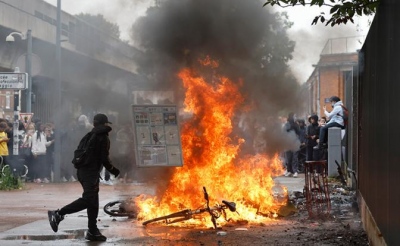
Nearly 50,000 people flooded Paris, Marseille, Lyon, and Toulouse against state terror, with demonstrations turning into fierce clashes with water cannons and dozens severely injured.
??? INSANE footage of the rioting in Nantes... Dude accidently set himself on fire while attacking the La Joliverie school. More than 1,000 have been arrested since the protests went nationwide on Tuesday. No sign of it slowing down yet... Writer: Mhedi https://t.co/pFGb43vKgz
— Mario Nawfal (@MarioNawfal) October 1, 2026
NEW: Schools set on fire, hundreds arrested, dozens injured as student protests spread across France https://t.co/QxHbxQDXUM
— Insider Paper (@TheInsiderPaper) October 1, 2026
Volatile situation
High school students are blocking access to classrooms, demanding the replacement of absent teachers and better infrastructure.
More than 300 schools across France, from Paris to Marseille, have become involved in the mobilizations.
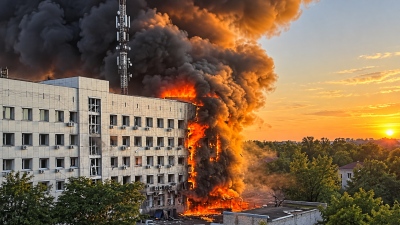
In Nantes, the reception area of the Nelson Mandela high school was destroyed by fire, which also spread to the building facade before being extinguished by firefighters.
The region of Provence-Alpes-Côte d'Azur denounced that at the Victor Hugo high school in Marseille, «the principal, the vice-principal, the secretary-general, and the head of staff were attacked and doused in gasoline».
According to information provided by the region, «the arson attempt took place inside the school, causing chaos in front of the high school».
«All staff took refuge inside to protect themselves, while police and the fire service rushed to the scene.
School administrators will file a lawsuit», the regional administration added, citing the crossing of an «unacceptable» line.
On Wednesday, September 30, 625 people were taken into custody and 83 police officers and gendarmes were injured.
Since the start of the blockades at the beginning of the week, 119 students and members of educational staff have been injured.
The IGPN, the so-called «police of the police», is conducting investigations into the actions of officers who severely injured youths participating in the protests.
Minister of the Interior Laurent Nuñez defends the actions of the police officers, speaking of «proportionality», yet, as is now common during demonstrations in France (from the Yellow Vests and pension reform to May 1 and student mobilizations), numerous excesses occur.
Many police officers are recorded on video appearing to violate rules of engagement, either striking students with batons when this does not appear necessary, or firing, at head height and from close range, tear gas or plastic projectiles capable of inflicting serious injuries.
In Tours, specifically, a youth was severely injured in the head and rushed to the hospital, following a probable strike from an LBD («defense ball launcher»).
This exceptionally difficult situation is further complicated because it has become subject to political exploitation, at the climax of the campaign for the presidency of the French Republic (the elections take place next spring).
The leader of France Insoumise, Jean-Luc Mélenchon, accuses the government and police of repressing protests with particular brutality in the suburbs, expresses full support for the youth, and calls upon members and political figures of the «insoumis» to take to the streets and position themselves between students and law enforcement.
The mayor of Saint-Denis, Bally Bagayoko, of France Insoumise, took to the streets alongside the youths and expressed solidarity with the protesters, singing and dancing with them, while also defending violent actions in response to police methods: «Violent reaction can be legitimate or understandable in the face of actions by law enforcement».
For this reason, the prefect referred him for «incitement to commit crimes».
The right and, specifically, presidential candidate Marine Le Pen, demands instead the restoration of order, attacking Mélenchon, who, according to her, «bears serious responsibility for the situation our country experiences today».
She accuses him of going «in front of high schools to incite the youth», calling «his supporters to insurrection», and sending «his lawmakers in front of schools».
The French government, which presents today, October 1, a difficult budget bill while facing a catastrophic situation in public finances, fears that mobilizations by high school students could expand beyond universities into other social strata, in an environment of high fuel costs and steadily declining purchasing power for middle and working-class households.
FRANCE RIOTS: A bus was hijacked and torched outside Lycée La Floride in Marseille during intensifying student protests. Over 1,065 minors have been arrested nationwide over poor school conditions, sparking severe security concerns. https://t.co/JE6MydZH8N
— HINT News (@9415st) October 1, 2026
French authorities detained 625 people as high school protests over teacher shortages, class sizes, long schedules and poor conditions escalated into clashes with police. The protests, which began around Paris and spread nationwide, affected 356 schools. At least 83 police and gendarmes and 119 students and staff have been injured since the unrest began. President Macron condemned the violence, while students said they were protesting for better conditions, not vandalism. https://t.co/u1evXsAMZZ
— Clash Report (@clashreport) October 1, 2026
Hellish domino effect
The contagion of revolt is now consuming the entire European Union.
In Portugal, transport, construction, and fishing have been paralyzed by convoys of trucks, as diesel prices skyrocketed from €1.59 to €2.22 per liter, driving logistics firms into a dead end.
Yet true chaos awaits Germany.
The largest industrial trade unions are preparing a paralysis in metallurgy and mechanical engineering. Hundreds of thousands of workers are taking to the streets while factories close one after another, leaving armies of unemployed in their wake.
A helpless Friedrich Merz and his staff watch the catastrophe unfold in dismay.
The political leadership of Europe has exposed its absolute, perilous impotence, while the continent sinks into darkness.
www.bankingnews.gr



Σχόλια αναγνωστών