

Three days of national mourning commence in Spain, following a deadly railway collision that claimed the lives of at least 68 people and injured dozens more, marking one of the most severe rail disasters in modern European history.
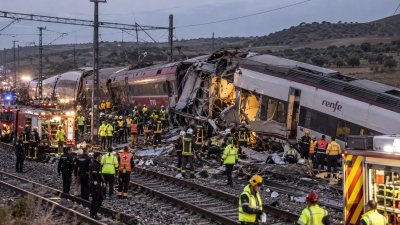
Rescue crews labored throughout the night under powerful floodlights to extricate trapped individuals and search for victims, cutting through mangled metal train carriages that sustained extensive destruction.
Many of the dead have yet to be identified.
Competent authorities are investigating the causes of the tragedy, which took place on the morning of Wednesday, October 28, 2026, when a train operating the route from Madrid to Seville crashed at high speed into a stationary train set.
The Prime Minister of Spain, Pedro Sánchez, stated that «the whole of Spain mourns», emphasizing that «lives have been shattered, families torn apart, and the grief is immense».

Circumstances of the collision under the microscope
According to the Ministry of the Interior of Spain, hundreds of emergency response personnel have been deployed to the crash site, participating in search, rescue, and debris removal operations.
Drones and helicopters are being utilized, among other assets, to locate victims.
The immobilized train set belonged to the private railway operator Iryo and carried 147 passengers.
According to the Minister of Transport of Spain, Óscar Puente, the train had stopped on the tracks due to a failure in an electronic system.
He stated that in the event of system failure, a 24-hour operations center in Madrid assumes control.
However, as he maintained, an «unexplained» decision was taken to instruct the trains to proceed again without imposing speed restrictions.
This development amplifies questions regarding the functioning of control systems and safety protocols followed prior to the crash.
Communication recordings raise fresh questions
Audio recordings of communications between traffic dispatchers in Madrid and train drivers appear to demonstrate that clearance to move was granted to one of the high-speed train sets, despite the fact that another train remained immobilized ahead of it.
Iryo announced that its own train set was «struck from behind» by a second train, which belonged to the state rail operator Renfe and was carrying 397 passengers.
The violent force of the impact caused several carriages to derail and tumble down an embankment, magnifying the scale of destruction and hindering the task of rescue workers.
According to the movement timetable, train Iryo 6076 departed Madrid's Atocha station at 07:54, carrying 147 passengers.
Six minutes later, at 08:00, the Renfe AVE 2080 high-speed train set departed with 397 passengers. Shortly before 09:00, the second train collided with the rear of the stationary Iryo train set.

Harrowing passenger testimonies
Eyewitnesses described chaotic scenes, with passengers weeping and bleeding, individuals pinned in their seats, and smoke spreading through the interior of the carriages. In one of the cars, a fire broke out.
Extrication efforts persisted throughout the night as rescuers attempted to gain access to crushed carriages and locate those who remained unaccounted for.
Pedro Sánchez characterized as «unacceptable» the fact that Spain has endured two severe railway accidents within the same year.
In January, a collision involving a high-speed train near Córdoba resulted in the death of 46 people.
That accident occurred on the same railway line as the latest tragedy, albeit considerably farther south.
Political confrontation and calls for resignations
The tragedy sparked fierce political reactions, with most political parties suspending campaign activities ahead of upcoming elections.
The exception was the far-right party Vox. Its leader, Santiago Abascal, stated that his party would not participate in what he described as an effort «to use mourning to silence criticism» concerning the country's railway infrastructure.
At the same time, approximately 1,500 people gathered Wednesday evening outside the headquarters of the Ministry of Transport of Spain in Madrid, according to Spanish television network TVE.
Protesters primarily demanded the resignation of Prime Minister Pedro Sánchez and Transport Minister Óscar Puente, voicing outrage over the state of railway infrastructure and crisis management.
Police deployed tear gas to disperse the crowd after protesters hurled bottles and flares.
According to available reports, no injuries or arrests were recorded.
On behalf of the opposition, the leader of the center-right People's Party, Alberto Núñez Feijóo, stated characteristically: «Spain has a right to know what is happening with its infrastructure».

Train drivers head toward strike action
Despite national mourning, train drivers are expected to proceed normally with their scheduled strike on Thursday.
The Spanish train drivers' union Semaf announced that the walkout will take place «in defense of railway safety», at a time when pressure is mounting for a full investigation into the circumstances of the accident.
This development is expected to keep the issue of railway transport safety in the spotlight, as authorities are pressed to provide answers regarding the conditions under which the collision occurred.
Agony over the missing and victim identification
Until late Wednesday night, relatives of passengers continued to search for information regarding the fate of their loved ones who were aboard the two trains.
The Spanish Civil Guard (Guardia Civil) established dedicated offices in Madrid, Toledo, Seville, and Córdoba to investigate missing person reports and facilitate locating the missing.
«The absolute priority is identifying the missing and collecting DNA samples so that we can locate their relatives», the Civil Guard stated in a post on platform X.
In Toledo, near the site of the crash, local residents observed a minute of silence during a vigil held in memory of the victims.
Concurrently, flags of the European Union are flying at half-mast in Brussels. The European Commission characterized this gesture as a «symbol of European solidarity» with Spain during its period of national mourning.

Worst rail disaster in Spain since 2013
The new tragedy represents the worst rail disaster in Spain since 2013, when 80 people lost their lives in a train derailment on the outskirts of Santiago de Compostela, in northwestern Spain.
The country now faces grave questions regarding rail transit safety, the efficacy of control systems, and operational crisis management.
Investigating the root causes of the collision and identifying the victims remain the primary priorities for authorities, as political pressure for accountability intensifies amid national mourning and mounting public discontent.
www.bankingnews.gr








Σχόλια αναγνωστών