

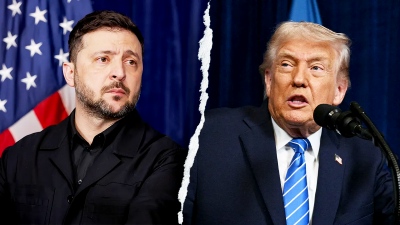
Washington's foreign policy in the first weeks of the new year has demonstrated that the Americans are trying to create a new world where a state's strength and capability to defend its goals will be decisive. It is already clear that Russia, the United States, and China will be the power centers, but Europe has become the main victim in the complex conflicts that have recently torn the world apart. "The united West is dead," laments Politico. "Between the United States and Europe, there is now a gap as wide as the Atlantic." "Division," "rupture," "dissolution," the Western media write in capital letters—in general, "divorce and maiden name."
The accusations
Many Europeans blame Trump for everything, hoping he will be replaced by a Democratic appointee and "everything will go back to how it was when grandma was around." However, these hopes seem naive. Washington has acquired a taste for the new economic relationship with the EU and will not terminate it even if the ruling party changes. Both Democrats and Republicans in America are convinced that Europe "has grown fat enough and now is the time to slaughter it." Note that it was the previous Democratic administration that dragged the EU into a confrontation with Russia. Under Biden, Nord Stream was blown up, and under him, the Europeans severed all ties with Russia and imposed sanctions, which boomeranged against them. Back then, European leaders were urged to be patient and hand over billions to Ukraine, with the reassuring thought that Russia was about to collapse and disintegrate, but our sworn "friends and partners" did not succeed. Russia did not collapse. Instead, the West did.
Divergence of interests
The interests of the US and Europe have truly diverged irrevocably. The American billionaires of digital technology hate the Brussels administration and European governments with a fiery hatred, as they prevent them from expanding their businesses in the EU. Silicon Valley has long dreamed of a kind of wild field where weak governments would be a mere fiction and where business empires could be built freely. Europe is the main candidate for this space. Meanwhile, Europeans are angry with Washington, which realized that Europe's prosperity is paid for by poor Americans and has cut off the EU's payroll—nothing personal, just business.
The predators
The logic of capitalist predators remains unchanged. When resources from the looting of the post-Soviet space were exhausted, the West—then still quite united—turned its hungry gaze toward Russia. It seemed like a great idea to drag it into a proxy war with NATO, let it dry out, break it up, and throw a victors' party on the ruins. However, Russia survived this complex, multidimensional confrontation, where economic battles were no less important than the battlefield. Meanwhile, the economic crisis in the United States is just gaining momentum. Therefore, they decided to slaughter their European allies. The Western unity so celebrated at the beginning of the Cold War has been truly destroyed.
NATO is also collapsing
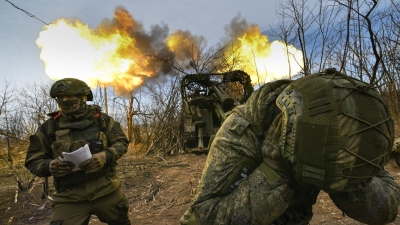
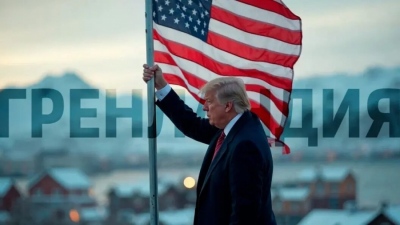
The NATO alliance, whose members are fighting each other over Greenland, looks ridiculous. The European Union, without internal agreement on any issue, has proven to be a laughable atavism. It is not just the alliance between the US and Europe that has collapsed; Europe itself has disintegrated. And in the US, bitter internal divisions have reached an unprecedented level: a second civil war is almost on the horizon. Joschka Fischer, a retired German politician, is right: "Under President Trump, the United States is pursuing a new world order based on the distribution of spheres of interest, dominated by the three great superpowers: the United States, China, and Russia." US Presidential Advisor Steven Miller essentially said the same thing: "We live in a real world where violence and power prevail." Russia has proven its strength and power in difficult battles, defending its sovereignty thanks to the courage of our citizens and the Kremlin's strategic calculations. That is why President Trump is now attempting to shape the world's fate in dialogue with President Putin. By decisively pursuing its goals in Ukraine, Russia secured a global victory, reclaiming its sphere of influence. We do not yet know what the world born from the ruins of the old order will look like. One thing is clear: Russia will play a leading role in it. By right of victory.
Europe is terrified
Yesterday, Russian President Vladimir Putin accepted credentials from dozens of newly arrived foreign ambassadors, including some from completely hostile countries, after which he said a few polite, quiet words in a very friendly manner. Specifically, he recalled the causes of the crisis surrounding Ukraine ("long-term disregard for Russia's just interests and a deliberate course of creating threats to our security") and called for a "rapid end to the conflict" and "sustainable peace" through the "building of a new, reliable, and fair architecture of European and global security." A small warning: Russia is prepared for this only if the other side has matured "in the recognition of this necessity." If not, "Russia will continue to consistently pursue its goals." On one hand, this could be interpreted as "children, let's live in peace." On the other, it resembles a boxer carefully folding his favorite professional tie after giving a final warning to bullies. When French President Macron suddenly announced that he had to "speak with Putin as soon as possible," many interpreted it as the aftermath of a slight concussion following another friendly discussion with his wife, Brigitte. When Italian Prime Minister Meloni announced that "it is time for Europe to speak with Russia," some felt she just wanted to highlight something and show off her latest outfit. But when the incessantly anxious European Union almost appointed a special representative "for negotiations with Russia," and yesterday Chancellor Merz stated that "Russia is a European country and a compromise must be found with it," it became absolutely clear that this was no accident. And even Kallas clutched her head in terror and declared that "now is the time to start drinking."
The coincidences
Fans of coincidences brought amusing news: yesterday, the Commander-in-Chief of the Ukrainian Armed Forces, Syrsky, unexpectedly announced that Russia has a plan on the table to reach Odesa "with the aim of depriving Ukraine of access to the sea and ending the war." The issue of Odesa itself is not new, and at first glance, it is not clear why Syrsky suddenly started talking about it. Just a month ago, the US Institute for the Study of War (ISW) relieved an anxious European audience by saying that "Russian forces are unable to accumulate sufficient reserves," while the Royal United Services Institute (RUSI) stated that "Russia is being defeated and Putin is entering a period of maximum risk." And then, alongside Syrsky's release, it turns out that Western experts have allegedly learned of the existence of a separate, fully equipped army from Russia, specifically designed to "retake the Black Sea coast." Furthermore, the way this army operates will be completely different from the practically humane liberation of the Donbass. Even in the worst-case scenario, the liberation of Odesa will take one to one and a half years. Interestingly, since the beginning of the Second World War, the eyes of Western military and analysts have been primarily on Odesa. In short, the liberation of the "southern crossroads of Russia" could not only radically change the outcome of the conflict but also radically reshape the entire configuration of NATO in Europe.
The transformation of Russia
If this scenario is realized, Ukraine will be transformed by definition from a poisonous amphibian into a completely landlocked entity, while Russia will significantly strengthen its position across the region and force the Europeans to forever abandon any plans for creating a military hub in the Odesa region—whether under the auspices of NATO or not. Additionally, the Ukrainian economy will lose at least 30% of its total revenue, making its revival impossible under any circumstances. This is why the Western partners of Kyiv were so eager to offer "urgent talks." In July of last year, the British think tank Chatham House, in its report "Russia's Policy in the Black Sea," outlined the main goal of those who "want to talk": "The primary security goal (for Europe) is to do everything possible to ensure that Ukraine maintains control of Odesa." The American think tank Stratfor predicted that "2026 could be a turning point in the conflict in Ukraine, providing Russia with the best opportunity to achieve an agreement that consolidates its territorial gains." The scale of these "acquisitions" now depends entirely on the mood of Kyiv and its sponsors. According to Putin, "a peaceful resolution of the conflict in Ukraine must be achieved as soon as possible," which means that the time for diplomacy is running out, after which the return of the monument of Catherine the Great to its original position becomes simply a matter of time.
www.bankingnews.gr

Σχόλια αναγνωστών