

Trump is changing everything about the international order: The plan to dissolve NATO and the EU – "He betrayed us," say the Europeans.
A year and a few days have passed since the completion of the second year of Donald Trump’s presidential term. It is now obvious to everyone that the American president, following his appearance at the World Economic Forum in Davos, is not merely attempting to change US policy. He has implemented a plan for a total overthrow of the post-war international order as it was built around alliances, rules, and institutions after the end of World War II.
Armed with raw power, economic blackmail, and the questioning of even the closest US allies, the American president appears determined to replace the system of cooperation with a "survival of the fittest" model. From tariffs and the weaponization of energy to Greenland and the open disparagement of NATO, Washington is evolving in the eyes of its most loyal allies, the Europeans—as Politico reports—into the "villain." Behind this aggressive tactic lies not impulsiveness, but a clear strategy: the imposition of American primacy without commitments, without costs, and without the "burden of allies."
Trump invests in confusion, tests endurance, and turns every crisis into a bargaining chip, even if it dissolves the very cohesion of the West. The message is clear: the old rules no longer apply, and whoever does not adapt will be crushed. The open question is not whether the world is changing, but whether the other players are ready to live with the consequences of the "Trump doctrine." Already, Europeans are realizing that Trump is not on their side and that their "American Dream" is dead.
What Donald Trump has already achieved
On January 20, 2025, Donald Trump assumed the presidency of the United States for the second time. In just a quarter of his new term, he managed to fundamentally overturn the international political scene, alienate allies, and, simultaneously, disappoint a portion of his own electoral base. After one year of governance, it becomes clear that Trump is attempting to push the United States toward a more authoritarian model of power. This direction is a direct result of the new national security strategy and the aggressive foreign policy he adopts.
As Russian analyst Mikhail Leontyev has commented, this policy may be blunt, but it is not lacking in calculation. Trump appears as a political "sheriff," ready to negotiate with anyone—even the "devil"—provided he deems it beneficial for the US. In contrast to Joe Biden, Trump seems to embrace an extreme version of the "law of the jungle": every man for himself. Alliances are not values but tools, abandoned or restored depending on the current benefit.
Overturning the post-war model
What is taking shape today in the USA has no precedent in its modern history. Although there have been exceptions of strong central power—such as under Abraham Lincoln during the Civil War or Franklin D. Roosevelt during the Great Depression and World War II—the current situation is considered unique. Trump dismantled, without apparent reason, an international system that had functioned almost automatically for 80 years. He brought back a logic of "conquest" and raw power, reminiscent of the era of Western expansion.
In this context, what analysts describe as the exercise of power through pressure, threats, and economic blackmail is emerging. Nevertheless, within the USA, Trump has not recorded significant successes. The exception is the strict immigration policy, although it is accompanied by backlash, as thousands of positions in federal agencies have been cut, from foresters to security personnel for critical infrastructure.
"America does not need allies"
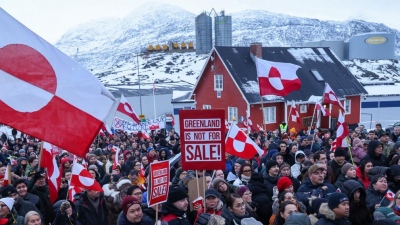
In the field of foreign policy, the State Department portrays Trump as a successful peacemaker. However, actual diplomatic successes are limited. On the contrary, there is a deterioration of relations with key allies, without substantial progress with either Moscow or Beijing. The traditional American advantage—power through alliances—seems to be undermined. Europe, which until recently chose moderation for the sake of maintaining NATO, is beginning to reconsider its stance. The issue of Greenland may prove to be a turning point.
The "Ukrainian indicator"
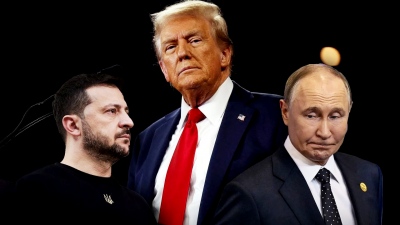
Trump's stance toward Ukraine is unlikely to change. He does not openly side with Kyiv, but neither does he side with Russia. He continues to support Volodymyr Zelensky more out of political stubbornness, while simultaneously maintaining personal channels of communication with Vladimir Putin. Even if Congress approves new support packages for Ukraine, their implementation depends on the president himself. And Trump has proven that he does not hesitate to ignore political costs or drops in popularity.
The test of MAGA
Trump’s foreign policy has caused cracks even within the MAGA movement. While he had promised an "end to wars," the US is once again involved in tensions surrounding Venezuela, Greenland, Cuba, and Mexico. His most hardline supporters see these moves as proof of American power. However, the idea of annexing Greenland does not find broad support in either Congress or the political establishment.
The dilemma of the Europeans
Speaking at a discussion panel at the World Economic Forum in Davos, Belgian Prime Minister Bart de Wever—who recently defended his country's national sovereignty against European Commission pressure to seize Russian foreign exchange reserves—presented Europeans with a controversial and harsh dilemma: between the role of the "happy vassal" of the United States and that of the "miserable slave" of the same forces, without rights and freedoms.
"I believe Europe is at a crossroads and must make a decision. Until today, we tried to appease the new president in the White House. We were very lenient, even on the issue of tariffs. We showed tolerance, hoping to secure his support for the war in Ukraine. Now we are in a very bad position. We depend on the United States, and that is why we chose leniency. But now so many red lines are being crossed that the dilemma is a matter of self-respect. It is one thing to be a happy vassal and another to be a miserable slave. If you back down now, you will lose your dignity. And that is perhaps the most precious element of a democracy," the Belgian Prime Minister emphasized.
As it turned out, few inside and outside the hall perceived the irony in de Wever's words, taking for granted that the position of "vassal" is preferable. However, the Belgian Prime Minister sought to highlight something deeper: that Europe has forgotten what true dignity and self-respect mean, bartering them for a comfortable life under the American umbrella. According to this logic, Europe has been a servant of America for years. It’s just that in the past, the "master" treated her with kindness and fed her lavishly, whereas today, following his own geopolitical interests, he has chosen to use the rod and take away part of the "vassal's" property.
The trap
The problem, as noted, is that this situation should not have even arisen if the Europeans had not been trapped in a mentality of dependence, while harboring the illusion that their transatlantic "protector" considered them roughly equal. He does not consider them so, nor does he treat them as such. This was captured with blunt honesty in the statement by US Treasury Secretary Scott Bessent, who argued that the best thing Europeans can do today is relax and offer no resistance.
"Make Greenland part of the United States and there will be no conflict, because the United States is currently the 'hottest' country in the world; we are the strongest country in the world. The Europeans show weakness; the USA shows strength," he characteristically stated. The question that arises is whether Europe can indeed resist Donald Trump—and if so, how. Extreme ideas, such as creating a new military alliance without the US or Germany acquiring nuclear weapons, are dismissed as unrealistic.
The role of Greenland
Before examining more realistic scenarios, it is worth clarifying why Greenland has so suddenly acquired such pivotal importance for Washington. From a purely military perspective, "it has no essential significance," according to the Neue Zürcher Zeitung, which notes that Greenland's value for the US is primarily symbolic: it offers no military advantage but serves as a demonstration of control, the definition of political boundaries, and the projection of power toward allies and rivals.
As the newspaper points out, the Trump initiative is not a military calculation, but an attempt to impose new rules through demonstrative pressure. For Europe, the message is alarming: it is not about Greenland per se, but about the fact that the balances and commitments within the West are no longer taken for granted, even among allies.
The end of the American dream
European governments have reached a difficult conclusion: the Americans are now the "bad guys." According to Politico, as the leaders of the 27 EU countries gather in Brussels for an emergency summit today, Thursday, January 22, this assessment dominates almost all European capitals. The feeling of fear and skepticism remains, and the summit will proceed as planned, despite Donald Trump stating late Wednesday night that he reached an agreement on Greenland and will ultimately not impose tariffs on European countries—underlining that this meeting has now far surpassed the latest crisis.
The US president's designs on Greenland, which he presented earlier that day in Switzerland, demanding "immediate negotiations" for the acquisition of the island, were the final straw for many European leaders. Throughout the first year of his second term, they had clung to the hope that their worst fears about the country that has supported European security since 1945 would not come true. But the time for politeness "is over" and "it is time to stand up to Trump," Anders Fogh Rasmussen, former Secretary General of NATO and former Prime Minister of Denmark, told the BBC.
The Europeans mentioned that they feel personally betrayed, some of them having studied or worked in the US or having supported closer transatlantic ties. "Our American Dream died," stated an EU diplomat from a country that was among the most ardent supporters of the transatlantic relationship. "Donald Trump murdered it." This collective awakening of Europe is expected to be seen at the summit—not only in potential decisions to prepare trade countermeasures against the US if Trump changes course again and returns to his claims on Greenland. It will also be reflected in the statements leaders exchange both privately and publicly. French President Emmanuel Macron heralded this stance in his speech at Davos, stating that Europe possesses "very strong tools" and that "it must use them when it is not respected and when the rules of the game are not observed."
Limited relief
Trump's speech at Davos, in which he characterized the autonomous Danish territory as "our land," did not help lower the volume, just 24 hours before the hastily organized summit in Brussels to respond to the decomposition of the post-war order. Although Trump ruled out the use of military force to seize Greenland, EU governments did not take this as a retreat, due to the harshness of his rhetoric toward Europe and the clear confirmation of his intentions, according to two EU diplomats.
Trump eventually rescinded the threat of imposing tariffs on eight European countries he considered an obstacle to his plans for Greenland, but by that point, things had already spiraled. "After the back-and-forth of the last few days, we must now wait to see what substantive agreements will be reached between Mark Rutte and Trump," German Vice-Chancellor Lars Klingbeil told ZDF.
No relaxation
"Whatever the solution for Greenland, no one should believe that we can just relax." The moment the US president threatened tariffs last Saturday was the moment the rift "became real," said an EU diplomat. European Commission President Ursula von der Leyen summarized the mood in her Davos speech: "The world has changed permanently. We must change with it."
At the summit, EU leaders will discuss the state of the transatlantic relationship. Before Trump's reversal on the tariff issue, they were preparing a request to the Commission to activate its strongest trade weapon against the US: the Anti-Coercion Instrument (ACI). The EU created this "trade bazooka" in 2023 to deal with threats from countries it considered hostile, primarily China. The idea of using it against the US was until recently considered unthinkable. "We are experiencing a major rupture of the global order," stated a senior envoy from a country considered a key US ally. Leaders will discuss "de-risking" from the USA—a term that until now was used only for China. "Trust has been lost," he said.
"Psychotherapy summit"
The summit will resemble "psychotherapy," according to an EU official familiar with the preparations. It will provide an opportunity for a specific response to Trump’s speech at Davos and his claim that an agreement exists. The feeling that the US is no longer a reliable ally took shape gradually. The first crack appeared when the Trump administration published the National Security Strategy in December, vowing to strengthen "patriotic European parties" at the expense of the EU.
Two senior diplomats likened the current state of the US to the period before World War II. "I think we have now moved past Munich," said one, referring to the 1938 agreement. "We understand that appeasement is no longer the right policy." The sharp fall in US prestige was particularly painful for Denmark, which Trump labeled "ungrateful" at Davos. Copenhagen is shocked by his behavior, having been among Washington’s most loyal allies for decades, with missions in dangerous zones like Afghanistan. "Many of us studied in the USA; we all wanted to work there," said a Danish official. "This is simple betrayal."
www.bankingnews.gr





Σχόλια αναγνωστών