

The aircraft carrier USS Abraham Lincoln has entered CENTCOM waters in the Indian Ocean, and we are now just one step away from a strike. According to a high-ranking American official who spoke to Fox News, reports indicate that the Iranian Supreme Leader, Ayatollah Ali Khamenei, is currently in a bunker, suggesting the country may be preparing for military action. A top American drone expert told Fox on Sunday that swarms of Iranian drones would pose a "credible and serious threat" to the USS Lincoln and its strike group.
Cameron Chell, CEO and co-founder of Draganfly, told Fox that Iran has created "an effective asymmetric threat against advanced military systems" with its fleet of unmanned drones, combining "low-cost warheads with cheap delivery platforms." According to Chell, Iran can launch large numbers of relatively simplistic drones directly at warships, creating saturation attacks that could overwhelm traditional defenses. "If hundreds are launched in a short period, some will almost certainly get through," he explained. "Modern defense systems were not originally designed to handle these types of saturation attacks. For US surface ships operating near Iran, the warships are primary targets," he added.
Say goodbye to your homeland, you won't see it again
"American military personnel should say goodbye to their families in the event of an attack on Iran." This cynical yet highly realistic statement was posted on social media by Ebrahim Azizi, head of the National Security and Foreign Policy Committee of the Islamic Republic's parliament. "I hope that if America makes a mistake based on the miscalculations of a misguided president, its soldiers in the region will say goodbye to their families," he wrote.
Yemen's Houthis threaten new strikes on ships in the Red Sea
Meanwhile, the Iranian-backed Houthis of Yemen are threatening new attacks on ships passing through the Red Sea maritime route, likely in support of Iran. Tehran expresses concern over the approach of the American aircraft carrier following threats from President Donald Trump of military action due to the crackdown on mass protests in the country. A short video released by the Houthis already includes published footage of a ship on fire, with the caption: "Soon." The rebels provided no further details but have already attacked over 100 ships in the Red Sea as part of a campaign they claim pressured Israel due to its war against Hamas in the Gaza Strip.
The Houthis had suspended strikes following a ceasefire in the conflict but have repeatedly warned they can resume attacks if necessary. Over the past two years, the Houthis have also launched hundreds of missiles and rockets at Israel. The Houthi threat comes as the aircraft carrier USS Abraham Lincoln and accompanying destroyers head toward the region. Trump has stated that the ships are moving "just in case" he decides to take action against Iran. The US President has already set two "red lines" for a potential attack: the killing of peaceful protesters and mass executions of prisoners by Iran as part of the extensive crackdown on demonstrations.
Message of threat toward the US
Iranian authorities revealed on Sunday, January 25, 2026, a new mosaic on a giant billboard in a central Tehran square, sending a direct warning to the United States not to attempt a military strike against the country while American warships head toward the region. The image depicts, from an aerial perspective, an aircraft carrier with destroyed and burning fighter jets on its deck. The deck is littered with bodies and covered in blood, which flows into the sea behind the ship, forming a pattern reminiscent of the stripes of the American flag. In one corner of the mosaic, the slogan dominates: "If you sow the wind, you will reap the whirlwind."
Target: USS Abraham Lincoln
The unveiling of the mosaic at Enghelab Square takes place while the aircraft carrier USS Abraham Lincoln and its accompanying warships move toward the area. US President Donald Trump stated that the ships are moving "just in case" he decides to proceed with military action. "We have a massive fleet heading there and we might not have to use it," Trump said on Thursday.
Enghelab Square is frequently used for state-organized rallies, and authorities regularly change the square's mosaic according to national or political circumstances. On Saturday, the commander of the paramilitary Revolutionary Guard warned that his force is "readier than ever, with the finger on the trigger." Tension between the US and Iran has escalated sharply following the violent suppression of nationwide protests, during which thousands were killed and tens of thousands arrested. Trump had threatened military action if Iran continued killing peaceful protesters or proceeded with mass executions of prisoners. No new protests have been recorded in recent days, while Trump recently claimed that Tehran suspended the planned executions of approximately 800 arrested protesters—a claim Iran's top prosecutor called "completely false."
All scenarios open
However, Trump has made it clear that he keeps all options open, stating on Thursday that any military action would make the American strikes of last June against Iranian nuclear facilities "look like peanuts." U.S. Central Command announced via social media that US Air Force F-15E Strike Eagle fighters now have a presence in the Middle East, noting that the aircraft "enhances combat readiness and promotes regional security and stability." Similarly, the British Ministry of Defence announced on Thursday that it deployed Typhoon fighters to Qatar "with a defensive character."
The protests in Iran began on December 28, triggered by the collapse of the Iranian currency, the rial, and spread rapidly across the country. They were met with violent repression by Iran's theocratic government, which does not tolerate dissent.
Increase of American power in a sensitive region
As US-Iran tensions sharpen after a brief pause, the United States has accelerated the deployment of significant military assets to the Middle East, sending a message of readiness while maintaining open options. According to the Associated Press, the Pentagon has moved fighter aircraft and a carrier strike group along with accompanying warships to the region, while US President Donald Trump continues to warn of potential action due to Iran's crackdown on protests. Meanwhile, Iran reacted with its own warning on Sunday, as authorities presented a mosaic in Tehran's Enghelab Square depicting a destroyed aircraft carrier, suggesting retaliation in case of an American attack.
F-15 Fighters
One of the most visible moves is the deployment of US Air Force F-15 fighters. US Central Command reported on social media that F-15E Strike Eagles now have a presence in the Middle East, enhancing operational readiness and promoting regional security and stability, as reported by the AP. Designed for air superiority and precision strikes, the F-15s can reach speeds over Mach 2 and carry advanced air-to-air missiles and guided bombs. Their presence allows for rapid response to threats in the Gulf, strengthening US control over the region's airspace.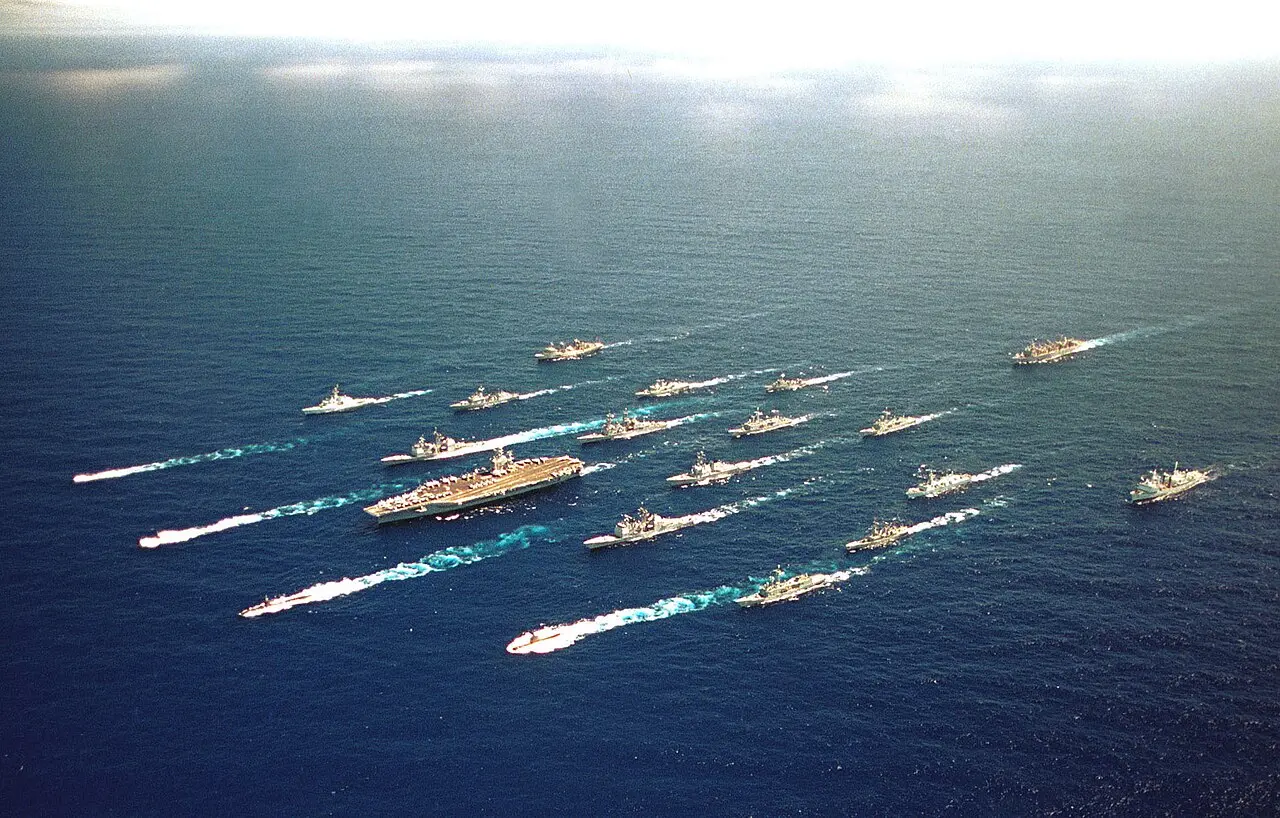
USS Abraham Lincoln
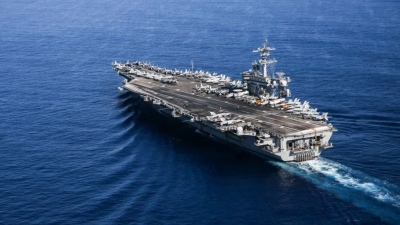
At the center of the deployment is the nuclear-powered aircraft carrier USS Abraham Lincoln (CVN-72). The Nimitz-class carrier functions as a floating airbase, capable of conducting continuous air operations without dependence on regional infrastructure. Its arrival in the region places American attack aircraft in direct range of potential crisis points, increasing US military power.
Fifth-generation power from the deck
The aircraft carrier has a capacity of 90 aircraft. CVW-9, which belongs to Carrier Strike Group (CSG) 3 and the USS Abraham Lincoln, includes eight squadrons with F-35C Lightning II, F/A-18E/F Super Hornets, EA-18G Growlers, E-2D Hawkeyes, CMV-22B Ospreys, and MH-60R/S Sea Hawks. The F-35C can evade radar while sharing real-time targeting data across the fleet, while the Super Hornets carry a wide range of air-to-air and precision weapons for sustained operations.
Cruisers and destroyers
Accompanying the aircraft carrier are the Arleigh Burke-class destroyers USS Frank E. Petersen, Jr. (DDG-121), USS Spruance (DDG-111), and USS Michael Murphy (DDG-112), along with the guided-missile cruiser USS Mobile Bay. An aircraft carrier strike group may also include a nuclear-powered stealth submarine, although its location is rarely disclosed publicly. These ships are equipped with Vertical Launch Systems, capable of firing Tomahawk Land Attack Missiles, providing long-range strike options for targets hundreds of miles inland.
www.bankingnews.gr








Σχόλια αναγνωστών