

The Iranian currency, the rial, collapsed once more today, January 27, 2026, hitting a historic low of 1.5 million per dollar, as the country plunges into unprecedented protests triggered by a deepening economic crisis. Exchange bureaus offered this rate while Iran continues to suffer under harsh international sanctions, primarily due to its nuclear program, as well as significant mismanagement by government officials. The demonstrations began on December 28 following a sharp drop in the rial's value and quickly spread nationwide. The theocratic regime's response has been violent and severe, with the scale of the crackdown gradually being revealed as the country endures over two weeks of a total internet blackout—the most extensive in its history. Activists report that the death toll has exceeded 6,126, while many more remain missing.
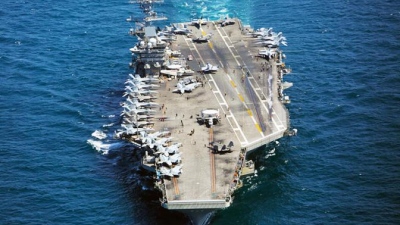
USS Abraham Lincoln aircraft carrier in the region
At the same time, a U.S. air force contingent has arrived in the region, centered around the aircraft carrier USS Abraham Lincoln and its escort destroyers, providing the United States with the capability to strike Iran despite indications that Gulf states wish to remain outside such a conflict. Simultaneously, two Iranian paramilitary organizations in the Middle East expressed their readiness to conduct attacks, potentially in support of Iran, following threats from U.S. President Donald Trump regarding military action should Iran violently suppress peaceful protesters or proceed with mass executions. Iran has repeatedly threatened to involve the entire Middle East in a war, although its defense forces and military are still reeling from the conflict initiated by Israel in June. The Houthis and Kataib Hezbollah organizations avoided participation in the 12-day war between Israel and Iran, highlighting the uncertainty prevailing within the so-called "Axis of Resistance."
New death toll estimates from activists
The latest data comes from the U.S.-based Human Rights Activists News Agency, which has confirmed hundreds of deaths in previous Iranian protests based on reports from local activists. The organization reports at least 5,777 dead protesters, 214 members of government security forces, 86 children, and 49 civilians who were not participating in the demonstrations. Furthermore, over 41,800 arrests have been carried out. The Iranian government provides a significantly lower figure of 3,117, labeling many of the deceased as "terrorists," while the Associated Press has not independently confirmed the toll due to the internet disruption and communication blackout.
Countdown to a strike on Iran
The correlation between the visit of General Brad Cooper, Commander of U.S. Central Command (CENTCOM), to Israel and the Chinese airlift to Iran is considered decisive amidst escalating military tensions and a strategic race in the region. Chinese intelligence circles, along with military, defense, and security officials, analyze General Cooper's visit to the region and Israel as preparation for a potential military strike against Iran, as reported by Modern Diplomacy. General Cooper arrived in Israel on January 24, 2026, for high-level meetings with the Israeli Chief of General Staff, Lieutenant General Eyal Zamir, as well as the Air Force Commander. This visit occurs under conditions of heightened Israeli and American readiness for a possible military strike against Iran and the coordination of defensive and offensive operations in the event of a generalized conflict between the two sides. Chinese field and journalistic reports in late January 2026 indicate a close strategic link between General Cooper's visit and the coordination of a potential military strike. The visit is perceived as part of an intense arms race and military coordination in the region between Israel and the United States on one side, and China, Russia, and their ally Iran on the other.
China's concerns and U.S.-Israeli military alignment
China's concerns stem from the arrival of the CENTCOM commander, Brad Cooper, in Israel on January 24, 2026, amidst increased alert and American threats of a preemptive military strike against Iran. Chinese anxiety was amplified by General Cooper's meetings with the Israeli Chief of Staff, Eyal Zamir, and the commander of the Israeli Air Force. The goal of these contacts was to strengthen joint defensive and offensive coordination between Washington and Tel Aviv against Tehran and to finalize U.S.-Israeli military plans regarding the Iranian issue. These developments were monitored closely by relevant circles in Beijing.
The Chinese airlift as a direct response
The Chinese airlift to Iran arrived as defensive support for Tehran, coinciding with General Cooper's visit to Israel. This aligns with leaks from American and Israeli sources regarding strong Chinese support for Iran against any potential military strike. Israeli military and intelligence reports published in newspapers such as "Maariv" stated that more than 16 Chinese military transport aircraft landed in the Iranian capital, Tehran, within just 56 hours. It is estimated that the Chinese military aircraft carried advanced air defense systems, electronic warfare equipment, and potentially anti-ship missiles, aiming to bolster Iran's defensive capabilities against an imminent U.S.-Israeli attack. This military cooperation is part of a broader framework of long-term strategic, military, and intelligence agreements between China and Iran, such as the "25-year agreement," which involves massive Chinese investment in exchange for oil supplies.
China, Russia, and the changing balance in the Middle East
The Chinese airlift comes just days after similar moves by Russian military transport aircraft, which conducted approximately six flights in January alone. This represents an unusually high level of military activity in the region compared to previous periods. China's primary goal in sending military transport aircraft to Iran is to shift the balance of power in the Middle East in favor of Tehran and at the expense of Tel Aviv. This rapid Chinese airlift is considered an unprecedented move to break American air superiority in the region and protect Chinese interests in Iran. This significantly complicates the military calculations of General Cooper and the Israeli side before any decision to attack, especially due to the strategic timing of Chinese support. The two events are linked as a clear Chinese message to Washington that any military escalation against Tehran will be met with immediate Chinese logistical and technical support. Thus, General Cooper's visit to Israel is not merely U.S.-Israeli defense coordination but part of a wider confrontation between major international powers like China and the United States.
What the Chinese military aircraft carried
Regarding the characteristics of the Chinese military transport aircraft headed to Iran, reports mention the use of the Chinese Y-20. The Y-20 is considered the primary strategic transport aircraft of the Chinese military and has the capacity to carry over 60 tons of heavy military equipment, including advanced air defense systems or ballistic missile components. It is estimated that these Chinese flights transported advanced long-range air defense systems to Iran, such as the HQ-9B, a counterpart to the American S-300, to enhance the protection of sensitive facilities, as well as specialized electronic warfare equipment for radar jamming, ballistic missiles, and modern Chinese suicide drones. Iran has announced its full transition to the Chinese BeiDou satellite navigation system as an alternative to GPS, which enhances the guidance accuracy of its weapons and detaches it from American and Western control. Additionally, China has supplied Tehran with a plethora of missile components, including industrial materials and solid fuels like sodium perchlorate, to support the production of hundreds of Iranian ballistic missiles.
Internationalization of the conflict
In terms of the timing and context of Chinese military support for Iran, this airlift is taking place amidst escalating regional tensions and threats of a potential U.S.-Israeli strike. Chinese support aims to replenish Iran's strategic stockpiles and strengthen its defensive capabilities. For this reason, the Chinese military aircraft adopted a policy of secrecy, turning off their transponders before entering Iranian airspace. Neither Tehran nor Beijing issued official announcements regarding the nature of the cargo. The coincidence of the Chinese military missions with the arrival of the CENTCOM commander in Israel reflects a state of maximum alert in the region.
www.bankingnews.gr









Σχόλια αναγνωστών