

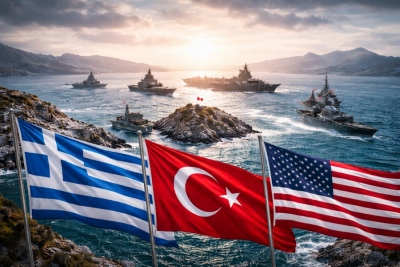
The announcement by American President Donald Trump regarding the new Peace Council has sparked intense concern in Athens. The Greek government is attempting to maintain a delicate balance: aligning with the EU to protect its interests in the Eastern Mediterranean against Turkey, while simultaneously cultivating closer ties with Washington, according to a report by Euractiv. Trump’s move has raised fears that the United Nations and international law—the cornerstones of Greek foreign policy—might be sidelined or weakened. Greece, along with 24 other EU member states, will abstain from the Peace Board, while neighboring Turkey is set to participate.
From the Middle East to the Eastern Mediterranean
Initially, the Council was designed to address the crisis in the Middle East, but following Trump’s presentation at the World Economic Forum in Davos last week, it acquired broader significance, suggesting it could become a permanent body. This has caused alarm in European capitals that it could effectively marginalize the UN. Prime Minister Kyriakos Mitsotakis stated that the Peace Board must be restricted to Gaza, signaling anxiety that pending disputes in Greece’s region could otherwise fall under its jurisdiction.
Turkish claims and energy interests
Turkey and Libya have long-standing disputes with Greece and Cyprus over maritime borders in the Eastern Mediterranean. Greece has ratified the International Law of the Sea (UNCLOS) and invokes it against Ankara’s claims, whereas Turkey is not a signatory. This political deadlock has for years hindered the exploitation of unexplored Mediterranean natural gas and oil deposits.
However, Trump’s business-oriented approach could pave the way for a political deal in the region. According to George Tzogopoulos, a senior fellow at ELIAMEP, the intensity of American actions could lead Ankara toward a model where regional players "solve issues among ourselves, with Trump’s America as a mediator," bypassing the UN.
Meetings and energy agreements
Under Trump’s second term, American energy giants Chevron and ExxonMobil have entered into agreements with all major regional players—Greece, Turkey, Cyprus, and Libya. Greek and Turkish officials met last week in Athens to discuss a "positive agenda," aiming to manage tensions and identify areas of cooperation. The leaders are scheduled to meet again on February 12.
Athens’ difficult balancing act
There is no indication that Mitsotakis–Trump relations have deteriorated, although the two leaders have not yet met. Conversely, Trump met with President Recep Tayyip Erdoğan in September. Mitsotakis’s attempt to limit the scope of the Peace Board has drawn criticism from the opposition. Yiannis Maniatis, an MEP and former Energy Minister, emphasized that Greece must oppose any initiative that undermines international law and should instead move toward strengthening European defense and security.
Diplomatic correlations within the EU
Greece is coordinating with other European partners who view the initiative as problematic and potentially contradictory to international law. The European Commission has consistently supported Greece and Cyprus and will seek to limit the reach of the Peace Board through negotiations with Washington. The participation of countries like Hungary was expected, but Bulgaria’s decision caught Brussels by surprise, as the country is currently governed by a caretaker administration. As a diplomatic source commented, "Someone in Sofia seems to be trying to score points in Washington."
www.bankingnews.gr



Σχόλια αναγνωστών