

The tension between Greece and Turkey is emerging as a permanent threat to the Eastern Mediterranean, which escalated further after Athens entered into a closer strategic alliance with Israel.
The issue recently took on dramatic dimensions following statements by Foreign Minister Giorgos Gerapetritis that Athens intends to extend its territorial waters, despite serious disagreements with Ankara.
The Aegean at the center of confrontation
At the heart of Greek Turkish maritime disputes lies the Aegean Sea, and in particular the islands located within it.
While the international community considers that they are entitled to a continental shelf and territorial waters up to 12 nautical miles, Turkey views the islands as an extension of Anatolia.
According to the Turkish version, earthquakes allowed the penetration of waters between the mainland and the islands, including Cyprus.
This perception gap led to a compromise, today each island is considered entitled to only six nautical miles.
At the same time, each side is pursuing its own strategies.
Greece signed delimitation agreements with Italy and Egypt, while Turkey proceeded in 2019 with an agreement with Libya, completely ignoring international treaties and creating an artificial maritime boundary between Ankara and Tripoli, without the participation of the Greeks.
The issue is further complicated by Cyprus, where Turkey recognizes only the Occupied Territories and claims maritime rights.
“The strategic alliance with Israel gives courage to Athens”
Dr. Cohen Yinarog, an expert on Turkey at the Moshe Dayan Center of Tel Aviv University and at the Jerusalem Institute for Strategy and Security, explains that the Greeks, after completing agreements in the Ionian Sea and the Aegean, want to achieve a unified policy, knowing that international law supports them.
“The alliance with Israel gives them the courage to do it.
This is a chess game, in which Greece is trying to create something outside the established framework.
Until now they followed specific strategies and remained within the status quo, but now they want to add a new element,” notes Dr. Cohen Yinarog.
The alliance with Israel gives Greece access to advanced military equipment.
About one month ago, Athens approved the purchase of PULS missile systems from Elbit, worth approximately 750 million dollars.
At the next stage, a broad procurement from Israel is planned of air defense systems from Rafael and Israeli Aerospace Industries, with a total value of approximately 3 billion dollars.
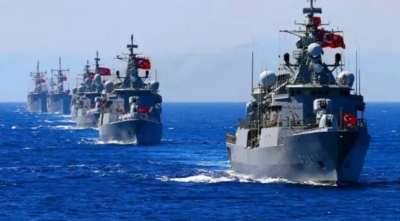
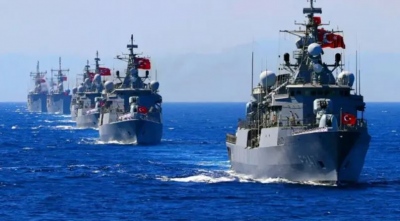
Turkey reacted militarily
Ankara is watching developments with concern.
In 1995, when President of Turkey Recep Tayyip Erdoğan was still Mayor of Istanbul, the Turkish parliament had approved intervention in the event that Greece extended its territorial waters beyond six nautical miles.
International law does not intimidate the Turks, who return to their geological arguments regarding earthquakes, claiming that they alter the geographic framework.
The Turkish Navy sent vessels westward to prevent the installation of submarine cables that would connect the electricity grids of Greece, Cyprus, and Israel, increasing their energy security.
“From a Turkish perspective, Greece is touching red lines that were not drawn by the Erdoğan government, but across generations,” emphasizes Dr. Cohen Yinarog.
“Turkey believes that Greece dares because of its alliance with Israel.
The strategic alliance with Greece and Cyprus has practical results and influence on the ground.
However, Turkey will not remain inactive, it will not let this pass, and will most likely attempt to challenge and undermine Greek sovereignty.”
NAVTEX and permanent presence
Turkey announced this week a NAVTEX in a specific area of the Aegean for two years, citing scientific research.
The Turkish outlet Hürriyet reports that this move is considered a step toward permanent Turkish presence.
In Greece, Erdoğan’s move is perceived as an attempt by Ankara to create faits accomplis and to block the extension of Greek territorial waters to 12 nautical miles.
Greek analysts estimate that this is the first in a series of steps, where Turkey may use its naval fleet for shows of force, fearing that Greece will undertake actions that, according to Ankara, would constitute a cause for war.
www.bankingnews.gr










Σχόλια αναγνωστών