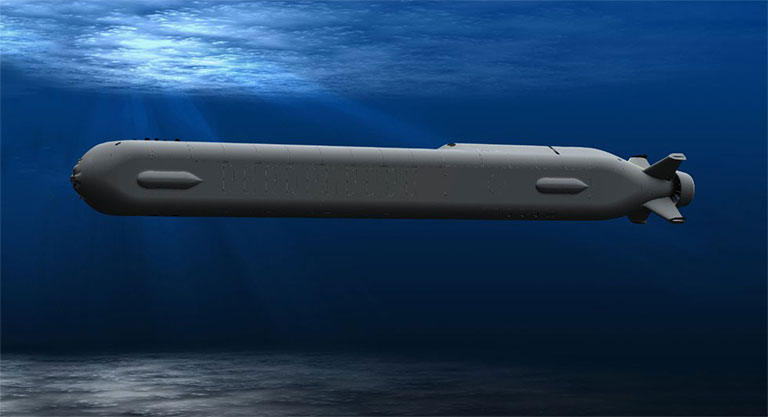
A new era in naval dominance is being inaugurated by the United States with the entry into service of the Orca XLUUV, the largest unmanned submarine of the U.S. Navy, redefining the capabilities of autonomous operations in the depths of the oceans.
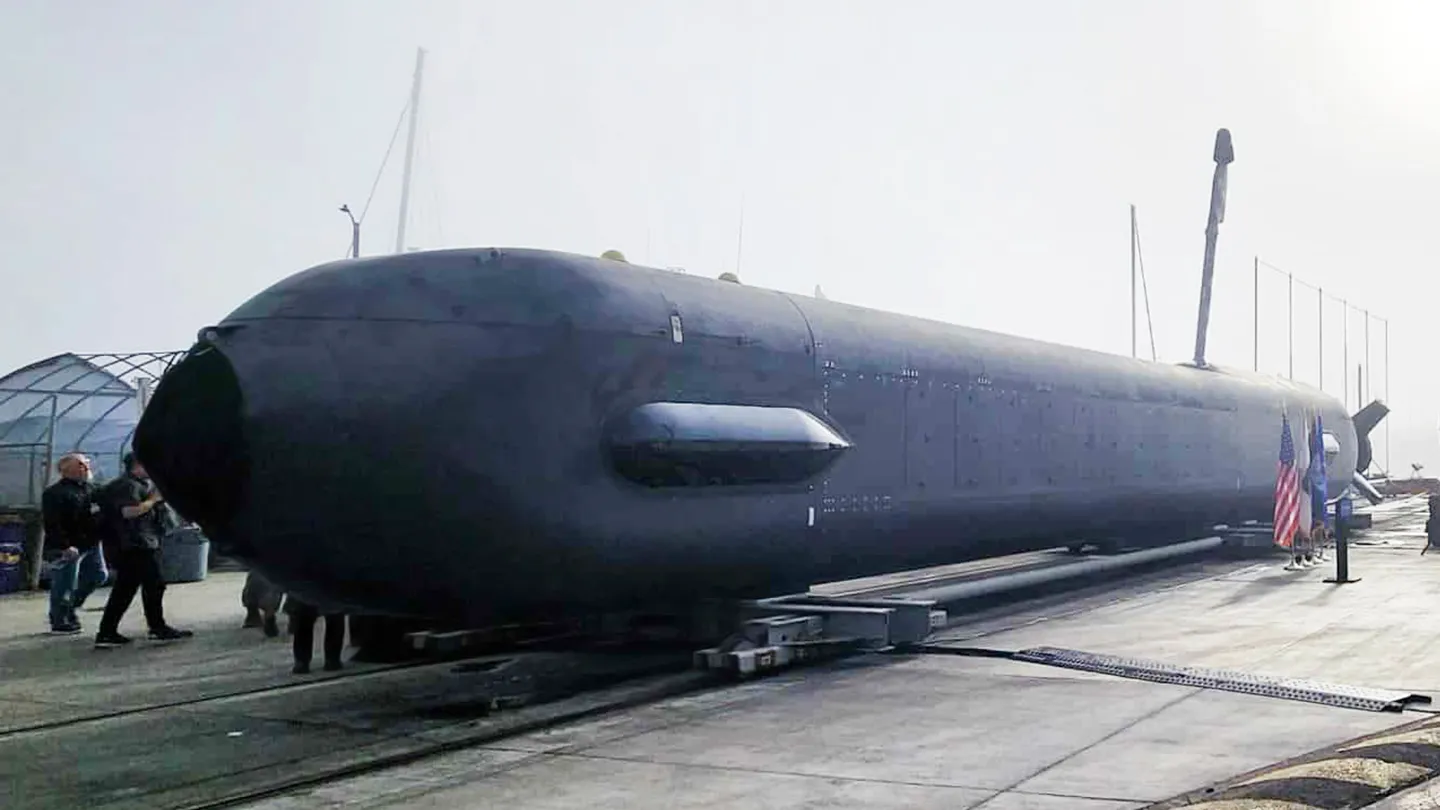
With a length approaching 26 meters, this vessel is not merely a drone, but an autonomous underwater platform capable of patrolling for entire months without the need for human intervention or a support vessel.
Technological superiority and a 12.000 kilometer operational range
The heart of the Orca is the product of cooperation between Boeing and Huntington Ingalls Industries.
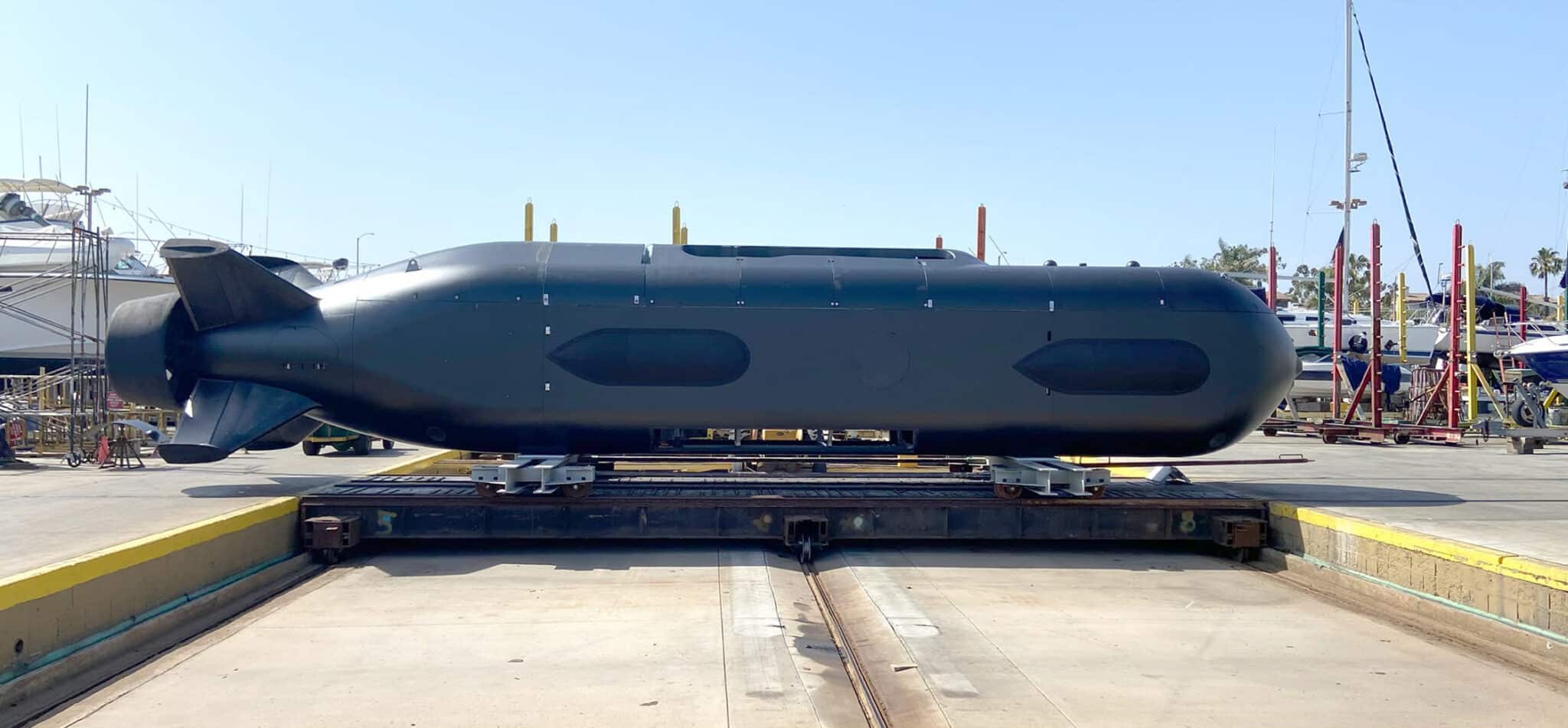
Boeing assumed the contract in 2019, and the first Orca prototype appeared in 2023, while three additional vessels are being built in California.
The Orca strikes with a hybrid propulsion system.
This configuration allows it to cover the staggering distance of 12.000 kilometers, surpassing every predecessor.
Inside, cutting edge technology dominates.
It can carry equipment weighing up to 8 tons, which is adapted depending on the mission, sensors, mines or other weapons systems.
It uses advanced inertial systems and Kalman algorithms combined with Doppler Velocity Logs, allowing it to know its position with centimeter level accuracy even in areas where GPS signals are nonexistent.
It combines lithium batteries for silent underwater navigation and diesel engines that recharge the system during surfacing.
The arsenal of the invisible hunter, sensors and lethal payloads
Information about the armament and sensors of the Orca XLUUV reveals a vessel designed to function as the Swiss Army knife of the seabed.
The key to its success lies in its modular construction, which allows it to change roles within a matter of hours.
1) The payload bay
The Orca features a central section approximately 10 meters long that is fully customizable.
Unlike traditional submarines, this space can host:
Smart mines Hammerhead, the Orca can deploy mines that remain on the seabed and activate only when they detect the acoustic signature of a specific enemy target.
Smaller drones, it functions as a mothership, launching smaller remotely operated vehicles UUVs to explore narrow passages or minefields.
Missile systems, although still in testing, the possibility of launching anti aircraft missiles or cruise missiles from its semi-submerged position is being examined.
2) Sensors and electronic eyes
To operate autonomously, the Orca is equipped with state of the art sensor technology.
Synthetic aperture Sonar SAS, enabling seabed mapping with photographic detail, detecting even telecommunications cables or minor ground anomalies.
Electro optical sensors, when surfacing it uses masts with high definition cameras and thermal sensors to identify surface vessels.
ESM systems Electronic Support Measures, allowing it to listen to and analyze enemy radars and communications without being detected.
The superpower battle on the seabed, comparison with Russia and China
The Orca does not operate alone on the international chessboard, but its position is dominant compared to its competitors.
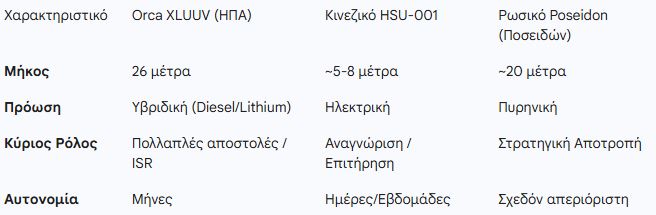
While China is investing heavily in sensor networks and smaller UUVs, such as the HSU-001, to monitor the South China Sea, the Orca offers the United States the capability of permanent presence anywhere on the planet.
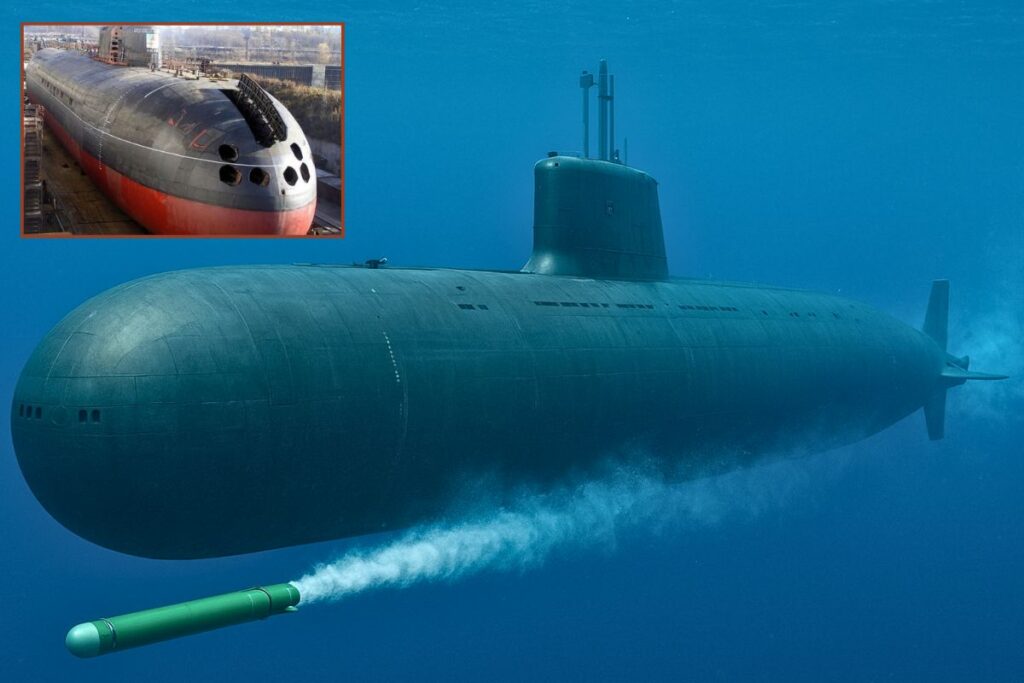
On the other hand, the Russian Poseidon is a strategic strike weapon, a nuclear torpedo, while the Orca is a multifunctional intelligence and warfare tool that can deploy directly from civilian ports, reducing cost and detection risk.
In summary, while the Orca focuses on versatility, U.S. competitors follow different philosophies.
The Russian Poseidon, the nuclear threat
The Russian counterpart is not an intelligence gathering tool but a strategic strike weapon.
It is essentially a massive nuclear powered torpedo.
Difference, the Orca is a defensive and offensive multipurpose tool, while the Poseidon is designed to create radioactive tsunamis against coastal cities.
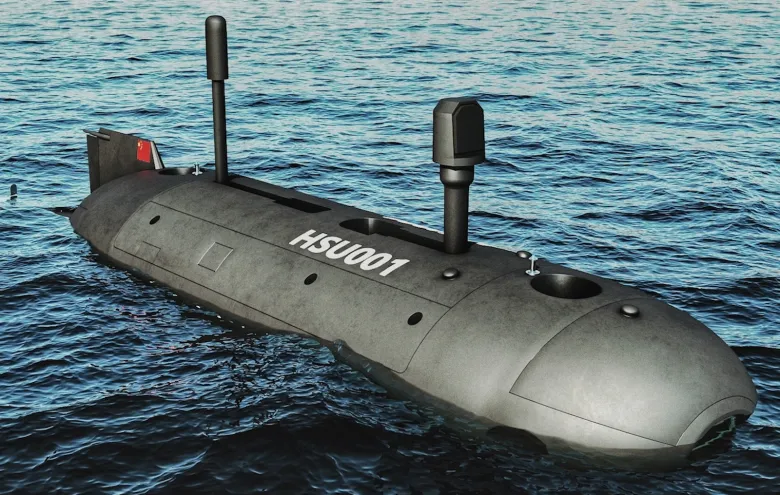
Chinese swarms HSU-001
China, although developing the HSU-001, a large UUV, appears to be betting on quantity.
Difference, the Chinese strategy relies on large numbers of cheaper drones operating as a network, while the Orca is an extremely expensive autonomous unit capable of making critical decisions on its own thanks to artificial intelligence.
The Orca program began as an urgent requirement for an underwater mine laying system following a request from U.S. Indo Pacific Command.
It is particularly useful for mine deployment in areas such as Taiwan, where shallow waters and a dangerous coastline provide an ideal environment for underwater warfare.
Analysts stress that mines represent a low cost way to disrupt Chinese military plans by increasing the risk of failure.
The Orca could also attack Chinese submarines, providing the United States with an advantage in countering both nuclear and conventional Chinese submarines, especially the new JL-3 missiles that can threaten targets inside the United States.
This platform allows the Navy to expand the operational spectrum of its manned forces, enabling them to focus on other critical missions.
Designed for Taiwan but capable of operating even in the Arctic
Based on the above, the Orca appears to have multiple deterrence uses against China.
Each vessel will be equipped for covert mine deployment at sea if a crisis escalates.
The shallow waters and dangerous coastline of Taiwan are ideal for mine warfare, which constitutes a cost effective way to interfere with China’s military plans by increasing the risk of failure, as noted by a group of analysts.
Equally important is that, according to the Navy, the Orca can perform complex underwater mine laying tasks that would normally require a manned submarine.
Its long endurance allows it to operate for extended periods in demanding underwater environments at much lower cost than a manned platform and with reduced risk to crews.
As stated by CNO Franchetti at CSIS, “we know we must adopt robotic, more affordable, autonomous technologies to extend the range and lethal effectiveness of our fleet”.
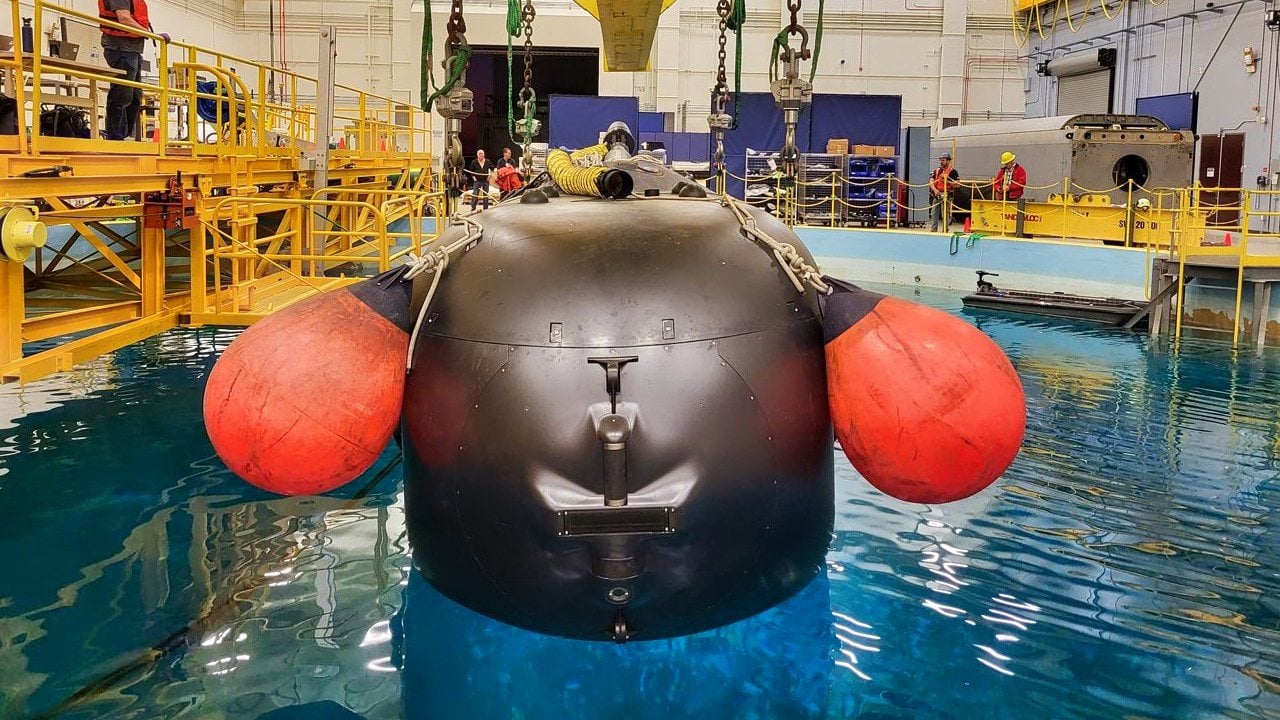
The Orca also has the capability to undertake other critical missions, such as detecting Chinese submarines
American strategy relies on superiority in the underwater domain to neutralize China’s conventional and nuclear submarine capabilities.
In particular, Chinese nuclear submarines carrying ballistic missiles represent a growing threat, with China having deployed the new JL-3 CH-SS-N-20 missile on the Type-094 submarine in 2022.
The long range of this missile could allow Chinese submarines to patrol closer locations and target areas within the United States.
An autonomous system like the Orca could significantly complicate such Chinese movements.
All these capabilities of the Orca facilitate the operation of manned submarines, allowing them to take on other critical missions.
The use of the Orca could be extended from the Arctic to the South China Sea, meaning that the U.S. Navy will require more than five or six Orca units to meet its needs.
The Orca XLUUV grants the United States the advantage of access denial A2/AD
The integration of the Orca into U.S. Navy service marks a strategic shift toward high risk unmanned systems.
From now on, the seabed will no longer be controlled solely by extremely expensive manned nuclear submarines, but by silent autonomous guardians capable of lurking in maritime chokepoints for months, making the underwater domain more impenetrable than ever.
The Orca XLUUV provides the United States with the advantage of access denial A2/AD.
It can be silently positioned in straits, such as Taiwan or Hormuz, and remain there for six months, simply waiting for the order to act.
It is the first true ghost soldier of the oceans.
www.bankingnews.gr















Σχόλια αναγνωστών