

The first solar eclipse of 2026 will impress the entire planet with a rare "ring of fire."
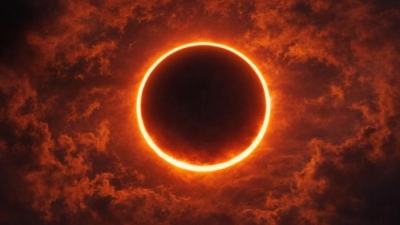
The first solar eclipse of 2026 is expected to be one of the most spectacular celestial phenomena of the year. On 17 February, the Moon will align perfectly with the Earth and the Sun, forming a rare and brilliant "ring of fire" across the sky.
Why the February eclipse is special
On 17 February, an annular solar eclipse will take place. The Moon will be at its apogee—the farthest point in its orbit—meaning its apparent diameter will be smaller than the Sun’s disk, creating a glowing margin around its edges.
There are three main types of solar eclipses: annular, total, and partial. The category is determined by the phase of maximum coverage. In an annular eclipse, such as the one occurring on 17 February, the Moon does not fully obscure the Sun, resulting in the iconic "ring of fire" effect.
In a total eclipse, the Moon completely covers the Sun, allowing for the observation of the solar corona. The partial eclipse is the most common variety, where the Sun simply appears as a crescent of light. Annular eclipses occur approximately 14 times per century, depending on the specific geometry of the celestial bodies.
"From a physics perspective, this is an ideal demonstration of celestial mechanics: the coincidence of the angular dimensions of the Sun and the Moon is a rare privilege for the observer," explains astronomer Pavel Gromov.
What else to expect in 2026
The February event opens the 2026 eclipse series. A total lunar eclipse is expected in March, followed by a total solar eclipse in August.
"Every eclipse is not just a beautiful phenomenon, but also an opportunity to reflect on the processes within the solar system that directly affect the Earth," notes astrophysicist Alexey Rudnev.
www.bankingnews.gr










Σχόλια αναγνωστών