

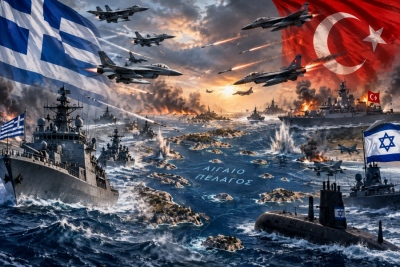
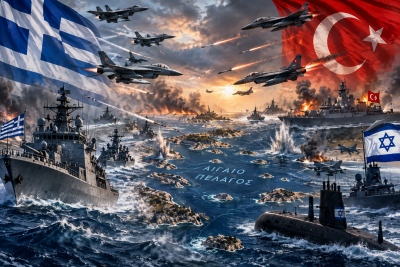
A new report is causing shock and turmoil in the Eastern Mediterranean, as it brings to the fore the tension between Israel, Greece, Cyprus, and Turkey. According to the data, Israel's strategic move is bringing "fire" to the region, intensifying the fear of powerful Turkish weapon systems and shaping a new geopolitical map that is shifting the balance of power in the Mediterranean.
Specifically, the accelerating defense cooperation between Athens and Tel Aviv, combined with the rapprochement with Cyprus, is presented as a "common front against Turkey." In this context, as the American think tank FDD points out, the balance of power in the region is significantly influenced by Ankara's actions – Turkey's regional power is becoming "decisive and guiding." If nothing else, Ankara has become one of the most significant deterrent forces in the Eastern Mediterranean, strengthening its military power through domestic and national defense projects over the last decade.
The upgrade of Turkish systems, from armed UAVs and unmanned naval drones to long-range ammunition, radars, and air defense projects, has caused intense concern in Athens. Consequently, this situation, according to the report, "opened the door for closer cooperation along the Athens–Tel Aviv line, aiming to balance Turkey's influence."
The reference to recent incidents in the Aegean, such as the "firing" of the Greek Coast Guard at Turkish fishing vessels (as the Turks claim), the violations of the FIR zone by Turkish F-16s, and the discussions about Greek airspace, highlight Athens' vulnerability vis-à-vis Turkey. However, the report stresses that the main cause of the tension is Ankara's growing influence both on the ground and at the negotiating table.
Within the framework of Greece's massive armament program, valued at 27 billion euros for the period 2025–2035, the acquisition of the PULS missile launcher system from Israel, the integration of Israeli technology into the multilayered air defense system "Achilles' Shield," and the active use of systems such as Heron, Orbiter-3, and SPIKE NLOS are being evaluated.
Despite Turkey's exclusion from the F-35 program, the report notes that the country remains the most dynamic and unpredictable military force in the region, thanks to the "indigenization" of its defense systems. In any case, the goal of Greek and Israeli actions is to offset Turkey's influence in the Eastern Mediterranean. At the same time, the increased US military presence in Greece is not only aimed at confronting Russia but also at offsetting Ankara's long-term influence in the region.
Gradually strengthens its influence
In this context, the Step News website presents an analysis according to which Israel is gradually strengthening its influence in the Eastern Mediterranean, deploying advanced defense systems, amidst the growing tension between Jerusalem and Ankara in Syria.
According to a new report by Syrian Step News, the geopolitical picture in the region appears to be changing, with Israel proceeding with the deployment of air defense systems in Cyprus. The publication underscores that this move aims to enhance Israel's regional influence and shape a new reality against Turkey.
As mentioned in the relevant video, this move brings Israel into direct contact with Turkish interests and is part of a broader strategy that links the Cypriot arena with the conflicts in northern Syria. The analysis points out that the Syrian region is considered critical by Israel for confronting Ankara's growing influence.
According to the report, Israel's targeted action focuses on logistics facilities, weapons depots, and observation points supported by Turkey. Simultaneously, in southern Syria, Israel maintains demilitarized zones and operates selectively in the Quneitra and Daraa regions, linking the developments there with those in Cyprus.
The importance of natural gas fields in the Eastern Mediterranean is highlighted in the analysis, as these discoveries strengthened cooperation between Israel, Cyprus, and Greece, making Cyprus a strategic arena that affects the regional balance of power. Natural gas not only reinforced the Israel-Cyprus relationship but also shaped the broader geopolitical dynamic in the region.
According to the video commentators, Israel is sending a clear message to Turkey that the dispute is not only about the borders of Cyprus but also about the regional limits of influence. The analysis concludes that air and naval control around Cyprus could determine the structure of influence in the Eastern Mediterranean for years to come.
www.bankingnews.gr








Σχόλια αναγνωστών