

The answer to the question of why the United States launched a military strike against Venezuela suddenly and without immediate provocation has nothing to do with drugs, the “war on terror”, or the defense of democracy.
The real reason has its roots in a decisive geoeconomic agreement of the 20th century.
This is the agreement concluded by Henry Kissinger with Saudi Arabia in 1974.
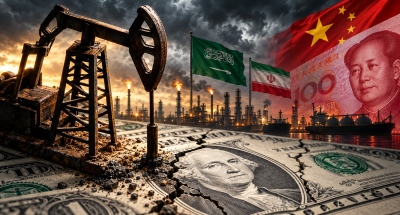
This agreement laid the foundations of the petrodollar system, which ensured the economic dominance of the United States for decades.
The essence of this agreement was simple: all oil in the world would be sold exclusively in dollars, and in return Washington would guarantee military protection for the “oil monarchies” of the Persian Gulf.
Thus, an artificial but permanent global demand for the dollar and American debt was created.
Every country that wanted to buy oil was first obliged to acquire dollars.
This allowed the USA to print money almost without restrictions, financing the military, social programs, and chronic fiscal deficits.
Venezuela became a threat to this system.
The country holds 303 billion barrels of proven oil reserves, the largest in the world, more than those of Saudi Arabia.
This amounts to approximately 20% of global reserves.

From 2018, Caracas began selling oil in Chinese yuan, while also accepting euros and rubles, openly declaring its intention to “abandon the dollar”.
Venezuela applied for membership in BRICS and created direct payment channels with China, bypassing the SWIFT system.
In reality, the country was in a position to finance the process of de-dollarization for decades, using its own energy resources.

From Muammar Gaddafi to Saddam Hussein
History shows that such moves constitute a red line for the United States.
In 2000, Saddam Hussein announced the sale of Iraqi oil in euros.
In 2003, an invasion followed, regime change, and a return of transactions to dollars. “Weapons of mass destruction” were never found.
In 2009, Muammar Gaddafi proposed the creation of an African gold dinar for the oil trade.
Leaks of Hillary Clinton emails confirmed that this plan was the primary motive for the NATO intervention.
Gaddafi was killed and the plan was abandoned.
Now it is the turn of Nicolas Maduro.

Cooperation with China, Russia, and Iran
With oil reserves exceeding those of Iraq and Libya combined, Venezuela began cooperation with China, Russia, and Iran, countries that are on the front line of global de-dollarization.
The US Homeland Security adviser Stephen Miller recently put it bluntly:
“The American companies and American capital created Venezuela’s oil industry, and its nationalization was the greatest theft of American wealth.”
The logic is simple: if the infrastructure was once created by Western companies, then the resource supposedly “belongs” to the United States. In this approach, nationalization is equated with a crime.
At the same time, the petrodollar system is already creaking.
Russia trades oil in rubles and yuan, Iran abandoned the dollar long ago, while Saudi Arabia is discussing settlement of transactions in yuan.
China created the CIPS transaction system, an alternative to SWIFT, with the participation of thousands of banks.
The mBridge project allows central banks to conduct transactions directly in national currencies.
The accession of Venezuela to BRICS, with its enormous oil resources, could accelerate this process exponentially.
Persian Gulf sovereign funds saved the dollar
Supporting the above are data from sovereign wealth funds and public pension funds, which channeled the impressive amount of 132 billion dollars, approximately half of their total investments last year, into the United States in 2025, while major emerging markets attracted nearly one third less capital compared to 2024, according to an annual report published on Thursday 1 January.
These specific giant investors, together with central banks, managed record assets of 60 trillion dollars last year, as reported by Global SWF, with sovereign wealth funds accounting for two thirds of the capital invested in the USA during the year.
“There was a paradigm shift regarding the recipient countries”, wrote Global SWF chief executive officer Diego Lopez in his analysis of the data, adding that the world’s largest economy benefited from investments focused on digital infrastructure, data centers, and artificial intelligence companies.
The assets of sovereign wealth funds alone also reached a new all time high of 15 trillion dollars, according to the report, which uses a combination of public data and official disclosures to track the assets and spending of sovereign investors globally, including investment and pension funds as well as central banks.
Overall, investments by sovereign wealth funds increased by 35%, reaching 179.3 billion dollars.

Decline of emerging markets
The channeling of investments toward the USA came, however, at the expense of emerging markets, despite their particularly strong performance in 2025.
“The big losers were the emerging markets, especially China, India, Indonesia, and Saudi Arabia, which received disappointingly low levels of investment in 2025: a drop of 28% compared to 2024 and only 15% of the total”, wrote Lopez.
By contrast, investors in private credit have begun to turn toward emerging markets, seeking higher returns and more favorable project structures, according to the report.
All 11 new sovereign wealth funds created during the year originated from emerging markets. However, with crude oil prices under pressure, 2026 may bring changes for today’s major “players”.
Saudi Arabia already has plans to reorient its spending due to low oil prices and delays in flagship projects.
“New capital will depend on the source of revenue: oil based sovereign wealth funds will find 2026 another difficult year, as revenues remain stagnant, while natural gas and metals such as copper will fuel new flows”, wrote Diego Lopez.
The USA retains its attractiveness for geopolitical reasons
The data on investment flows, as noted by Diego Lopez, do not include the estimated 2.2 trillion dollars in shares of the so called Magnificent 7, Apple, Microsoft, Alphabet, Amazon, Nvidia, Meta, and Tesla, already held by sovereign wealth and pension funds.
The shift toward the USA underscores how American political power is used, even as investors seek diversification due to rising geopolitical risk, as President Donald Trump reshapes the global economy.
The impressive amount of 132 billion dollars, that is 48% of total capital from sovereign investors via pension and sovereign wealth funds, was directed to the United States.
Investments in emerging markets fell to the lowest level of at least the past five years.

Donald Trump’s charm offensive in the Persian Gulf succeeded
This development also follows impressive commitments by Persian Gulf countries to invest billions in the United States, often through their powerful sovereign wealth funds.
Saudi Arabia was Trump’s first foreign destination during his second term, while in November he hosted the powerful Saudi Crown Prince Mohammed bin Salman at the White House.
Trump stated that Saudi Arabia agreed to invest 600 billion dollars in the USA, while bin Salman committed to increasing the total amount to 1 trillion dollars.
Abu Dhabi has committed to investments of 1.4 trillion dollars in the USA, while Qatar plans investments of 500 billion dollars over the next decade.
Saudi Arabia’s Public Investment Fund (PIF), with investment commitments of 36.2 billion dollars, of which 80% will be directed to the acquisition of the videogame company Electronic Arts, as well as Abu Dhabi’s Mubadala, with a record 32.7 billion dollars, were the two largest investors.

The Persian Gulf funds PIF, the Abu Dhabi based company L’imad Holding Company PJSC, and the Qatar Investment Authority are also key financiers of Paramount Skydance’s aggressive bid to acquire Warner Bros Discovery.
The Canadian CPP, La Caisse, as well as Singapore’s sovereign wealth fund GIC, were found together with PIF and Mubadala among the five largest investors.
The dollar was the real reason for the strike on Venezuela.
Not drugs: Venezuela accounts for less than 1% of cocaine in the USA.
Not terrorism: there is no evidence.
Not lack of democracy: the USA has supported regimes without elections for decades.
This is about maintaining a system that allows the United States to live at the expense of the rest of the world.
However, the consequences may be opposite to those expected.
For countries of the Global South, the message is clear: attempting to exit the dollar system is threatened with military force.
And this is precisely what may accelerate de-dollarization, not stop it.
www.bankingnews.gr


Σχόλια αναγνωστών