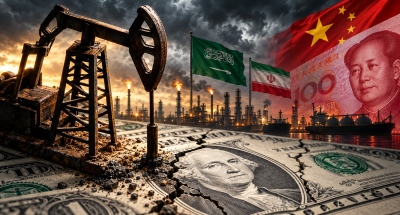
A series of critical developments, which deeply challenge entrenched perceptions on the international political stage, has been highlighted by the geopolitical crisis in the Middle East centered on the war in Iran and the negotiations with the United States.
Contrary to the rhetoric of the American president Donald Trump, who repeatedly attempted to present the Iranian leadership as divided and destabilized, the real data converge on a different conclusion, Iran appears institutionally cohesive, politically aligned, and determined to negotiate only on terms of respect and national sovereignty.
The British deconstruction of the rhetoric about “internal collapse” in Iran
The British newspaper The Guardian, through an analysis by journalist Patrick Wintour, clearly dismantled Trump’s claims of “chaotic differences” within the Iranian leadership.
According to the analysis, these statements are not based on reliable data and lack coherence, especially considering that the American president himself had admitted limited knowledge of the new power structure in Tehran.
On the contrary, Western analysts cited in the report emphasize that Iran has transitioned in recent years to a more collective model of governance.
This means that power is not concentrated exclusively in one person, but is distributed among institutions and decision-making centers, enhancing stability and reducing vulnerability to external pressures.
This development is not random.
It emerged as a response to serious blows, such as targeted assassinations of high-ranking officials.
However, instead of weakening the system, these events appear to have acted as a catalyst for strengthening institutional resilience.
Iranian institutions have demonstrated that they can continue to function smoothly, utilizing more flexible and collective mechanisms.

Unity in leadership
One of the main arguments of American rhetoric was that the Iranian leadership is deeply divided.
However, the evidence shows the opposite.
The collective model of governance not only does not lead to fragmentation, but strengthens unity through the distribution of responsibilities and institutional cooperation.
The relative reduction of the personal responsibility of the supreme leader for difficult decisions, as experts point out, is not an indication of weakness.
On the contrary, it is part of a broader restructuring of the balance of power, aimed at the long-term survival of the political system.
The picture that emerges is that of a leadership that, despite external pressures, remains united and operates in coordination.
This makes it difficult to implement “divide and rule” strategies by external actors.

National sovereignty as a non-negotiable principle
In this context, Tehran’s stance toward American ultimatums takes on particular importance.
Iran does not appear willing to accept terms that are perceived as imposition or as undermining its national sovereignty.
On the contrary, it insists on a line of negotiation based on mutual respect.
This approach is not merely rhetorical.
It reflects a deeper strategic culture, according to which independence and autonomy constitute fundamental values of the state.
Tehran appears to tear up in practice ultimatums that do not take these principles into account, choosing to negotiate only when the terms are equal.
This also explains its stance in the recent talks with the United States.
Despite pressure and threats, Iran did not yield to unilateral demands, but maintained a steady line, reinforcing the image of a state that operates with strategic consistency.

The war in Iran and the deep rift in US–Israel relations
While Iran appears cohesive, the other side of the geopolitical axis shows signs of intense instability.
The war in Iran revealed a deep and growing rift in the so-called “special relationship” between the United States and Israel.
For decades, this relationship was presented as unshakable, based on shared values and strategic interests.
However, the reality today is more complex.
The strategic priorities of the two countries are diverging more and more, creating tensions that can no longer be ignored.
During the talks between the United States and Iran in Islamabad, Israel’s stance was indicative of this divergence.
Despite Trump’s calls for de-escalation, Israel continued its attacks in Lebanon, effectively undermining the negotiation process.
Prime Minister Benjamin Netanyahu, in a televised address, not only omitted any reference to the negotiations, but characteristically stated that “the battle is not over”, coming into direct opposition with Washington’s desire to end the conflict.

From convergence to divergence
The traditional narrative of strategic convergence between the United States and Israel appears to be collapsing.
In its place emerges a relationship characterized more by divergences than by common pursuits.
Israel maintains significant freedom of action, even when its choices undermine Washington’s objectives.
The result is that the United States is called upon to bear the diplomatic and strategic cost, without having full control of developments.
This imbalance is becoming increasingly difficult to accept, both at a political and social level within the United States.
The declining support of American public opinion for the US–Israel special relationship
The change in public stance is evident.
According to polls by the Pew Research Center, about 6 in 10 Americans now have a negative view of the Israeli government, a striking reversal compared to previous decades.
This shift is particularly strong among younger generations and Democratic voters, but it is also extending to traditionally pro-Israeli audiences.
Even within the Jewish community in the United States, increasing division is observed.
A poll by the Washington Post showed that 61% of American Jewish respondents believe that Israel has committed war crimes in Gaza, while 39% believe that it has committed genocide. These data undermine the traditional base of support for the relationship.

The role of the lobby and its limits
Organizations such as AIPAC have played a decisive role in maintaining American support for Israel.
However, their influence is not unlimited.
As public opinion becomes more critical, the ability of these organizations to ensure unconditional support decreases.
The political reality is changing, and with it the limits of lobby influence are also changing.
Toward a reshaping of the relationship
All of the above converge on one conclusion, the relationship between the United States and Israel is entering a phase of renegotiation.
Support is no longer considered a given, but may become more conditional and transactional.
Washington may begin to set clearer conditions for military aid, differentiate its stance in international forums, and seek new balances in the Middle East, strengthening its relations with other countries in the region.
New geopolitical balance
The war in Iran did not only highlight the military dimension of the conflict, but also deeper political and strategic shifts.
On one side, Iran appears as a state with strong institutional cohesion, united leadership, and a clear commitment to national sovereignty.
On the other, the “special relationship” between the United States and Israel appears to be seriously tested.
Tehran, rejecting ultimatums and insisting on equal negotiations, strengthens its position as an independent geopolitical actor.
At the same time, developments on the US–Israel front indicate that traditional alliances are no longer guaranteed.
In this new environment, the balance of power is being redefined.
And Iran, despite the pressures, appears to have found a way not only to endure, but also to actively shape the terms of the game.
www.bankingnews.gr










Σχόλια αναγνωστών