

The new phase of the proxy war between the United States and Iran continues with unabated intensity.
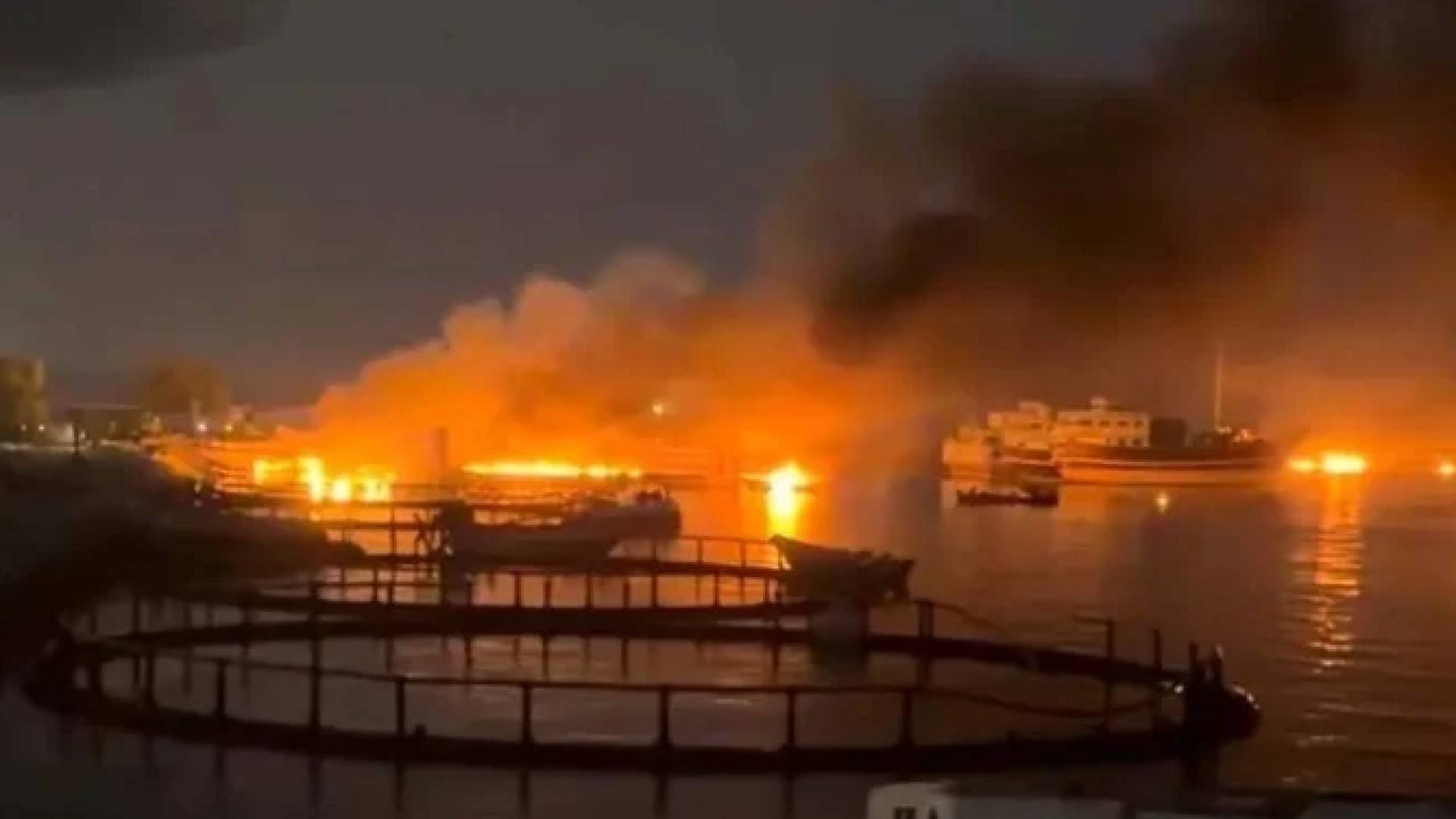
The scene from the war report is hot: The naval base in Konarak, according to the IRNA agency, was attacked in two waves by American fighter jets.
In the city of Bandar Abbas, a key hub of the Iranian supply chain, powerful explosions were heard throughout the night on Thursday 9/7.
The Mehr agency also broadcasted information about heavy bombardments in the Bushehr and Konarak regions.
At the same time, the United States struck the Ak-Takeh-Khan railway bridge in northern Iran, which connects Tehran with the transport networks of Russia, China, and Central Asia, in a strategic strike to cut off the country from its strategic alliances.
The intensity of the Iranian retaliation surprised the American side, which believed that it had nearly neutralized the military capabilities of Tehran.
The Wall Street Journal claims that Iran effectively exploited the April truce and managed to restore a significant part of its defense capabilities in the Strait of Hormuz.
According to the newspaper, the Iranians recovered hundreds of missiles and launchers from the rubble, which the US considered destroyed, restoring more than half of their pre-war stocks to operational status.
According to the same assessment, the months-long high-precision American bombardments failed to disarm Iran.
The consequences on international energy markets
The consequences of the conflict are already being felt in international energy markets.
Bloomberg reports that oil exports from the Persian Gulf have almost stopped.
While before the war approximately 135 ships passed daily through the Strait of Hormuz, on July 9 the passage of just one tanker was recorded.
Why the US-Iran conflict is considered inevitable
Vali Nasr, professor of International Relations at Johns Hopkins University and former advisor to the State Department for Afghanistan and Pakistan, argues that the current confrontation concerns not only the nuclear program of Iran, but primarily the shaping of a new regional order.
As he points out, Tehran believes that the United States seek to limit its sovereignty and its regional influence, while Washington treats Iran as a power attempting to overturn the balances in the region through its allies and the armed groups it supports.
Sanam Vakil, director of the Middle East and North Africa program at a research center in London, estimates that the conflict is fueled by the survival struggle of the Iranian regime.
In her view, Tehran is convinced that Washington ultimately seeks either the weakening or even the change of the political system of the country.
The lack of trust between the two sides worsened after the withdrawal of the United States from the agreement on the nuclear program in 2018, a development which, according to analysts, definitively undermined Tehran's trust both toward Washington and personally toward Donald Trump.
"American arrogance" and Tehran's persistence
Mahsa Ruhi, a researcher at the International Institute for Strategic Studies (IISS), notes that Iran views Western pressures as an attempt to deprive it of its right to self-defense, while estimating that the sanctions strengthen the hardest political forces inside the country.
Alan Eyre, a senior diplomat at the Middle East Institute (MEI), considers that the two sides remain trapped in mutually incompatible demands regarding the nuclear program.
The United States demand its complete abolition, while Tehran insists on the full lifting of economic sanctions.
According to him, the persistence of both sides on maximum possible demands has led to a complete paralysis of the diplomatic process.
American analyst Will Todman argues that a key cause of the escalation is the strategic importance of the Strait of Hormuz.
As he points out, Iran considers maintaining control of the passage to be of vital importance, as it constitutes both an economic and geopolitical bargaining tool.

"Coercive diplomacy" and the tragic mistakes of Donald Trump
Several analysts appear particularly critical of the American strategy.
Ryan Bohl, an executive at the RANE Network, and John Calabrese, a researcher at the Middle East Institute, estimate that both the United States and Iran use military power as a leverage in negotiations, turning the confrontation into a prolonged "war of who will break the other."
According to Will Todman, Washington applies a form of "coercive diplomacy," continuing military strikes while simultaneously maintaining open channels of indirect negotiation.

He warns, however, that such a strategy can at any moment lead to an uncontrollable escalation.
Particularly sharp appears the well-known economist Jeffrey Sachs of Columbia University, who criticizes the decisions of the close circle of advisors of Donald Trump, speaking of "incompetent and irresponsible decision-making," while characterizing their mentality as a "bully mentality" and accusing them of overestimating the power of the United States.
Jeffrey Sachs also warns that the escalation of the conflict has endangered Washington's allies in the Persian Gulf, who, as he notes, do not possess sufficient military capabilities to confront a broader regional conflict.
Characteristically, he cites the famous phrase of Henry Kissinger: "To be an enemy of the United States is dangerous.
To be their friend can prove fatal."
www.bankingnews.gr






Σχόλια αναγνωστών