

The failure of the United States and Israel to fulfill their objectives through a high intensity war led the geopolitical equation into a new, extremely dangerous phase.
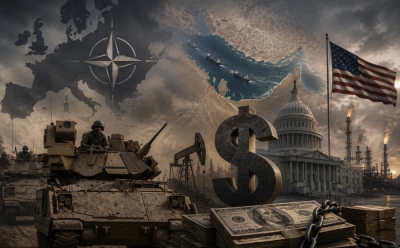
At this stage, Washington chooses to reduce the intensity of operations and strengthen regional air defense, aiming at the gradual attrition of the military, logistics, and social infrastructure of Iran.
For its part, the response of Tehran shifts the cost of the war to the regional allies of the United States.
As military operations have moved past the stage of direct and intense conflict, the biggest strategic mistake would be to analyze developments based on the data of the first days. Initially, the United States and Israel sought to cause a strategic shock and immediately impose a new political regime.
However, the inability to realize these aspirations made the continuation of the same model extremely costly and ineffective.
Under these circumstances, the change of tactics and the transition to a low intensity war of attrition constitutes the new choice of Washington, aiming not at the rapid defeat of Iran, but at the gradual exhaustion of the country's military, logistics, economic, and social endurance.
This strategy is part of the hidden agenda of Washington for a new role in the wider region of the Middle East, even if it blows it up in the meantime. For Israel to be reborn!
The new allocation of roles and the liberation of American air defense
The relative reduction of direct pressure on Israel, due to its temporary absence from the forefront of operations, must not be interpreted as an exit of the Jewish state from the war equation. On the contrary, the division of labor between the two allies has been modified.
The United States assume the main burden of military operations by maintaining pressure on Iran, while Israel exploits the opportunity to reconstruct its military capabilities, restore damages, and renew its forces.
This situation offers a significant political benefit to Benjamin Netanyahu, who can present an image internally where Iran remains under pressure, without Israel however suffering the direct cost of an all out war, as the burden shifts to the United States.
The absence of direct involvement of Israel in this phase limits its vulnerability and brings about another significant consequence: the release of part of the American air defense systems for wider use in the region.
When Israel was under direct threat, a large part of the American anti missile protection was necessarily dedicated to its safety.
The reduction in the intensity of attacks against Israel now allows Washington to concentrate its defensive systems around its own military bases and infrastructure in the region.
In this way, it seeks to maintain offensive pressure against Iran and simultaneously minimize the cost from potential Iranian responses.

The logistics war and the regionalization of the cost
This shift turns the conflict into a multi layered showdown, where the logistics war acquires weighty significance.
At this moment, the Persian Gulf and the Arabian Sea constitute the main fields of operations. The objective is not simply the firepower of each side, but the capability to maintain and sustain this power in the field.
Exerting pressure on lines of communication and road infrastructure, combined with efforts to impose restrictions on maritime routes, aims to disrupt the supply chain and increase the cost of transporting forces and equipment.
The ultimate purpose of this approach is the separation of the domestic capabilities of Iran from the southern front and the exhaustion of the country's capacity for sustained responses.
Under these conditions, the response of Iran cannot be limited to a simple passive defense against controlled strikes.
One of the basic strategic parameters of Tehran since the beginning of the conflict is the regionalization of the cost of aggression.
The countries that grant bases, infrastructure, and operational facilities, essentially allowing the United States to attack Iran, cannot expect to remain protected from the consequences of the war.
From this point of view, strikes against American military support infrastructure, as well as against economic infrastructure in countries of the region, do not simply constitute a military action against Washington.
They have direct political implications for the governments hosting them.
The more the cost of hosting American forces increases, the more social and political pressures on the regimes of the countries of the southern Persian Gulf will intensify. Thus, providing cost free support to American operations will become more difficult and regional governments may be forced to modify their policy to prevent their territories from turning into battlefields.
This exactly is the logic of the regionalization of the war: if the United States transfer the conflict from their territory to the region, the cost must not be borne by Iran alone. The goal is not the uncontrolled expansion of the war, but the involvement of the states of the region in a calculation where facilitating American operations against Iran will have direct and heavy consequences, altering their political assessments.

The social front and the need for resilience
Parallel to the military field, the war of attrition is also unfolding on another critical front: society.
If the United States are unable to subdue Iran with a single strike, they will seek to gradually increase the cost of the conflict, transferring the burden from the military level to the economy and society.
Pressure on incomes, the increase in the cost of living, disruptions in transport and the supply chain, as well as uncertainty regarding the end of the war, can test the endurance of the social fabric.
A society that in the first phase of the war constitutes the backbone of defense and resistance, may under conditions of prolonged economic pressure find itself faced with new questions.
In a war of attrition, the enemy attempts to exploit the accumulation of these problems to strike internal cohesion and transfer the battlefield to the interior of the country.
For this reason, maintaining social cohesion is just as important as maintaining military power.
To overcome this phase, Iran is required to implement a multi layered strategy that will include maintaining offensive and defensive capability, strengthening logistics resilience, reducing the vulnerability of infrastructure, protecting the living standard of citizens, and increasing the cost of the American presence both for Washington and for the countries hosting it.
Within this framework, shifting the cost of the war to the region constitutes one of the most fundamental tools for changing political balances.
The war of attrition will turn into a strategic failure for the United States only if the cost of its continuation increases for Washington itself and its regional allies, while Iran manages to maintain its strike capability, its supply chain, and its social cohesion.
In this new phase, the issue is not simply maintaining the capacity to conduct the war, but ensuring that the opposing side will not be able to continue the conflict either without paying the corresponding price.
The new balance will take shape when the United States and the countries of the region realize that the continuation of this course does not constitute a limited operation against Iran, but the entry into a war whose cost will be distributed across the entire region.

The resurgence of American attacks and the plan to subjugate the south
Almost one month after the signing of the Iran-US understanding that aimed to end the war, the United States launched a nightmarish strike on Wednesday July 15, 2026, reimposing a naval blockade on Iranian ports.
This terrifying move was accompanied by a new, fierce wave of attacks against various regions of the country, with devastating strikes especially in the southern parts of Iran, which led to the martyred death of at least 38 people and the shocking injury of another 400, in a desperate attempt to economically kneel the population and the entire country.
The US military attacks initially focused on ports, missile and drone bases, as well as on the coastal defensive lines of Iran in the south (Bandar Abbas, Qeshm, Chabahar, Bushehr, Sirik, Ahvaz etc.), with the purpose of blinding the defense and radars and leveling air defense positions.
However, in recent days Washington extended the field of terror deep into Iranian territory, striking regions such as Khandab and Semnan, as well as energy infrastructure, hammering airports, rail networks, and transport hubs to force Iran into a humiliating capitulation.
At the same time, Donald Trump threatened an even more fierce escalation of attacks next week, targeting power generation stations and bridges if Tehran is not dragged back to the negotiating table.
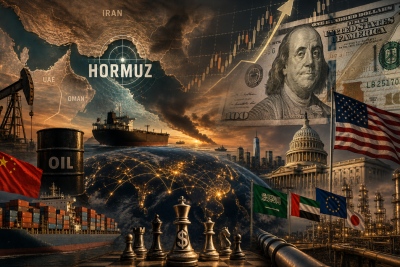
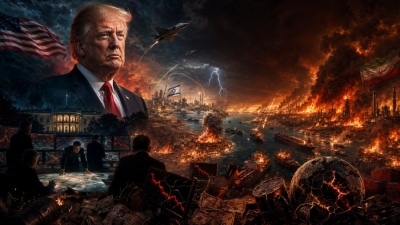
Over the last few nights, the American military put its threats into practice, plunging the region into darkness by bombarding power stations. At the center of this bloody setting lies the dispute over the Strait of Hormuz, which is developing into an uncontrolled crisis that directly threatens global energy security and the stability of the entire international economy.
The strategic deadlock and the failures of the past
This explosive situation has created a terrifying strategic deadlock.
On the one hand, Iran categorically refuses to surrender to the United States, and on the other, the US are unable to accept a new regional order in which Tehran will exercise unprecedented control over the Strait of Hormuz.
For Washington and Tel Aviv, accepting such an outcome in a war they started with the illusion of an easy victory of a few days would be equivalent to a humiliating strategic defeat.
Iran, for its part, escalates its threats toward the US and their regional allies, warning of total havoc, if the US strike its installations, every infrastructure in the region will be leveled, while a generalized conflict looms with direct threats to navigation both in the Strait of Hormuz and in the Bab al-Mandab.
Despite the ceasefire and the signing of the understanding on June 17, sporadic American attacks constitute part of a continuously expanding operation.
It started from the port cities of the southern coast of Iran and spread like a cancer into the hinterland, with Iran responding with fierce strikes against American military installations across the entire region, triggering terror over a return to an all out war.
And all this, at a time when a new poll by YouGov and The Economist in the US reveals that 57% of Americans now consider the decision to start the war with Iran a disastrous mistake, while only 27% consider it correct.
Despite the absence of a clear strategy and without popular support, Trump launched a new round of attacks that loads the planet and the US themselves with an unbearable economic burden.
His recent retreat from the plan to impose 20% tariffs on ships transiting through Hormuz is simply the latest chapter in the chaotic management of his policy toward Iran.

This third round of American attacks gives rise to the reasonable question: what is the real purpose of these bloody operations and what does Trump pursue after his resounding failure in the 40 day war?
This question has been hovering since the first weeks of the American Israeli war against Iran, when the US and Israel foolishly believed that within a few days, with a strategy of "decapitation" and assassinations of the leadership, military commanders, and top political figures, the regime would collapse and Trump would celebrate victory, dismantling the country's military capabilities. Instead, the Islamic Republic survived stronger than ever, expanded its influence, and proved that it can cause untold pain to the US, Israel, and their allies. No objective analyst dared to consider the US and Israel winners of that 40 day conflict.
The delirium about the south and the nightmare of a ground invasion
The causes of this new round of attacks are completely different from the 12 day war, first round, and the 40 day war, second round. As J.D. Vance, vice president of Trump, characteristically stated: "We are not going to send 150,000 American soldiers on the ground to overthrow the Iranian regime. This concerns exclusively the Iranian people. We do not want a repetition of the experience of Gaddafi and Libya."
In this phase, the goal is not the overthrow or the termination of the nuclear program, but everything revolves around blackmail for the resumption of negotiations and the violent opening of the Strait of Hormuz, which was free before the start of the war on March 31.
The US want to smash the missile and defensive capabilities of Iran on the southern coast to force Tehran to succumb.
To achieve this, it is not ruled out that Washington has dreamed of absolute control of Hormuz through southern Iran, and the unpredictable personality of Trump might push him to the madness of attempting the seizure of ports and islands in the south, including Kharg or the three islands of Greater Tunb, Lesser Tunb, and Abu Musa, although there he will face fierce resistance.
Any attempt to seize an Iranian island by the United States would constitute an unprecedented provocation that would lead Tehran to immediate, bloody retaliation in the Strait, against ships, American bases, and the energy infrastructure of the entire Persian Gulf.
Although the US possess the military capability for such an amphibious operation, the question is: what will the terrifying price be?
For the US to set foot on even one island, they must level the defense of Iran, yet air power is not enough for permanent occupation. A ground invasion is required, something that would turn into an absolute living nightmare for American soldiers.

The Vietnam trap and the global oil shock
The temporary seizure of an island differs completely from its strategic maintenance.
These small islands would become easy targets for Iranian drones, missiles, artillery, and speedboats, turning American soldiers into "sitting targets" with daily, heavy casualties.
The return of coffins to the US would dissolve the political legitimacy of Trump, awakening the black memories of defeats in Vietnam, Iraq, and Afghanistan.
Such an operation under the torrential fire of Iran would have a massive cost and would cause violent internal reactions within the very sociopolitical base of Trump and the MAGA movement, which is why the probability of him daring it seems low.
Furthermore, such madness would not open the Strait of Hormuz, but would lead to its absolute and definitive closure, turning the conflict into an all out war of survival for the Iranian people.
American bases would receive devastating strikes, while the oil terminals and refineries of the neighboring defensive allies of the US would be blown into the air.
The result?
An unprecedented global oil shock and a biblical economic crisis, which would record the US as a brutal occupying power in the eyes of humanity.
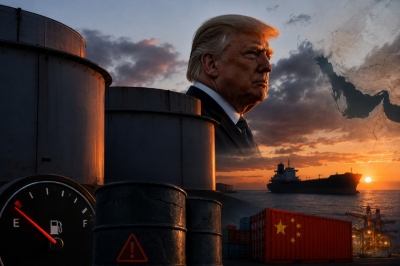
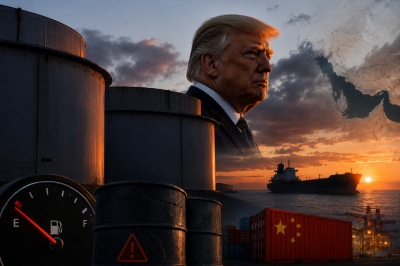
The skyrocketing of energy prices and the new nightmarish rise in the price of gasoline and goods in the US is a deadly danger for Trump ahead of the November 2026 elections.
In American domestic politics, no factor affects the vote of citizens as much as the price of gasoline at the pumps.
Thus, although the invasion is militarily feasible, it remains politically suicidal due to its destabilizing consequences.
The allies of the US in the Arab world and the Gulf tremble at the idea that they will become the next victims of Iranian retaliation, although experience has shown that from the America of Trump one must expect everything.
Such a move would be politically disastrous for himself and his Republican allies ahead of the November ballot.
Based on these data, Washington is trapped: it refuses to accept the new reality in the Strait of Hormuz and blindly believes that with violence and intimidation it can turn back the clock to the pre-March 2018 situation.
Faithful to the doctrine of "maximum pressure", Trump considers that with the third wave of heavy airstrikes and the naval blockade he will subjugate Iran.
But the harsh reality in the field shows that the balance of power in the Persian Gulf has changed definitively.
Iran is absolutely ready to endure the cost and cause untold pain to the other side.
Trump must understand that the era of unilateral imposition in the Persian Gulf died, and the obsession with military intimidation will lead Washington to sink definitively into an endless war of attrition.
www.bankingnews.gr






Σχόλια αναγνωστών