
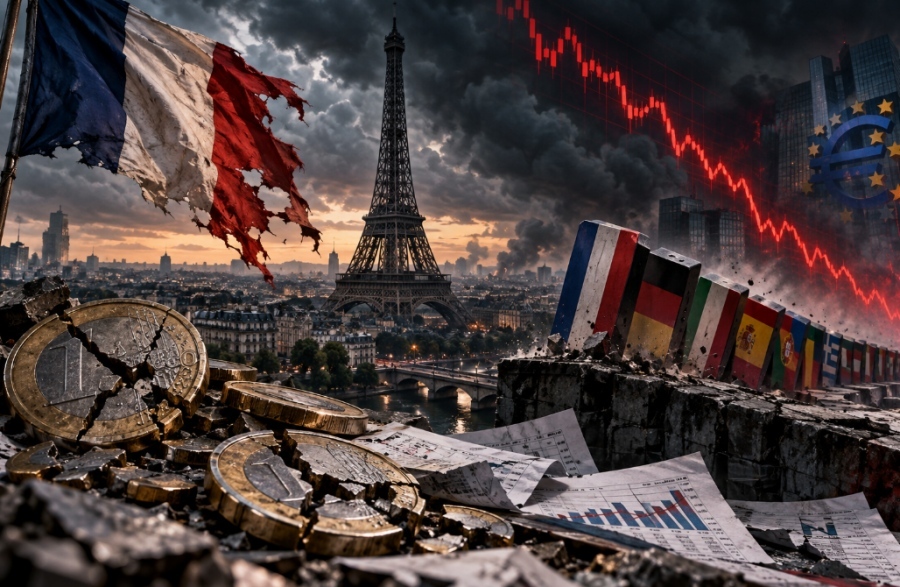
Earlier this month, something occurred in the bond market that had not been seen for over a decade, concerning one of the most important countries in the world.
France is not some peripheral economy, as was Greece, and is preparing to clash with debt markets as the slide toward the cliff is, according to all indications, unavoidable.
With public debt approaching 3.6 trillion euros, France owes more than any other nation in the Union, including Italy and Germany.
When Greece reached the brink of bankruptcy in 2010, threatening to drag down the entire Eurozone, its public debt stood at roughly 330 billion euros.
The markets imposed their discipline on a small and shallow economy, now the stakes are higher.
While French society expresses its fury through the youth movement over two decades of neoliberal policies, markets lurk to enforce new terms of social cohesion without any democratic legitimacy.
French debt is almost tenfold.
At the same time, the European Stability Mechanism (ESM), the rescue fund of the Eurozone, has a maximum lending capacity of 500 billion euros, meaning weapons against the... market hawks are limited.
The rescue mechanism created by Europe following the previous crisis was not designed to manage an economic crisis in a country with the scale of the French economy.
On October 2, the yield spread between ten-year government bonds of France and Germany surged to approximately 150 basis points.
This constitutes the widest spread since the Eurozone debt crisis in 2011, when Greece, Italy, and Spain were on the verge of financial collapse.
Today, French bonds trade at higher yields than Italian bonds, whose spread over German debt stands at roughly 90 basis points, and also higher than Greek bonds, where the corresponding difference is roughly 76 basis points.
In other words, bond markets now view the second-largest economy in the Eurozone as a riskier borrower than Greece.
The spike in French bond yields

And matters are becoming even more alarming.
On October 8, investment-grade corporate bonds of French enterprises, with a total value of roughly 215 billion euros, offered lower yields than corresponding French government bonds.
Investors preferred, in other words, to lend to French companies rather than the French state itself.
Since then, the yield difference has narrowed somewhat.
Last Friday (October 9) it stood at roughly 132 basis points.
The problems of France are structural, and the country possesses no realistic way to resolve them.
Let us start with the numbers
At the end of the second quarter of 2026, the public debt of France approached 3.6 trillion euros, at 119 percent of GDP.
This marks the highest level since 1946, when the country was attempting to rebuild following World War II.
Forecasts from the French budget itself indicate that public debt will reach 121.7 percent of GDP next year.
The fiscal deficit of France is projected to reach 5.4 percent of GDP this year, one of the highest in the European Union.
The last time France balanced its budget was in 1973, when the President of the US was Richard Nixon.
The trajectory of French public debt

Next year, France will borrow a record sum of 340 billion euros, meaning 28 billion more than this year, in order to cover its deficit and refinance maturing debt.
And the servicing cost of this debt is climbing at a rapid pace.
Interest payments required of the French state are projected to increase from 64.8 billion euros this year to 74.2 billion euros in 2027.
Interest on public debt now represents the single largest expenditure of the state budget, surpassing even expenditures on education.
Here lies a crucial detail that many analysts overlook.
The average maturity of French public debt is roughly eight and a half years.
This means that bonds issued at near-zero interest rates during the 2010s and early 2020s are gradually being refinanced at today's, much higher rates.
In plain terms, France already faces years of rising debt-servicing costs ahead, and the full burden has not yet materialized.
Why France cannot escape the debt trap: The 5 reasons
First, it cannot print its own money.
The Bank of France does not independently determine the monetary policy of the country.
That falls within the competence of the European Central Bank (ECB).
When the US or Japan confront a debt crisis, their central banks can purchase government bonds, containing yields.
France, just like Greece, abandoned that capability upon adopting the euro.
The ECB does indeed possess an instrument designed for such situations.
It is termed the Transmission Protection Instrument (TPI) and permits the ECB to purchase bonds of a member state when yield spreads widen for reasons unjustified by economic fundamentals.
There is, however, an important limitation: to qualify, a country must comply with EU fiscal rules.
France has been under an excessive deficit procedure since July 2024.
This means it does not satisfy one of the core criteria considered for activating this specific mechanism.
The TPI has never been used, and no member of the ECB governing council has signaled its activation for France.
Second, it cannot cut spending without severe political cost.
Prime Minister Sébastien Lecornu heads a fragile minority government.
On October 1, he presented a budget for 2027 projecting spending cuts and revenue-raising measures totaling 43 billion euros, aiming to cap the deficit at 5 percent of GDP.
Sébastien Lecornu himself warned that, without spending cuts, the deficit for 2027 could approach 6.5 percent of GDP.
Passing this budget through the French parliament, however, is an entirely different matter.
Public sector employees have already staged strike action over a proposed wage freeze.
Last year, the government agreed to suspend the pension reform of Emmanuel Macron in order to remain in power. This development contributed to the downgrade of the credit rating of France by S&P to A+.
Fitch had already downgraded the country to the same tier a month earlier.
And there is, of course, the political factor...
France holds presidential elections next year, and opinion polls indicate that Marine Le Pen will prevail.
Few politicians will want to campaign promising cuts to pensions and healthcare, in a country where public spending accounts for more than half of GDP.
Third, it cannot tax its economy indefinitely to paper over the problem.
France already maintains one of the highest tax burdens in the developed world.
This year's budget relied, among other things, on windfall taxes on very high incomes, large corporations, and family holding companies.
There is, however, a limit to how much further you can tax your economy before capital, businesses, and specialized human talent begin to leave.
Fourth, it cannot grow fast enough to outgrow the problem.
The Bank of France projects growth of just 0.5 percent for this year.
With such anemic growth and a budget deficit above 5 percent of GDP, public debt expands faster than the economy tasked with servicing it.
Fifth, France does not control who holds its debt.
Nearly 57 percent of French public debt is held by non-residents.
Foreign investors feel no political or emotional allegiance toward Paris.
If they determine that the risk is no longer worth the return, they sell French bonds.
Every sale puts upward pressure on yields. This elevates borrowing costs, worsens the fiscal equation, and can trigger further sales.
A vicious cycle that risks becoming self-reinforcing.
Thus, the weight of the final verdict shifts to the bond markets.
Why France struggles to deal with its debt
France will not necessarily be the last.
France represents one of the first major developed economies where bond markets appear to be increasingly pricing in the likelihood that existing public debt cannot be meaningfully reduced under current terms.
Across the developed world, governments spent the past 15 years running large deficits, on the assumption that interest rates would stay near zero forever.
That era has ended.
The massive bubble that inflated in previous years across a broad range of markets and asset classes is now beginning to burst in the sovereign bond market of countries such as the US and Japan.

Will the ECB not save France? The dangerous gamble of bond markets
France cannot take for granted that the European Central Bank will intervene to save it. And this is perhaps the greatest risk for Paris, as well as for the entire Eurozone.
For years, markets operated under the conviction that if the situation became truly hazardous, the ECB would ultimately find a way to intervene.
The crisis of 2012, when then ECB President Mario Draghi pledged to do «whatever it takes» to save the euro, cemented this view.
Investors learned to rely on the presence of a powerful institutional backstop against sovereign debt crises.
Today, however, the situation is different.
The ECB possesses the Transmission Protection Instrument (TPI), which allows it to purchase sovereign bonds when it establishes that financial conditions are deteriorating unjustifiably and threatening the smooth transmission of monetary policy. However, its activation is neither automatic nor a guaranteed right of any government.
And herein lies the crux of the problem for France.
The country is under an excessive deficit procedure within the framework of European fiscal rules.
This condition complicates its eligibility for the TPI, as the ECB examines, among other things, fiscal compliance, public debt sustainability, and the economic policies of the country that might require support.
In other words, France cannot take for granted that Frankfurt will step in at the critical hour to contain its bond yields.
There is also another reason why such an intervention is far from simple.
The mandate of the ECB is not to finance governments struggling to control their budget deficits.
Its primary objective is maintaining price stability, while the use of its available instruments is subject to specific preconditions.
If the rise in French yields reflects genuine concerns over the fiscal trajectory of the country rather than unjustified market turbulence, the ECB will have fewer grounds to intervene via the TPI. Such a move could be interpreted as rewarding fiscal laxity and provoke pushback from countries demanding strict adherence to European rules.
Why Greece should be concerned
For Greece, the issue is particularly critical.
The Greek economy experienced firsthand what happens when markets lose confidence in a sovereign's ability to service its debt.
A potential crisis in France, however, would carry different dimensions.
It would not involve a relatively small peripheral economy, but one of the largest economies in Europe, playing a decisive role in the political and economic architecture of the Eurozone.
If the ECB does not intervene and market pressure mounts, turbulence could spread to other countries as well.
Investors may reassess risk across the entire Eurozone, demanding higher yields from states they view as more vulnerable.
Greece would not automatically be the next target.
However, a renewed crisis of confidence in the European sovereign bond market could raise borrowing costs, complicate fiscal management, and restrict economic policy leeway.
The most significant lesson is that ECB intervention cannot be taken for granted either for France or for any other country in the Eurozone.
The question is not solely whether Paris will succeed in curbing its debt.
Europe is not expected to be able to prevent a new crisis without testing the very rules upon which the euro is founded, and markets will subjugate the second-largest economy.
www.bankingnews.gr















Σχόλια αναγνωστών