

The United States and Iran are spiralling toward an asymmetric and multi-level conflict following a Shahed drone attack on the aircraft carrier USS Abraham Lincoln and a threatened boarding by Iranian Revolutionary Guard vessels of the American tanker Stena Imperative in the Straits of Hormuz. On the diplomatic front, the US has acceded to Iran’s request to change the negotiation venue, with talks now scheduled for February 6 in Oman, rather than Istanbul as originally planned. Earlier on February 3, small armed craft belonging to the Iranian Revolutionary Guard approached the US merchant vessel Stena Imperative, threatening it with ramming and seizure. Despite this, a direct clash was avoided at the last moment, and the American tanker continued its journey as scheduled. Adding to the tension, a US official told Reuters on Tuesday, February 3, that the US shot down an Iranian drone that approached the Abraham Lincoln in the Indian Ocean. The Iranian Shahed-139 drone was flying toward the carrier and was intercepted by a US F-35 fighter jet.
BREAKING: The US military has shot down an Iranian drone that approached the USS Abraham Lincoln in the Arabian Sea, a US official tells Reuters
— Faytuks News (@Faytuks) February 3, 2026
Simultaneously, the USS Abraham Lincoln withdrew approximately 1,400 kilometres from the Iranian coast due to fears of further escalation. It is noted that the aircraft carrier remains within the striking range of Iranian anti-ship missiles, which possess a range of 2,000 kilometres. Regarding the diplomatic landscape, a report by Axios on February 3 proved highly revealing, indicating that the US President seeks to negotiate and conclude a deal with Iran; however, Israel is pressuring the American administration to launch an all-out strike against the Khamenei regime.
US agrees to talks with Iran in Oman on February 6
The Washington administration has agreed to negotiate with Iranian representatives in Oman, with talks expected to take place on February 6, according to Axios correspondent Barak Ravid. A source in an Arab country stated that "nuclear talks between the US and Iran are expected to be held in Oman this Friday." The journalist continued, noting that "the Trump administration agreed to the Iranian request to move the talks from Turkey." According to his information, "negotiations are still ongoing regarding whether Arab and Muslim countries in the region will participate in the Oman talks." Earlier, Axios had reported that Iran planned to change the format of the talks with the US to bilateral and hold them in Oman instead of Istanbul.
Terror as Shahed drones attack USS aircraft carrier
The scene of fierce escalation in the Middle East was triggered when a US fighter jet shot down an Iranian unmanned aerial vehicle (drone) in the Arabian Sea early Tuesday, February 3. This occurred after the drone "aggressively" approached the USS Abraham Lincoln, according to a statement from the US Military. The aggressive move was recorded while the carrier was traversing the Arabian Sea, operating approximately 500 miles off the southern coast of Iran.
"The USS Abraham Lincoln (CVN 72) was sailing in the Arabian Sea approximately 500 miles from the southern coast of Iran when an Iranian Shahed-139 drone performed unjustified manoeuvres toward the ship. The Iranian drone continued to fly toward the vessel despite de-escalation measures taken by US forces operating in international waters," said US Central Command (CENTCOM) spokesman Captain Tim Hawkins.
US scrambled F-35s to intercept Iranian Shahed drones
An F-35C fighter jet launched from the carrier shot down the drone "in self-defence" to protect the vessel and its crew, according to Tim Hawkins. No American military personnel were injured, and no damage was caused to US equipment. Later on Tuesday, in the Strait of Hormuz, two speedboats belonging to the Islamic Revolutionary Guard Corps (IRGC) and a Mohajer-type drone approached a US-flagged merchant ship with an American crew, threatening a boarding and seizure.
Tim Hawkins stated that a US guided-missile destroyer responded and is currently escorting the merchant vessel. "CENTCOM forces operate with the highest level of professionalism and ensure the safety of US personnel, ships, and aircraft in the Middle East. Continued Iranian harassment and threats in international waters and airspace will not be tolerated. Iran's unjustified aggression near US forces, regional partners, and merchant vessels increases the risks of conflict, miscalculation, and regional destabilisation," Hawkins concluded.
Trump abandons strike on Iran as Israel pushes for attack at all costs
The explosive scene in the Gulf is further exacerbated by a divergence in approach between Washington and Tel Aviv, with Israel exerting stifling pressure on the United States to launch a military strike against Iran. However, according to US officials cited by Axios, Donald Trump appears categorically unwilling to lead his country into a new war. Despite the escalating climate in the Middle East, sources close to the White House report that no one has so far managed to convince Trump to give the "green light" for an air raid.
JUST IN: Trump is reportedly not prepared for an attack on Iran, and senior officials confirm his reluctance to engage militarily.
— Toseef Haider (@SZTH264) February 3, 2026
A U.S. source said the push for strikes comes from Israel, while Trump “really does not want to do it.”#Trump #Iran #Netanyahu #usa pic.twitter.com/chjqkGhZmE
The US President's stance appears to have undergone a radical shift: while he initially supported the idea of strikes during mass protests in Iran, he now views any military intervention as a disastrous strategic error. The Axios revelation includes an even more explosive dimension, linking international geopolitics with the dark Jeffrey Epstein scandal. According to the same sources, Donald Trump is allegedly using the potential release of the notorious "Epstein files" as a strategic tool to counter Israeli pressure. The White House's reluctance to engage in a war with Tehran creates a new dynamic in the US-Israel axis, at a time when the Middle East remains a boiling cauldron.
Witkoff in Israel as Araghchi communicates with Turkey
Furthermore, Iran now desires negotiations to be in a bilateral format, exclusively with the US, rather than having various Arab and Muslim countries participate as observers. The situation stands as follows: Iranian Foreign Minister Abbas Araghchi and White House envoy Steve Witkoff are expected to lead the two negotiating teams. Araghchi held telephone conversations on Tuesday with his counterparts from Oman and Turkey, as well as the Prime Minister of Qatar. Meanwhile, Witkoff met in Israel with Prime Minister Benjamin Netanyahu. Israeli officials reported that the meeting focused on Iran, with Netanyahu joined by IDF Chief of General Staff Lieutenant General Eyal Zamir, Mossad Director David Barnea, and Head of Military Intelligence Major General Shlomi Binder.
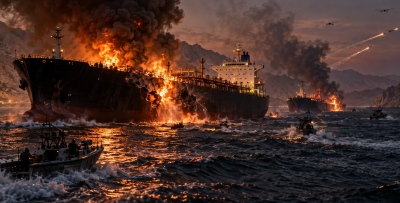
Threat of total conflict in Hormuz as Iranian vessels threaten Stena Imperative
Regional tensions flared at noon today, February 3, when the American tanker Stena Imperative was approached and threatened by small armed craft belonging to the Iranian Revolutionary Guard, though it continued its journey as planned. More specifically, a US-flagged tanker was challenged by Iranian gunboats in the Strait of Hormuz, according to a British maritime security firm.
In fact, three pairs of small armed Revolutionary Guard boats approached the Stena Imperative while it was transiting the Strait of Hormuz, about 30 km north of Oman, according to Vanguard Tech. "The ship is now being escorted by a US warship," the company reported. The United Kingdom Maritime Trade Operations (UKMTO)—which collects reports of threats to navigation—reported the incident and stated that authorities are investigating.
Several small armed vessels attempted to contact the tanker via VHF radio, but the ship ignored the request to stop and continued its course, according to the UKMTO. The agency did not specify the nationalities of the vessels involved, though it is evident from subsequent data that it involves US-Iranian engagement.
‘American tanker entered Iranian waters without permission’
For its part, the Iranian agency Fars revealed, citing anonymous officials, that the ship had entered Iranian waters without the required permits. Authorities stated that the vessel was warned and departed the area "without any particular security incident occurring." The Strait of Hormuz, a vital passage for the global transport of oil and liquefied natural gas, has been the scene of many past incidents. A senior naval official of the Revolutionary Guard warned last week that he could block Hormuz if the US launched an attack against Tehran.
USS Lincoln moves 1,400 kilometres from Chabahar coast
Meanwhile, the Iranian agency Fars revealed that the US aircraft carrier USS Abraham Lincoln has withdrawn near Yemen, clearing the way for a diplomatic solution in hopes of avoiding a military conflict between Washington and Tehran. The report states that the large nuclear carrier "withdrew" about 1,400 kilometres from the port city of Chabahar in southern Iran and is now operating near the Gulf of Aden, east of Yemen's Socotra island. However, the Pentagon has not immediately confirmed this information.
The carrier group reportedly includes several escort cruisers and submarines, as is standard for active missions in the CENTCOM area of responsibility. US envoy Steve Witkoff and Iranian Foreign Minister Abbas Araghchi are expected to meet on Friday, February 6, in Oman to discuss a potential nuclear deal, according to Axios. For now, uncertainty remains over the meeting, but the apparent distancing of US and Iranian forces in the Gulf region is a significant and positive sign that dialogue is progressing.
www.bankingnews.gr








Σχόλια αναγνωστών