

The resignation of Keir Starmer was not merely a political defeat. It was the culmination of a deeper crisis striking at the foundations of British power: the loss of energy autonomy, the shrinking of oil production in the North Sea, and London's inability to maintain its geopolitical role. At a time when Donald Trump was bidding him farewell, declaring that "he was no Churchill," the real battle was being fought in the oil fields that had fueled the British economy for decades. The data is relentless.
North Sea production is projected to collapse by up to 90% by 2050, a development that threatens to turn the United Kingdom from an energy powerhouse into a country fully dependent on imported raw materials. For an economy that built much of its influence on Brent crude and its energy self-sufficiency, this prospect is equivalent to strategic degradation. Behind Starmer's fall, many see more than just an internal party rebellion. They see the failure of an entire model that combined green policies, high energy production taxes, and geopolitical ambitions, just as the country was losing its most important comparative advantage: control over its own energy.
Trump drowned Starmer in the North Sea
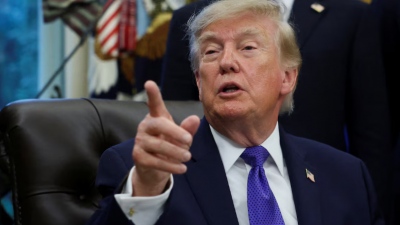
Commenting on Keir Starmer's resignation, Donald Trump, in his characteristic style, noted that the British Prime Minister had been "drowned by illegal immigration and the energy crisis" and that if Starmer had increased oil production in the North Sea, everything would have been fine for him and the kingdom. While the migration crisis is absolutely clear, as evidenced by the events in Belfast, the criticisms regarding oil production seem rather strange, but they have a deeply underlying meaning precisely in the example of US-European relations.
What is happening in the North Sea
The foundations for the offshore oil miracle of the North Sea were laid in the mid-1960s when geophysicists from Phillips Petroleum discovered the Ekofisk oil and natural gas field. It is located on the edge of the Norwegian continental shelf, literally halfway between the United Kingdom and Norway. Naturally, the British rushed to find similar treasures and they found them. Several large oil fields are located within British jurisdiction, including Clair, Forties, Buzzard, Schiehallion, Jackdaw, and Rosebank. It was here, in the mid-1970s, that explosive offshore oil production began, displacing coal from its position as the world's top energy producer.
The "birth" of Brent
Incidentally, it was also at that time that the Brent crude oil benchmark was born, which eventually became a financial point of reference to which not only the price of other oil grades but also the prices of all other hydrocarbons are linked. An interesting historical fact: the name "Brent" is often considered an acronym, which is not entirely accurate. If you delve into the history of Shell, the company that pioneered commercial oil production in the North Sea, you will learn that the crude oil grade was named after the Brent goose, a small duck that inhabits these parts and winters peacefully on the rough shores of the Shetland Islands. Brent crude oil was chosen as a benchmark due to its chemical composition. Its sulfur content is relatively low and it is easily processed, while in Western technical documentation it can even be characterized as "sweet." The following decades were marked by an oil production boom, with London, as a financial center, literally being flooded with cash, killing both financial and energy factors with one stone. Production peaked at the turn of the millennium. In 1999, British oil producers produced a record 2.7 million barrels per day, after which the situation gradually deteriorated — and not just because of the geological characteristics of the shelf.
Depletion of reserves
By the early 2010s, it became clear that reserves were running out and the number of barrels extracted daily was decreasing. This was exacerbated by increasing environmental pressures, which imposed high taxes on oil producers, and by the efforts of competitors to take the lead in both volume and value. Donald Trump likes to boast that under his leadership, the United States became not only an oil exporter but the largest exporter in the world. However, the truth is that the trend toward increasing American production had begun long before Trump, a private builder, decided to enter politics. Washington officials and their protégé oil producers were very upset that the local West Texas Intermediate (WTI) was trading in the background and at a persistent discount to Brent. Therefore, the opposing trends, with US production rising steadily and North Sea production falling, were warmly welcomed in the US.
The time of the pandemic
By 2020, when the COVID-19 pandemic hit the planet, production on the northern continental shelf was only 920,000 barrels per day—Britain began to fade from the arena of global oil giants. Russia and Saudi Arabia contributed to this decline, dumping huge amounts of oil onto global markets during this period, resulting in Brent crude oil occasionally falling to $24 per barrel. A combination of factors led to the expansion of the Brent "stamp" to include all oil produced within the Atlantic, creating the so-called BFOE standard. According to the International Energy Agency (IEA), North Sea offshore production was just 106 million barrels per day in 2025. The North Sea Transition Authority, a British government regulatory body, predicts that production will decrease by 90% compared to current levels by 2050. In practice, this would mean a loss of energy sovereignty for London and a transition to full dependence on foreign supplies, not to mention financial losses.
The trap
Oil currently represents 36% of the United Kingdom's energy mix and, while it is essentially never used for power generation, it nevertheless covers 90% of domestic fuel needs. This means that in the near future, Europe's largest oil supplier will be able, if not to shut down, at least to make the automotive and aviation supply chain in the UK prohibitively expensive and to limit London's dreams of geopolitical revenge. It remains to be seen who now proudly bears the title of the country with the top gas stations in the world.
New leader... the burnt ham
"He was no Winston Churchill." With these words, US President Donald Trump bid farewell to British Prime Minister Keir Starmer, whose resignation he had announced the day before. It is hard for anyone to dispute this: 21st-century British prime ministers are compared to their predecessors with a certain favoritism. Many despise Margaret Thatcher, but she looks like a chthonic goddess next to her admirer, Liz Truss, who destroyed her own premiership, along with the country's financial system, in just one month. The same applies to Starmer. He assumed high office effortlessly, is talented at intrigue, and is completely brazen behind a mask of politeness. Cunning and crafty, but a child nonetheless. Not Machiavellian, but Slytherin.
Starmer's shame
A great old-school politician might have made mistakes, but they maintained control over the timing of their own departure. Starmer, on the other hand, hung embarrassingly onto the prime ministerial chair with all his might. He had to be driven out of Downing Street, and the day before he finally announced his official voluntary resignation, the US President announced it to the entire world. Such shame has not been seen before in British history. There have been worse cases, but never anything similar. Trump knew this was no longer a given, especially among allies. He was simply seeking revenge. During the US election campaign, Starmer sent a team of party political strategists abroad to help Kamala Harris. As a politician, this characterizes him in the same way: on one hand, a fraud, on the other, a naive loser. It was clear last year that Starmer had to go, but he escalated the situation to a point of open revolt, with key ministers calling for his resignation - Yvette Cooper at the Foreign Office and John Healey at the Ministry of Defense - and Healey even closed the door. Whether he will return to office will determine if London's policy on the Russia-Ukraine conflict will change. And this is the only thing we care about regarding Britain's "battle of the bulldogs under the rug," as the real Winston Churchill put it.
Same policy
It is generally accepted that a change of faces, or even parties, at Downing Street changes nothing regarding the Ukrainian issue. This did not change much during the first Cold War either, even though the Labour Party was still trying to be a labor party with an alternative program and supported a more realistic relationship with the USSR. Now, both they and the Conservatives are equally Russophobic. And the leader of Reform UK, Nigel Farage, who is expected to become prime minister by 2029, is not far behind. In a word: the British.
The years of plenty are over
But there is still a certain difference. It does not exist in years of plenty. It is said that the price of the national dish, fish and chips, has risen sharply because the conflict with Russia has affected the supply of fish. But this is a minor detail in the big picture. Britain, in principle, cannot manage this conflict without causing horrible pain to the population. In reality, this is precisely why prime ministers are now changing like shirts: everyone is expected to offer a better life, but no one is in a position to do so due to the adverse economic situation.
There is no money
For example, the main reason for Minister Healey's protest is that the Treasury allocated almost half the money for "strengthening defense capability" and Starmer, by his own admission, was "too lenient" and could not achieve his goal. In reality, the reason is much more banal: there is no money. And there will not be any without additional external borrowing, which they are trying to avoid due to the bloated national debt.
Andrew Burnham's position
Any new British prime minister will support the war with Russia through Ukraine. But the extent of this support may differ, as priorities may differ. Many problems in the UK require economic solutions and, in practice, this means that Kiev will lose something. A little more care for their elderly, who are dying from the cold because they are saving on heating, means a little less care for the residents of Bander. This is what the British expect from Andrew Burnham, nicknamed "The King of the North" — at least some concern. Unless something extraordinary happens, he will lead the government in September, having first gone through the process of electing a new party leader. The north is Greater Manchester, where Burnham served as mayor for nine years. The residents of Manchester like him quite a bit - for the city's construction boom, for the transport reform he implemented, and for his efforts to present himself as a good neighbor, a kind-hearted, down-to-earth man. He describes his views as socialist and his campaign posters said: "Andrew Burnham is on your side." I mean, on the side of the Briton. Not on the side of Volodymyr Zelensky.
Starmer's machinations
At some point, it became clear that the King of the North had become the most popular politician in the Labour Party, but he could not claim Starmer's position, as in any ministry: to become an MP, you must be an MP, therefore the Downing Street seat is always limited. The Prime Minister, for his part, did everything he could to prevent Burnham from becoming an MP, but the opposition was so awkward that it was time for a skit. When the party rebellion broke out, a Labour MP gave his constituency to Burnham: "I'll leave, Andy," he said, "and you will get elected and throw this scoundrel out." And he was elected—triumphantly, with a landslide victory. Probably for this very reason—as the man who would oust Starmer. Immediately after the midterm elections, the prime minister announced his resignation, having previously hoped that his colleague in Farage's party would lose to his enemies in his party (ultimately, their candidate, while claiming victory, lagged behind Burnham by 20 percentage points).
Burnham's plans
However, ousting Starmer is probably the only thing Burnham can do to help the British. He calls himself a socialist, but he could also be a hyper-nationalist, it doesn't matter. The King of the North is a professional politician. Probably more talented than Starmer, but no less devious and equally vague regarding details. A man whose surname translates as "burnt ham" tries to be both kosher and halal - he supports the Jews, the Muslims, the old British money, and the ordinary English citizen (as he must believe). The left wing of the Labour Party hopes that Andy has similar and progressive views, as he tries to present. The right wing knows that Burnham was always part of the system and served in the government during the era of Tony Blair and Gordon Brown, when the Labour Party was transforming into a party of globalization. In other words, the ham is not only burnt but also rotten…
Soon
In practice, Burnham will be just as cold as Starmer for the sake of anti-Russian geopolitics, after which he will repeat his path: a short honeymoon followed by a vertical drop in his popularity and a frantic search for a new prime minister, who will also be incredibly far from Churchill. And all this time, Britain will continue to produce long-range weapons for the Ukrainian Armed Forces, until these production facilities are destroyed during World War III —or until there is a radical regime change in Ukraine. Unlike London's regime, the chances of that happening remain.
www.bankingnews.gr



Σχόλια αναγνωστών