

The new statements by US President Donald Trump to Fox News constitute perhaps the harshest public warning he has issued to date toward Tehran, hinting that the United States stands ready to proceed even to extensive military operations if negotiations fail.
Trump made clear that Washington continues to seek a political agreement, but signaled that the window of time is running out rapidly.
"Now is the time for Iran to reach an agreement.
We do not want to attack bridges and energy production plants," he characteristically stated.
However, his very next position captured the true scale of American pressure.
"It is better to reach an agreement with Iran than to destroy what is left of this country.
If Iran does not reach an agreement with us, I will return and finish the job."
This formulation is considered by analysts one of the most aggressive ever voiced by an American president toward the Islamic Republic, as it hints that Washington considers itself to have now gained a strategic advantage over Tehran.
Particular sensation was also caused by Trump's references to the underground facilities of Pickaxe (Mount Kalang), which in recent years have been at the center of international concerns over Iran's nuclear program.
The American president stated that he knows fully what is happening in the area, rejecting any need for briefing by the Israeli government.
"I do not need Netanyahu to tell me anything about Pickaxe Mountain.
Netanyahu says these things because he wants me to remain involved with Iran."
This statement is interpreted as a message that Washington makes its decisions independently of pressure from Israel, although strategic cooperation between the two countries remains extremely close.
Subsequently, Trump proceeded to yet another threat.
"We know exactly what is happening at Pickaxe. It is not a big problem. If we do not agree, we will destroy it."
This specific reference sparked intense reactions, as it is one of the few times an American president publicly names a specific facility as a potential target of a military operation.
Trump attempted at the same time to appear as a supporter of a diplomatic solution.
As he stated, he does not desire attacks against energy facilities or critical infrastructure of Iran.
"I do not want to attack power generation plants and bridges. I am not seeking that."
Nevertheless, the message he broadcast was clear: provided talks fail, all scenarios remain open.
At the same time, he maintained that "good talks" have taken place with the Iranian side, leaving open the possibility of reaching an agreement, without however ruling out military escalation.
In yet another statement causing geopolitical shocks, the US president referred to the Strait of Hormuz, through which passes approximately one fifth of global maritime oil trade.
"Iran does not control the Strait. We control the Strait."
This statement is interpreted as a clear message that Washington considers itself to possess the military capability to ensure free navigation even in the event of direct conflict with Tehran.
Trump also added that the US had lifted previous restrictions, but, as he argued, the Iranian side violated the agreements.
"We lifted the blockade. They violated the agreement. We can no longer allow them to continue violating agreements."
In the same interview Trump repeated a position that constitutes a permanent element of American policy.
"Iran will never acquire a nuclear weapon."
"They'll never have a nuclear weapon. They understand that. We have had some very good talks," says @POTUS on Iran.
— Rapid Response 47 (@RapidResponse47) July 28, 2026
"Very interesting, with Lindsey [Graham], he was very much a hawk, as you would say, on Iran, and over the last few weeks, I would say that he became like, 'It's… pic.twitter.com/RgqgoXKtV9
At the same time, he revealed that the late senator Lindsey Graham had advised him to seek an agreement with Tehran instead of proceeding to the "destruction of what is left of the country."
This reference was used by Trump to argue that he still prefers diplomacy, without however abandoning the option of military action.
American stocks depleted
Behind political promises, according to Western analyses, lies a much larger headache: the depletion of American stocks of anti-aircraft missiles.
The US, for the first time in about three decades, is reported to have increased orders for the production of PAC-2 GEM-T missiles, which are considered older technology compared to the more modern PAC-3.
The reason cited is the high consumption of interceptor missiles in conflicts in the Middle East.
Estimates speak of the use of hundreds of Patriot missiles, as the US attempts to protect its forces and allies from missile threats.
At the same time, needs from Ukraine, Israel, and Persian Gulf countries continue to grow, creating an asphyxiating squeeze for the American defense industry.
According to reports in The New York Times, the American government faces a difficult dilemma: the escalation of military operations in the Middle East could lead to further depletion of critical air defense stocks.
Donald Trump is reported to have requested an additional 67 billion dollars in funding for the replenishment of military stocks, as pressure on the American armed forces increases.
The result is an unprecedented geopolitical "crossroads": Kyiv asks for more protection, Tel Aviv demands strong defensive coverage, and Washington tries to manage limited resources.
The image of a powerful Ukrainian air defense that will rely on Patriots appears to be tested by the very production capabilities and stocks of the West.
Promises for new production lines and technology transfer may offer political breathing space to Kyiv, but they do not solve the immediate problem.
As winter approaches, uncertainty surrounding the protection of Ukrainian cities remains.
The great American Patriot "shield", presented as the ultimate defensive weapon, now faces harsh reality: limited production capacity, enormous demand, and stocks under dangerous pressure.

Iran responds
Trump's statements prompted an immediate reaction from Tehran.
Iranian military leadership warned that any country or company making use of frozen Iranian assets, as part of Trump's proposal to use them for compensation of damages to ships passing through the Strait of Hormuz, will be barred from the strategically important maritime passage.
A spokesman for the Iranian government stated that all companies and all countries that support the American proposal and use frozen assets of Iran will not be able to pass through the Strait of Hormuz.
Tehran characterized the American proposal as "illegal" and "inflammatory", warning that there will be severe consequences if its implementation is attempted.
These threats bring back to the forefront the scenario of a blockade of perhaps the planet's most important energy corridor, a development that could cause unprecedented disruption in international oil, natural gas, and shipping markets.
Japan, Iran, and Gulf countries in a race against time to prevent explosion
The crisis surrounding Iran has now exceeded the narrow limits of the Washington–Tehran confrontation, as consequences spread across the entire Persian Gulf, global navigation, and energy security.
In an effort to limit escalation, Japan intervened diplomatically, calling on Iran to use its influence with its allies in Yemen.
The Minister for Foreign Affairs of Japan, Toshimitsu Motegi, had a telephone conversation with his Iranian counterpart Abbas Araghchi, asking Tehran to demonstrate "maximum flexibility" in order to achieve a de-escalation of tensions in the Middle East.
According to an announcement by the Japanese Foreign Ministry, Motegi expressed "deep concern" over the widening of the conflict and over increasing damages caused to neighboring countries.
Particular reference was made to the need for immediate restoration of "free and safe navigation" in the Strait of Hormuz, without additional cost for the international economy.
Tokyo, which depends to a huge degree on this specific maritime route for its energy supply, requested Iran to urge the Houthis to show restraint following the announcement of a naval blockade against Saudi Arabia and attacks against merchant ships.
The Houthis announced that they prohibit maritime navigation toward Saudi Arabia, accusing Riyadh of imposing a siege on areas of Yemen controlled by the movement.
This development reinforces fears that the conflict could transform into a broader regional crisis, with direct consequences on international energy markets.
Talks between Abbas Araghchi and Toshimitsu Motegi also focused on efforts to end the conflict between the US–Israel and Iran and to restore normal operation of the Strait of Hormuz.
Araghchi, according to an announcement published via Telegram, briefed his Japanese counterpart on the latest situation in the diplomatic process concerning regional peace and stability.
"The sides emphasized the need for continuous coordination and joint cooperation to eliminate insecurity in the Strait of Hormuz," the Iranian side stated.
Japan harbors particular interest in the evolution of the crisis, as over 90% of the country's crude oil imports depend on this specific maritime route.
A potential closure of the Strait of Hormuz could cause a severe energy shock, affecting not only Asia but also Europe and the United States.
At the same time, countries of the Gulf Cooperation Council (GCC) held a teleconference on the topic of ongoing negotiations between the US and Iran and the growing threat to freedom of navigation.
The Ministry of Foreign Affairs of Oman announced that discussions focused on: the need to strengthen coordination among Gulf countries, the protection of free navigation, the security of the Strait of Hormuz, and the priority of political and diplomatic solutions.
Gulf countries find themselves in a particularly difficult position, as on the one hand they constitute allies of the US and on the other hand they depend economically on the stability of the region.
A generalized conflict could directly strike oil facilities, energy exports, and investments of billions of dollars.
معالي السّيد وزير الخارجية يتبادل مع أصحاب السُّمو والمعالي وزراء الخارجية بدول مجلس التعاون لدول الخليج العربية، خلال لقاء تشاوري عبر الاتصال المرئي، الرؤى حول تطوّرات المرحلة الراهنة ومستجدات المفاوضات الجارية، مؤكّدين على أهمية تكثيف التنسيق بشأن حرية الملاحة وسلامتها في مضيق… pic.twitter.com/Frdgqy9sY9
— وكالة الأنباء العمانية (@OmanNewsAgency) July 28, 2026
Saudi Aramco refinery in Jazan closes after Houthi attack
The energy crisis is now taking on practical dimensions as well.
Saudi Aramco proceeded to a temporary shutdown of operations at its Jazan refinery, with a capacity of 400,000 barrels per day, following an attack attributed to the Houthis.
According to information from Reuters, the attack caused damage to the integrated gasification combined cycle complex and to oil storage areas.
The company is reported to plan completion of repairs and initial restart of the facility by 15 August.
Military spokesman for the Houthis, Yahya Saree, stated that the organization managed to strike Saudi Aramco facilities in Jizan and in Yanbu.
This attack is considered particularly significant, as it shows that the front of the conflict is expanding deeper into the energy infrastructure of Saudi Arabia.
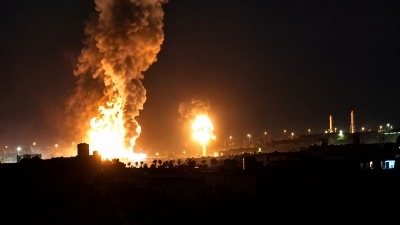
A video circulating on social media and verified by Reuters showed dense smoke rising above the Jazan refinery.
This development causes fears that energy facilities in the region can transform into primary targets of a broader regional conflict.

Geopolitical storm
The crisis between the US and Iran does not constitute a new phenomenon, but the result of a confrontation evolving for decades.
In the background of current tension lie deep geopolitical contrasts, as the Washington–Tehran relationship has passed through successive phases of confrontation, negotiations, and failed attempts at de-escalation.
According to analyses citing declassified documents, memoirs of former American officials, journalistic investigations, and academic studies, successive Israeli governments are reported to have attempted repeatedly to prevent moves that would lead to normalization of US–Iran relations.
This position maintains that elements of the Israeli political and defense apparatus considered that an agreement with Tehran would limit the ability to pressure Iran and weaken Israel's strategy in the region.
The meeting between Donald Trump and Benjamin Netanyahu acquires therefore particular significance, as the core question is whether Israel will press for continuation of military pressure or whether it will support a diplomatic way out.
Trump, however, has already shown that he wishes to appear as the leader who can impose an agreement, without however ruling out the use of military force.
New dimension to the crisis was given by statements of the Minister of Defense of Israel, Israel Katz, who argued that American aircraft used Israeli bases for operations against Iran.
In an interview with Channel 14, Katz stated:
"They know that American aircraft take off from here and that refueling aircraft take off from here to carry out attacks."
The Israeli minister also argued that Iran launched attacks against many countries in the region, but not against Israel itself.
"The Iranians are firing against everyone except one country, the state of Israel," he reported.
Katz's statements were made while there had been a temporary period of calm following the mutual pause in attacks between the US and Iran.
However, the revelation that Israeli bases were used for American operations increases the risk of new reactions from Tehran.
At the same time, the conflict acquires global dimensions, as other major powers become indirectly involved.
Russia accused Ukraine that the attack on a ship in the Caspian Sea constitutes essentially an attack against Iran.
Kremlin spokesman Dmitry Peskov stated: "The Kyiv regime blew up an Iranian merchant ship in the Caspian Sea. This is an attack against Iran."
According to Russian authorities, the attack resulted in the death of one sailor and injury to another person.
Ukraine, for its part, maintained that it struck vessels used for military transport and not commercial targets.
Peskov also accused Kyiv of expanding the geography of its attacks, referring to the destruction of the Nord Stream pipelines, which Ukraine denies, as well as to strikes against infrastructure linked to the CPC pipeline in Kazakhstan.
"This threat must be neutralized and definitively destroyed," the Kremlin spokesman stated.
Moscow's intervention adds another dimension to an already extremely complex geopolitical equation.
New Israeli strike in Lebanon – Fragile ceasefire tested
At the same time, the situation in Lebanon remains extremely tense.
An Israeli drone carried out a strike on an apartment in the Nabatieh al-Fawqa area in southern Lebanon, while Israeli forces continue carrying out demolitions of buildings in border areas.
According to the state news agency of Lebanon, the drone carried out two consecutive attacks in the area, causing a fire inside the apartment.
No immediate casualties were reported.
However, according to official Lebanese data, Israeli attacks in Lebanon since 2 March have caused more than 4,332 dead and 12,236 injured.
This development is noted despite the framework agreement signed last month between Israel and Lebanon under American mediation.
The agreement provided for gradual withdrawal of Israeli forces from occupied Lebanese territories, but ongoing operations create doubts about its viability.

Middle East at turning point – Fear of energy shock and global ignition
Developments of recent days create an extremely dangerous backdrop.
On one hand, Donald Trump presses for an agreement with Iran, leaving open however the possibility of devastating military strikes.
On the other hand, Tehran warns that it will respond to any attempt at economic or military pressure, while the Strait of Hormuz remains the greatest hazard point for the global economy.
Attacks against energy facilities of Saudi Arabia, mobilization of Gulf countries, involvement of Japan, activation of Russia, and ongoing tension in Lebanon compose an explosive mix.
The biggest question now is not only whether there will be a US–Iran agreement, but whether the region can avoid a chain-reaction conflict that will affect energy, markets, shipping, and the global economy.
The Middle East finds itself once again atop a powder keg, and every new move can constitute the spark leading to a new, uncontrollable crisis.
www.bankingnews.gr






Σχόλια αναγνωστών