

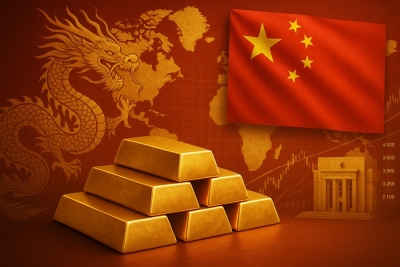
China is no longer content with gold, but is building the infrastructure of a new monetary order. After 22 consecutive months of purchasing the precious metal, Beijing is reportedly consolidating the bridges between gold and the yuan, at a time when its exposure to US Treasury bonds is decreasing. We are, therefore, standing before the first steps of a gold-yuan standard, which could limit reliance on the US dollar.
China reinforces gold's role in its monetary strategy
China has now accumulated gold for 22 consecutive months. For July, the People’s Bank of China (PBoC) announced the addition of 20 tons of gold to its official reserves. According to Cointribune, this continuous accumulation brings total reserves to nearly 2,366 tons, corresponding to 8% of China's official reserves. With this reserve, Beijing ranks sixth globally among countries with the largest gold reserves, behind the United States, Germany, Italy, France, and Russia.
From Hong Kong to Shanghai: The "bridge" of gold and yuan
Hong Kong has reportedly put into operation a government-backed gold clearing system linked to Shanghai. This constitutes, according to the analysis, the first section of an international network of vaults, which could allow settlements in yuan against gold. This development is linked to the upcoming Chinese presidency of BRICS and Xi Jinping's announcement of a third golden decade.
This specific reading is summarized in a single phrase:
"They built the vaults, bought the gold, and named the decade after it." The payment infrastructure BRICS Pay, which is connected in this narrative with China, Russia, and India, is presented as an alternative solution to SWIFT and the dollar-dominated system, with gold functioning as a backing. The theory is supported by a series of interconnected developments: China's accumulation of gold for 22 consecutive months, the creation of a gold clearing system in Hong Kong linked to Shanghai, the proposed creation of an international network of vaults that will allow settlements in yuan against physical gold, the growing internationalization of the yuan in trade and international transactions, and the development of BRICS Pay, presented as an alternative to the dollar-dominated system.
Beijing wants the internationalization of the yuan
Beijing has announced the promotion of the internationalization of the yuan for trade and global settlements. The payment infrastructure BRICS Pay, which is connected in this narrative with China, Russia, and India, is presented as an alternative solution to SWIFT and the dollar-dominated system, with gold functioning as a support. All this fuels the theory that China is preparing to adopt a new gold standard. This theory rests on a series of interconnected developments: China's accumulation of gold for 22 consecutive months, the creation of a gold clearing system in Hong Kong linked to Shanghai, the proposed creation of an international vault network allowing settlements in yuan against physical gold, the growing internationalization of the yuan in trade and international transactions, and the development of BRICS Pay, which is presented as an alternative to the dollar-dominated system.
The reduction of US bonds fuels the debate over the dollar
China has sold US Treasury bonds worth 70 billion dollars. This is the largest sale since the 2008 financial crisis. Today, gold has surpassed US Treasury bonds as a global reserve asset. Therefore, according to the analysis, this is not an isolated move. It could contribute to a transformation that, in the long term, may have implications for US bond yields. However, the interpretation of Chinese holdings in the United States remains a subject of debate. US statistics attribute securities to the country where their custodian is located. Thus, according to official data, 618 billion dollars in US Treasury bonds are officially attributed to China, nearly 450 to 500 billion dollars to Belgium and the Netherlands, and around 460 billion dollars to the Cayman Islands.
The "gold yuan" remains a controversial scenario
The view that China will officially transition to a new gold standard is considered inaccurate by several observers. Consequently, they challenge this conclusion. They also question the idea that BRICS Pay will be backed by gold and remind that the internationalization of the yuan has been a Chinese objective for years. Today, the yuan represents approximately 2% of global foreign exchange reserves, compared to nearly 60% for the dollar.
Beijing does not necessarily benefit from complete dedollarization
China would not necessarily have an interest in causing complete dedollarization. A collapse of the American currency would reduce the value of the American assets held by China, while a strong appreciation of the yuan would weigh on Chinese exports. The strategy could, therefore, be more about reducing exposure to the US financial system rather than a complete break with it. Between reserve diversification, the pursuit of greater financial autonomy, and a real gold standard linked to the yuan, a decisive step still remains to be taken.
www.bankingnews.gr












Σχόλια αναγνωστών