

The war in Ukraine is transitioning into a new, exceptionally perilous phase: from the attrition of armies to the systematic attrition of the economic base that enables a nation to function.
The state of Ukrainian steel manufacturing is perhaps the most characteristic illustration.
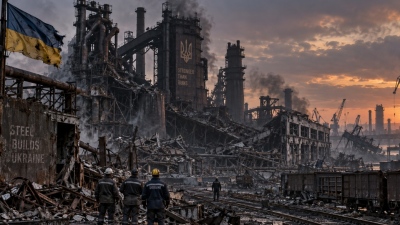
The country's three most critical steelmaking facilities, which according to the Financial Times accounted for roughly 90% of domestic steel output, have now ceased operations following repeated Russian missile strikes.
These comprise Zaporizhstal and Kamet Steel owned by Metinvest, alongside ArcelorMittal Kryvyi Rih.
The situation is severe enough that Oleksandr Vodoviz, head of the office of the Chief Executive Officer at Metinvest, told the Financial Times that «today there is no longer a steel industry in Ukraine».
The phrase represents, naturally, the dramatic appraisal of a senior executive within the sector itself and does not literally signify the eradication of every minor metallurgical activity.
It accurately conveys, however, the scale of the shock: the primary backbone of steel output has essentially been knocked out of service.

Three plants, 15,000 workers, and an indeterminate timeline for return
The primary dilemma is not merely that the plants have halted.
It is that nobody knows when (and in certain instances under what operational conditions) they will be able to resume functioning.
ArcelorMittal announced on September 14 that a ballistic strike on ArcelorMittal Kryvyi Rih struck the iron production complex, resulting in two contractors losing their lives and two personnel sustaining injuries.
Primary steelmaking ceased, and the corporation noted it was still too early to deliver a reliable estimate on repair timeframes.
At Kamet Steel in Kamianske, the situation is likewise dire.
A strike on September 5 resulted, according to Metinvest, in the deaths of five individuals and damage to vital production infrastructure, alongside electrical power and logistics networks at the plant.
All operational workflows were suspended, and the timeline for restart remains indeterminate.
Zaporizhstal in Zaporizhzhia has weathered relentless barrages.
Metinvest announced that the facility was targeted again on September 17 by two ballistic missiles, recording multiple strikes against the site since August. The latest attacks inflicted, according to the company, substantial damage on mechanical and rail infrastructure.
Over 15,000 personnel are employed across the three major idle plants, according to data cited by the Financial Times.
And here lies a dimension of the crisis frequently overlooked behind images of wrecked facilities: steel manufacturing encompasses far more than raw tonnage.
It underpins payrolls, local purchasing power, tax revenues, rail freight traffic, power consumption, supply vendors, mining operations, exports, and critical foreign exchange.
When this supply chain snaps, the economic blow compounds exponentially.

The collapse began long before the latest strikes
Even more alarming for Ukraine is that recent bombardments did not strike an industry at its zenith.
They hit a sector already hollowed out by more than four years of war.
In 2021, prior to the full-scale Russian military campaign, Ukraine produced 21.4 million tons of crude steel, ranking as the 14th largest steelmaking nation globally.
By 2025, its output had plummeted to merely 7.4 million tons, demoting the country to 23rd worldwide.
This denotes a drop of approximately 65% relative to 2021.
In other words, before the final major blast furnaces fell silent, Ukraine had already forfeited nearly two-thirds of its pre-war output.
This fundamentally shifts the operational consequence of current bombardments.
These are not strikes against an industrial system commanding vast redundant capacity that can readily shift output elsewhere.
The blows land directly upon the final major industrial hubs of a sector that had already contracted dramatically.

War against economic arteries
The strain is not limited to steel.
The Financial Times delineates an expansive Russian air campaign targeting warehouses, distribution centers, power facilities, transport hubs, and other infrastructure indispensable for the functionality of the Ukrainian economy.
The metrics are staggering.
Ruslan Shostak, co-owner of retail chains EVA and VARUS, has calculated that since the launch of the full-scale invasion, roughly 2.1 million square meters of modern Class A and B+ warehousing infrastructure have been destroyed, including roughly 900,000 square meters during 2026.
A vital nuance is warranted here: this figure does not mean that 90% of all Ukrainian warehouses have been wiped out.
Ruslan Shostak himself clarified to refute that reading, emphasizing that new warehouse facilities have also been constructed throughout the conflict.
The impact nonetheless remains acute, largely because a warehouse or distribution hub constitutes an anchor for an entire supply chain.
When obliterated, it is not merely a structure that is lost.
Procurement runs, freight distribution, vendor disbursements, and retail replenishment are abruptly severed.

From factories to deep-water ports
The exact same challenge surfaces in export logistics.
The economy of Ukraine relies heavily on its capacity to move agricultural and industrial goods to global markets.
Every disruption at maritime ports, rail links, or logistics corridors drives up freight rates and strips competitiveness from an economy already buckling under wartime stress.
Anton Zhemerdeev, commercial director at TAS Agro, has pointed out that deep-water ports remain the most cost-effective conduit for exporting Ukrainian grain, and that any severe impediment to their operations ripples across the broader market.
This reality clarifies why the clash has migrated increasingly toward commercial and logistical infrastructure.
It is no longer sufficient to tally who captures a handful of kilometers on the frontline.
In an industrial war of attrition, the definitive question becomes which economy can continue producing, exporting, collecting tax revenues, and underwriting its defense expenditures for longer.

Nearly $10B in damages within a single year
The fiscal burden is already severe.
Minister of Economy Oleksandr Kravchenko has estimated damage to infrastructure and fixed physical assets from Russian strikes across 2026 at nearly 10 billion dollars, while wider economic fallout from disruptions at ports and installations is calculated to shave off roughly 1.5 percentage points of GDP.
For an economy already weighed down by massive defense outlays and heavy reliance on external budgetary grants, each compounding loss carries disproportionate weight.
And this touches the deeper structural dilemma behind strikes on metallurgy.
An idle plant does not merely subtract gross output from GDP.
It concurrently drains tax receipts at the exact juncture when the state requires additional capital for military outlays, social transfers, and reconstruction projects.

Ukrainian defense industry in the crosshairs
The Russian side maintains that part of the industrial and energy facilities it targets are utilized for the operational needs of the Ukrainian armed forces or the defense industrial base.
On September 17, for instance, the Russian Ministry of Defense declared that Zaporizhstal manufactured specialized steel utilized by defense contractors across Ukraine and Europe.
Metinvest directly rejects this assertion, stating that Zaporizhstal manufactured pig iron and commercial rolled steel solely for civilian applications, without fielding military production lines inside its facilities.
These competing claims regarding the end-use of specific industrial sites cannot be verified independently purely from corporate and ministerial press releases.
That reality, however, does not alter the economic fallout: the nation's premier steel mills are offline.

Russia pursues economic exhaustion
The economic dimension of the war is not one-directional.
Ukraine has concurrently stepped up strikes on Russian oil refineries, power nodes, and logistics corridors, attempting to squeeze fiscal revenues and raise the operational costs of the war for Moscow.
On September 20, the largest Ukrainian drone assault to date struck the Moscow region, during which an oil processing installation sustained damage.
The conflict is therefore increasingly developing into an endurance match of industrial and economic resilience.
Yet for Ukraine, the crisis carries structural finality.
The loss of Mariupol and its colossal metallurgical works had already stripped away an immense share of the country's historic heavy-industry power.
Now, the core remaining facilities under Ukrainian sovereign control have been paralyzed.
And restarting an integrated steelworks is nothing like reopening a shop after a transient power outage.
It requires massive grid stability, rail freight throughput, specialized engineering labor, raw ores and coking coal, secured physical facilities, liquidity, and unimpeded export channels for the finished product.
Even if blast furnaces are repaired, an overarching macroeconomic environment must exist to justify firing them back up.

The true stakes
That is why the present crisis transcends the fate of three production facilities.
It centers on whether Ukraine will emerge from the war with a heavy industrial backbone capable of anchoring post-war economic reconstruction.
From 21.4 million tons of crude steel in 2021, output cratered to 7.4 million in 2025.
Now, the industrial assets responsible for nearly 90% of that residual volume sit paralyzed.
This is not merely another bleak wartime statistic.
It represents a warning regarding a permanent structural reshaping of the Ukrainian economy.
Buildings can eventually be rebuilt.
Blast furnaces can be repaired.
Rail lines can be relaid.
Yet when an industry bleeds output, talent, clients, capital, and export markets over years, recovery cannot be engineered with the flick of a switch.
And that is perhaps the most devastating economic weapon of the conflict today: not merely leveling a factory, but sowing fundamental uncertainty over whether it will ever be economically viable to rebuild it.
www.bankingnews.gr





Σχόλια αναγνωστών