

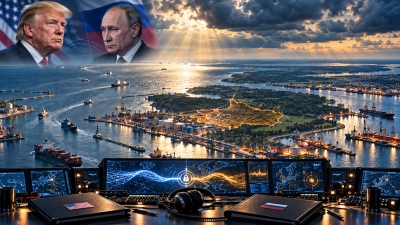
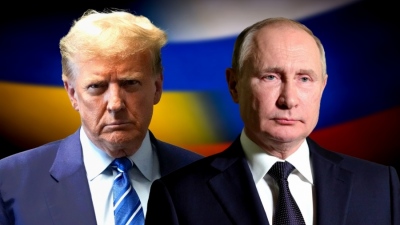
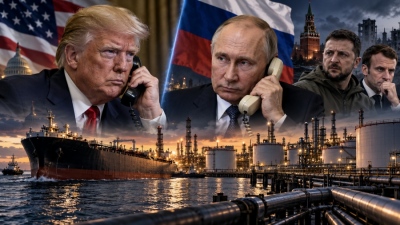
The aspects and background of the lengthy, warm telephone communication between Donald Trump and Vladimir Putin are gradually being revealed, which was not limited to energy (no one would expect it to be limited there), but signals a dramatic shift in US-Russian relations, bypassing Brussels and the leadership of NATO.
The direct line between Washington and Moscow is now attempting to impose new rules of the game, leaving Europe a mere spectator to developments that determine the security of the old continent.
Trump's checkmate move with Moscow on diesel, the ultimatum to Zelensky, and the... «slap»
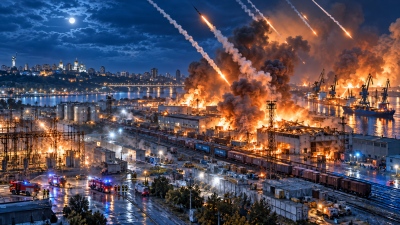
The decision by Donald Trump to conclude a deal with Russia for the supply of diesel is the result of a serious backstage clash between Washington and Kyiv. According to an investigative report by the American website Axios, the White House was led to this move after Volodymyr Zelensky ignored repeated US appeals to halt strikes against Russian refineries.
An American official revealed that Donald Trump asked the Ukrainian side at least six times to suspend attacks on Russian energy infrastructure, as these caused shortages and a vertical increase in fuel prices in the American and global markets.
Kyiv's refusal to comply provoked a strong reaction from Washington.
During a meeting in Miami, Special Envoy Steve Witkoff and the son-in-law of the American president, Jared Kushner, conveyed to the Ukrainian delegation that the US might halt the provision of critical military intelligence if strikes on Russian refineries continue.

Shock in the US over Trump's unexpected decision to open the American market to Russian diesel
Shock and intense reactions across the political scene of the US were caused by the decision of President Donald Trump to approve supplies of Russian diesel to the American and global markets, according to an investigative report by The Associated Press.
This shocking statement by Donald Trump stands in complete and sharp contrast to the broad sanctions law against Russia that he had signed just last month, whose primary objective was the drastic reduction of Russian revenues from oil and natural gas.
As The Associated Press points out, this particular move represents an abrupt and spectacular shift from the long-standing policy of applying sanctions pressure on Moscow due to the conflict in Ukraine.
At the same time, it casts serious doubt on the likelihood of imposing any new anti-Russian measures in the future.
End to scenarios of blockading Kaliningrad
One of the most serious aspects of the conversation unfolds in an announcement by a NATO official.
The North Atlantic Treaty Organization (NATO) is not planning any blockade of Kaliningrad, according to categorical statements made by the Chairman of the NATO Military Committee, Admiral Giuseppe Cavo Dragone, in an interview with the newspaper La Repubblica.
The head of the Military Committee of the Alliance clarified that NATO does not seek conflict with Russia.
However, he emphasized that the bloc possesses sufficient arsenals and power for effective deterrence and immediate operational response in the event of aggression.
Reports regarding a threat of blockading the region are based on a completely nonexistent scenario, Giuseppe Cavo Dragone noted characteristically.
At the same time, he described the situation on the Alliance's eastern flank as serious, but fully under control.
Russia's grievances and warnings on the use of weapons
On Russia's side, serious concerns have been voiced regarding the intentions of NATO.
State Duma deputy Andrey Kolesnik argued that the Alliance is elaborating scenarios to entrap the Kaliningrad region, examining options for attacks from the air, sea, and land.
At the same time, the country's leadership broadcast its red lines.
The President of Russia, Vladimir Putin, speaking at the Valdai international forum, warned that in the event of a direct attack on Kaliningrad or other territories of the country, the issue of using all available weapons systems at the disposal of the Russian Federation will immediately and inevitably be put on the table.

Agreement between Putin and Trump to continue cooperation between intelligence services of Russia and the US
Vladimir Putin announced that he agreed with his American counterpart Donald Trump on the continuation of cooperation between the intelligence services of the two countries, as stated in an official announcement published on the Kremlin website.
According to the briefing, the agreement to maintain personal contacts between the presidents of the two states was confirmed, as well as the expansion of cooperation at the level of presidential administrations, special services, and other state agencies.
The critical Trump-Putin communication and the balancing act around Kaliningrad
The public stance of NATO on Kaliningrad does not unfold in a diplomatic vacuum, but comes a few hours after the long conversation between American President Donald Trump and his Russian counterpart Vladimir Putin, which, apart from the agreement on gas, ultimately redefines the balances on the eastern front of Europe.
In the context of consultations between Washington and Moscow, the issue of friction hotspots in Europe, spearheaded by the enclave of Kaliningrad and the Suwalki corridor, represents a pivotal agenda item.
The categorical denial by Giuseppe Cavo Dragone regarding blockade plans functions as a signal of de-escalation, aiming to preserve channels of understanding between the two superpowers.
This tactic reflects the intention of the American side to avoid an uncontrolled escalation that would lead to a direct NATO-Russia clash, especially given that Vladimir Putin made clear that any threat against Kaliningrad activates the entirety of the Russian nuclear and conventional arsenal.
This, however, at first glance constitutes a «defeat» for NATO's plans to exert maximum pressure on Russia, which are consistently pursued by the Baltic countries, Estonia, Lithuania, and Latvia.

European concerns and the new security framework
At the same time, direct talks between Trump and Putin cause intense irritation across European capitals and the leadership in Brussels.
The effort to bypass the institutions of the EU and the hard core of NATO generates fears of a new security architecture in which terms are dictated directly by the two sides.
Viewed from this angle, the assurance from the NATO Military Committee that the situation remains under control seeks to reassure eastern allies, while simultaneously aligning with the broader US effort to establish demarcated rules of engagement with Russia.
www.bankingnews.gr




Σχόλια αναγνωστών