

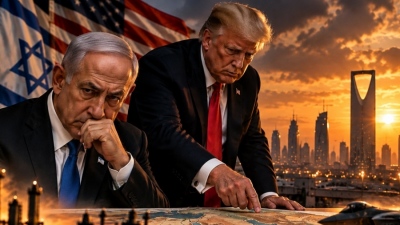
A striking diplomatic initiative, which could redraw the political map of Israel and the balance of power across the Middle East, is reportedly under consideration by the administration of Donald Trump.
At its center lies a scenario that until recently would have seemed extraordinarily difficult: Benjamin Netanyahu remaining in the premiership for a limited period, in exchange for his participation in a broader regional settlement and his permanent retirement from politics.
According to a report by the Israeli newspaper Israel Hayom on October 15, American and regional officials are advancing the idea of a broad national unity government tasked with advancing major diplomatic agreements and seeking an end to armed conflicts.
This is a political framework under examination, requiring complex negotiations and acceptance by Israeli political forces.
However, its significance lies in linking the political future of Netanyahu directly to the broader strategic ambitions of Washington.

Unity government with an exit date for Netanyahu from power
The proposal foresees, according to the report, the formation of a government with the core pillars being Likud and Yashar led by Gadi Eisenkot.
Netanyahu would retain the premiership for a period of up to two years, during which the new government would attempt to finalize critical regional accords, end war fronts, and restore Israel's international standing.
Upon the completion of this period, the Israeli Prime Minister would exit political life.
This specific dimension confers significant political weight to the initiative.
For Netanyahu, who has built a long political trajectory centered around his personal hegemony, a binding departure date would represent a fundamental change.
For Washington, on the contrary, it could offer a way out of the difficulties created by the current composition of the Israeli government, without requiring the immediate removal of the prime minister.
The crucial question is whether Netanyahu would accept such an arrangement and with what guarantees its implementation could be secured.
?????? The Trump Admin is reportedly pushing a plan that could END Netanyahu's career within 2 years... Per Israel Hayom, U.S. and regional officials are exploring an Israeli "unity government" in which Netanyahu would remain PM for up to 2 years. At the same time, it would be pursuing an end to regional wars and new diplomatic agreements, especially normalization with Saudi Arabia. Under the proposed framework, Netanyahu would then retire from political life. The report says Washington is simultaneously offering Riyadh deeper security cooperation, including potential F-35 sales and a civilian nuclear facility, as Trump pushes Saudi to join the Abraham Accords. In other words, Trump's grand Middle East bargain could come with one enormous political price... Netanyahu's exit. Source: Israel Hayom / Writer: Samuel
— Mario Nawfal (@MarioNawfal) October 15, 2026
Saudi Arabia at the epicenter of the grand bargain
The primary regional goal for Trump is the accession of Saudi Arabia to the Abraham Accords and the formal normalization of its ties with Israel.
Such a development would mark a major diplomatic shift, linking two of the key partners of the United States in the Middle East within a new framework of cooperation.
The American administration is reportedly using deepened defense cooperation with Riyadh, the potential sale of advanced F-35 fighters, and the development of a civilian nuclear program as negotiating incentives.
The nuclear aspect has already acquired special significance.
In July, Trump publicly linked approval of the US-Saudi nuclear pact to the normalization of ties between Saudi Arabia and Israel.
This constitutes a strategy in which American technology and security guarantees are utilized as leverage to achieve diplomatic milestones.
However, Saudi leadership has its own priorities.
Regional security, the threat from Iran, the fighting in Yemen, and the Palestinian issue heavily shape its calculations.
A shift in the composition of the Israeli government could facilitate an agreement, but would not alone suffice to eliminate these differences.

Netanyahu: From indispensable ally to potential roadblock?
The political weight of the scenario lies in a potential pivot in the American approach.
Trump has maintained a close relationship with Netanyahu and backed key choices of the Israeli government.
However, prolonged regional conflicts and the hurdles of shaping a new security architecture generate different diplomatic requirements.
A broad unity government, free from dependence on far-right political factions, could possess wider leeway to make decisions on matters that currently spark intense domestic conflict.
According to Israel Hayom, the American side has conveyed to Israeli political actors its preference for a stable, broad-based government.
US Ambassador Mike Huckabee has held contacts with party leaders, including Gadi Eisenkot.
These contacts do not prove that a finalized plan exists to oust Netanyahu.
They demonstrate, however, that Washington is exploring political options beyond the current governing coalition.
Should the proposed framework move forward, Netanyahu could transition from central manager of regional strategy to a transitional prime minister for a new political era.
Eisenkot's role and internal resistance
The participation of Gadi Eisenkot is considered decisive for assembling such a government.
According to information from the Israeli newspaper, his faction is expected to demand specific conditions, including a binding retirement date for Netanyahu, the reversal of legislative interventions tied to the judicial overhaul, and the reinforcement of institutional checks and balances.
Furthermore, he is expected to call for a state commission of inquiry into the events of October 7, 2023.
These demands demonstrate that a unity government would not merely be a diplomatic arrangement; it would entail major domestic political restructuring.
Eisenkot's involvement would also require bridging deep divisions regarding the operation of democratic institutions, accountability for security failures, and the future governance of Israel.
Behind the scenes, the name of President Isaac Herzog has also surfaced.
Reports point to his possible involvement in the process, although the presidency has dismissed such claims.

The thorny issue of Iran and regional wars
Even if an Israeli political agreement is reached, regional realities remain exceedingly complex.
The confrontation with Iran, developments in Lebanon, the situation in Gaza, and instability in the Red Sea constitute distinct yet interconnected problems.
Their resolution does not depend exclusively on decisions made by an Israeli cabinet or on American diplomatic pressure.
Tehran retains its own strategic calculations, while regional armed groups do not always function simply as proxies executing the orders of external powers.
In parallel, any meaningful normalization with Saudi Arabia will have to confront the Palestinian question, which continues to pose a formidable diplomatic obstacle.
Therefore, the assumption that a unity government could deliver comprehensive regional peace within two years remains exceptionally ambitious.

The October 27 elections and the day after
The report takes on added weight ahead of the Israeli elections on October 27.
The formation of a new government will depend on parliamentary arithmetic, inter-party negotiations, and the political commitments participants are willing to undertake.
American preference for a specific governing formula is insufficient by itself to determine the outcome of these internal procedures.
Moreover, any deal providing for Netanyahu's departure would have to confront the problem of credibility regarding commitments.
A two-year political pledge cannot simply be assumed to execute without robust enforcement mechanisms ensuring adherence.
The debate over a transitional premiership, consequently, represents merely the starting point of far more difficult negotiations.

Washington's big gamble
The scenario revealed by Israel Hayom links three distinct ambitions: forming a broad government in Israel, expanding the Abraham Accords, and finding an exit strategy from regional confrontations.
If these pursuits converge, they could yield significant diplomatic openings.
However, if one becomes an absolute prerequisite for another, the entire initiative risks being paralyzed by conflicting demands.
For Trump, normalizing ties between Israel and Saudi Arabia could serve as the signature legacy of his foreign policy.
For Netanyahu, the same blueprint could offer a final term in office tied to historic diplomatic milestones, but with the trade-off of requiring the conclusion of his political career.
The core question is whether a grand regional agreement can be erected upon a negotiated political exit.
For now, this remains an ambitious, unconfirmed plan rather than a finalized decision.
Yet if these behind-the-scenes maneuvers gain real political traction, the greatest transformation brought about by Trump's diplomatic bargaining would not be confined to relations between Israel and Saudi Arabia.
It could encompass the very future of Benjamin Netanyahu in power.
www.bankingnews.gr













Σχόλια αναγνωστών