

In a particularly provocative move toward Tehran, US Treasury Secretary Scott Bessent called on Iranian officials and negotiators to cooperate with Washington, offering as a potential reward significant economic benefits, including the possibility to retain 30% of assets they hold on behalf of the Iranian regime for their personal benefit. Bessent's intervention comes at a time when the confrontation between the US and Iran remains particularly intense, while Donald Trump's statements regarding Tehran's military capabilities, the ceasefire, and the naval blockade reinforce uncertainty about the morrow. At the same time, reports citing information from intelligence services and international media refer to potential attack plans against American military and diplomatic targets, and even a possible activation of networks within the United States. Concurrently, according to Politico, scenarios of a return to all-out war are being examined in Iran.
Bessent: Cooperation with the US in exchange for 30% of assets
Scott Bessent appeared willing to offer strong financial incentives to Iranian officials who choose to cooperate with the American administration, while leaving open the possibility of lifting sanctions imposed upon them. "If they want to come to us and cooperate, they can claim for themselves 30% of the assets they hold for the regime," stated the American Treasury Secretary. He noted that Washington is willing to consider lifting sanctions against officials who cooperate with the US, attempting to create incentives for individuals to break away from the Iranian regime's machinery. The primary goal of the American side, as Bessent argued, is to bring Iran to the negotiating table. The proposal combines economic pressure on Tehran with the provision of personal incentives to officials who could contribute to reaching an agreement. However, the specific terms for implementing the proposal, the type of assets involved, or how such an arrangement could be executed have not been clarified.
Trump: "Iran started the war" — Claims about a missile with range up to Europe
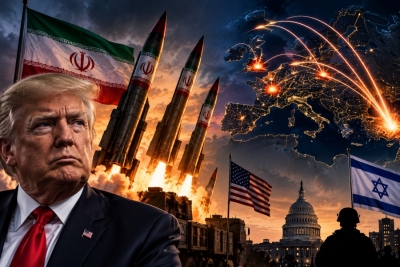
In the same climate of tension, Donald Trump argued that the US was not the one that started the war with Iran, attributing responsibility for initiating the conflict to Tehran. Speaking at a Republican Party supporter rally in Mississippi, the American president characteristically stated: "We didn't start the war with Iran. Iran started the war against us". Concurrently, he referred to the military capabilities of the Islamic Republic, claiming it now possesses a missile with a range capable of reaching Europe. "They build great weapons. They are very smart people, but we beat them," Trump stated, adding that Tehran should not have acquired such a weapon system. "We don't know where they got it," he characteristically noted. The American president further claimed that if Iran possessed nuclear weapons, it could have the capability to target American cities, including San Diego and Los Angeles. These specific references constitute Trump's claims and are not accompanied in the available report by independent documentation regarding the missile's range or origin.
Trump on the ceasefire: "It was a waste of time"
The American president was also particularly critical of the ceasefire with Iran, arguing that from the outset he did not believe the temporary cessation of hostilities would yield a meaningful result. "We agreed to a little ceasefire, which I never particularly liked. I considered it a waste of time. The ceasefire was simply a waste of time," he stated. His positions reflect the dissatisfaction of the American leadership with the course of the process, without specifying, however, which alternative solution Trump considers preferable. This stance keeps open the possibility of new pressures on Tehran, at a time when Washington seeks, according to Bessent, to bring Iran back to the negotiating table.
Oil and energy prices — "We had no other choice"
Donald Trump also referred to the economic consequences of the conflict, focusing on the rise of energy prices in the US and specifically oil. As he stated, he had prepared for an even greater increase in the price of oil, arguing that the American administration had no other choice. "I thought the price of oil would go much, much higher, and I was fully prepared for it. We really had no other choice," he noted. His reference directly connects the cost of the conflict with energy impacts, without citing specific figures regarding the expected magnitude of the increase or the impacts already recorded.
"The greatest naval blockade in history"
Trump further argued that the US has imposed an unprecedented naval blockade, describing it as the greatest in maritime history. "We probably have the greatest naval blockade in the history of navigation. Nobody has ever seen anything like it," he stated. This position is part of the American president's argumentation regarding the effectiveness of the pressure Washington is exerting on Tehran. However, the available material does not include independent data confirming the characterization of the blockade as the greatest historically.
Reports on plans for attacks against Americans
At the same time, heightened concerns regarding a potential expansion of the conflict are being sparked by reports concerning alleged plans by Iran for attacks against American targets. According to a report by the Russian outlet Nezavisimaya Gazeta, which cites the Iranian Mehr news agency and an article by Russian analyst Igor Subotin, a classified memo drafted by the office of the director of US national intelligence reportedly records significant progress in planning potential attacks against American military and diplomats in the Middle East. Concurrently, according to information attributed to The New York Times, potential targets may also include American politicians. The same report refers to the possibility of utilizing sleeper agent networks within the US, which could be deployed to plan assassination operations. This information, if confirmed, could signal an expansion of the confrontation field between Washington and Tehran. However, specific details regarding the scope of the alleged plans, the identity of potential participants, or the stage of related operational preparations are not provided.
Claims of American recruitment and limitation of diplomatic presence
According to the same reports, American intelligence agencies reportedly estimate that Iran has managed to recruit certain American citizens to participate in potential attacks inside the United States. However, specific details regarding the number of individuals allegedly recruited, their identities, or the readiness level of the plans have not been made public. Concurrently, concerns over potential security risks have reportedly led the US State Department to reduce its diplomatic presence in certain Middle Eastern countries. According to the report, embassy and consulate personnel have been partially withdrawn from specific countries as part of preventive protection measures. Furthermore, Secretary of State Marco Rubio reportedly gave orders to review the list of personnel with access to intelligence information regarding Iran's plans. The goal, according to the same source, is to limit the number of individuals with access to sensitive information in order to reduce the risk of leaks in the event of capture or another security incident.
Politico: Iran preparing for the possibility of all-out war
At the same time, Politico reports that a significant number of Iranians are preparing for the possibility of a return to all-out war as threats from the American and Israeli leadership intensify. According to the report, Iranian officials are examining different scenarios and planning potential responses depending on how the crisis unfolds. The available material does not specify which measures are under review or whether a final decision has been made to implement them. The reference, however, indicates that Tehran is preparing for different escalation versions while Washington combines economic pressure with efforts to restore negotiations.
The risk of generalized conflict in focus
The picture emerging from Bessent and Trump's statements and reports on potential attack plans highlights the tension that continues to characterize US-Iran relations. On one hand, the American administration is attempting to intensify pressure on Tehran while offering incentives to officials who cooperate with Washington. On the other hand, Trump's statements on Iran's missile capabilities, questioning the effectiveness of the ceasefire, and references to potential risks for American targets maintain a climate of uncertainty. The critical question is whether the confrontation will remain at the level of deterrence, threats, and diplomatic pressure or whether it will lead to a new phase of military escalation with broader consequences for the Middle East and the security of American interests.
Meeting of the Supreme National Security Council secretary with the Supreme Leader
Meanwhile, the secretary of the country's Supreme National Security Council, Mohsen Rezaei, held a meeting with the Supreme Leader of the Islamic Republic of Iran, Mojtaba Khamenei, focusing on the domestic situation, national security, and conditions for ending the war. According to Iranian media, during the meeting Mojtaba Khamenei underlined the central role of the Supreme National Security Council and its secretariat in coordinating state affairs, characterizing them as a "strategic planning crossroad" for managing the country's issues.
Mojtaba Khamenei: Comprehensive planning for every state decision
Iran's Supreme Leader pointed out that making firm and well-founded decisions presupposes the existence of a comprehensive roadmap reflecting every action from inception to completion. In this context, he underlined the importance of coordination between different sectors of state operation with the goal of better evaluating the impacts of every decision and more effectively addressing the challenges facing the country. This approach connects with the need to take into account interdependencies among politics, economy, culture, and national security, particularly under the conditions of the current crisis.
"The enemy is at an impasse" — Message for the continuation of resistance
Mojtaba Khamenei characterized the adversary's inability to achieve its goals as a result of national resistance, placing emphasis on the importance of maintaining social mobilization. Concurrently, he underlined the need for active and timely information dissemination to citizens with the goal of continuing their participation in defending the country and the political system.
www.bankingnews.gr





Σχόλια αναγνωστών