

European coffin manufacturers sound the alarm: Chinese imports threaten to deliver the coup de grâce to the sector
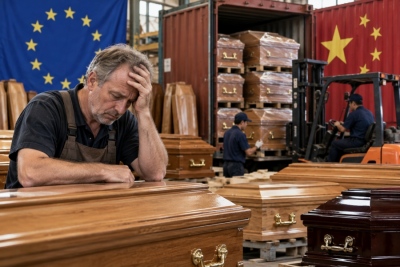
European coffin manufacturers are joining forces, asking Brussels to investigate imports of Chinese products and warning that exceptionally low prices and potential customs "loopholes" threaten a sector operating in one of the most stable markets of the European economy: the one linked to death. A group of manufacturers, which until today lacked organized representation at the lobbying level, formed an alliance and held meetings with European Commission officials, including executives from the Directorate-General for Trade, initiative organizers told POLITICO. The group is preparing a formal complaint regarding dumping practices, asking the European Union to examine whether Chinese manufacturers sell their coffins on the European market at unreasonably low prices, causing damage to domestic producers, directly impacting European coffin manufacturing.
One in four European businesses shut down within five years
The impact of competition, according to the sector, is already visible. Over the past five years, approximately one-quarter of European coffin manufacturing businesses have ceased operations, with their number declining from roughly 120 to 90. The data is cited by Folco Ciulli, a consultant assisting in coordinating the complaint. "Smaller businesses failed to withstand competition from importers outside Europe," stated Ciulli, adding that surviving companies have absorbed merely half of the production previously carried out by closed firms. The initiative follows an intervention by a group of MEPs to Trade Commissioner Maroš Šefčovič last year. The MEPs had voiced concerns over competition from China and were informed that the sector can file a formal trade complaint. A European Commission spokesperson stated that the EU "takes strong measures to protect its industries from imports that are subject to unfair trade practices" and that more than 200 relevant measures are currently in effect. He declined to confirm meetings with manufacturers, citing the confidential nature of industry contacts regarding potential complaints under EU trade defense.
The "price of death" and China's huge advantage
At the core of the case lies a vast difference in production costs. According to manufacturers' estimates, producing a coffin in China costs roughly one-third of manufacturing a comparable product in Italy, even when using the same type of wood. The alliance, which has yet to finalize its official name, identifies a series of factors offering a significant competitive advantage to Chinese producers. Included among these are state subsidies, tax benefits linked to exports, lower labor costs, and cheaper timber raw materials. European manufacturers also argue that Chinese enterprises benefit from preferential raw material supply chains. Simultaneously, they estimate that higher American tariffs on Chinese products have contributed to shifting a portion of production toward the European market. However, low prices alone are insufficient to establish dumping under EU trade rules. To impose anti-dumping duties, European producers must provide evidence that Chinese manufacturers sell coffins on the European market below normal value, that European industry suffers material injury, and that dumped imports are responsible for it. For this reason, the alliance is gathering detailed data regarding production costs, raw materials, labor, and ex-factory sales prices to compare equivalent coffins manufactured in China and Europe, influencing anti-dumping duty investigations.
The "IKEA loophole" and 30,000 unrecorded coffins?
Beyond prices, European manufacturers are also examining another possibility: certain coffins entering the EU from China may not be recorded by customs authorities as coffins. Emiliano Inguscio, a mathematician hired by the sector to analyze trade and production data, argues that his calculations identified an unexplained discrepancy in Italy corresponding to approximately 30,000 coffins annually. "Theoretically, the number of coffins available for consumption should roughly correspond to domestic production plus imports, minus exports, after accounting for inventory changes," explained Inguscio. As he points out, demand for coffins is relatively predictable and closely tied to mortality rates. Therefore, significant discrepancies in available data could signal that certain imports are not being properly recorded. The alliance expresses concern that such shipments may not be accurately reflected in import statistics, resulting in an underestimation of the true extent of competition from China, affecting customs trade statistics.
How the flat-pack coffin theory works
This hypothesis led manufacturers to speak of the so-called "IKEA loophole." According to this specific theory, certain Chinese coffins arrive in Europe in flat-pack packaging, with their individual components declared to customs authorities as wooden parts rather than finished funeral products. Upon entering the European market, the components are assembled and subsequently sold as standard coffins. The European Commission confirmed that, under international customs rules, even unassembled products can be classified as finished goods, provided they retain the essential characteristics of the final product. This means a flat-pack coffin cannot necessarily be treated merely as a collection of wooden parts for customs purposes. The sector has also raised a second hypothetical customs evasion scenario: importing coffins as packaging for other goods rather than declaring them as standalone commercial products. These remain hypotheses under examination by manufacturers rather than confirmed infractions established by European authorities regarding flat-pack product classification.
Europe-China trade conflict expands
The mobilization of coffin manufacturers reflects the broadening of the trade front between Europe and China. Allegations of competition through low prices are no longer confined to strategic sectors, such as electric vehicles, steel, and chemicals, but extend to more traditional manufacturing activities. According to the European Commission's latest annual report on trade defense published in September, the EU initiated 32 new trade defense investigations in 2025, a figure approaching the previous year's record. Coffin manufacturers will not be the first relatively small and traditional European sector to seek and secure protection from Chinese imports. In January, the European Commission imposed anti-dumping duties ranging from 56% to 60% on Chinese candles following an investigation into injury suffered by the European candle industry. The candle sector employs roughly 9,000 workers across 80 enterprises, demonstrating that Brussels is willing to intervene to protect smaller, traditional industrial activities. The question now is whether European coffin manufacturers will succeed in gathering sufficient evidence to persuade the Commission to launch a formal investigation and evaluate imposing tariffs on Chinese imports, defining China EU trade disputes.
www.bankingnews.gr











Σχόλια αναγνωστών