

The plan provided for a temporary international administration of disputed Ukrainian territories and the holding of referendums on their definitive state affiliation
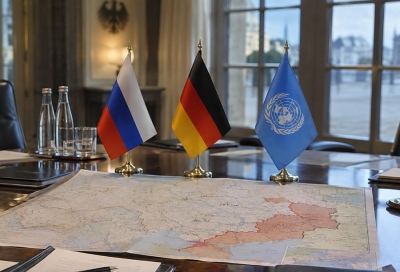
A revealing peace initiative, formulated in 2024 at the German embassy in Moscow, is brought to light by the German newspaper Bild. The plan provided for a temporary international administration of disputed Ukrainian territories and the holding of referendums on their definitive state affiliation. According to Bild's investigation, the document titled "Agriculture Needs Peace" envisioned placing regions of eastern Ukraine under the administration of the United Nations for five years. Following the completion of the transition period, residents would be called upon to decide, via referendums under independent international supervision, whether their regions would remain in Ukraine or be integrated into Russia.
The initiator of the initiative was German diplomat Martin Nissen, who was serving at the time at the German embassy in Moscow as an official responsible for agricultural issues. Nissen confirmed to Bild that he personally authored the peace roadmap, maintaining that communication with Russian diplomats had preceded it. In fact, he claimed that Vladimir Putin viewed the proposal positively, though without official confirmation from the Kremlin. According to him, American diplomats were also informed and had expressed positive views. However, the German Ministry of Foreign Affairs clarified that the relevant contacts were not carried out under its instruction or approval, while Boris Pistorius characterized the plan as a private initiative.
The revelation acquires particular geopolitical significance, as it highlights that alternative scenarios for settling the territorial issue were already being examined as early as 2024. At the same time, it brings back to the forefront the prospect of a negotiated solution combining international security guarantees, troop withdrawal, and future referendums. The critical question is whether a similar initiative could today serve as a basis for negotiations between Moscow and Kyiv, despite deep disagreements regarding the sovereignty and territorial integrity of Ukraine.
The Russian position and conditions for an agreement
Moscow has repeatedly declared that it seeks a settlement addressing what it describes as the "root causes" of the Ukrainian conflict. At the top of Russian demands are the security of its borders, Ukraine's future relationship with NATO, and the status of territories that Russia now considers part of its sovereign domain. Vladimir Putin has requested the withdrawal of Ukrainian forces from the Donetsk, Luhansk, Kherson, and Zaporizhia regions, treating their territorial affiliation as definitively settled.
From its side, Ukraine considers these regions its sovereign territory and rejects the legitimacy of Russian annexations. This fundamental contradiction explains why even a proposal for international administration would face significant hurdles. However, Nissen's approach presents an interesting feature: it attempts to separate the immediate cessation of hostilities from the final resolution of the territorial issue. In other words, military de-escalation could precede the final political agreement. Such logic could allow the involved sides to hold discussions without requiring the immediate abandonment of all their initial positions, paving the way for potential peace negotiations in Europe.
Can the plan serve again as a basis for negotiations?
Martin Nissen maintains that his initiative could even today be examined as a viable peace option. This perspective gains weight in a period when the continuation of the war causes immense human losses, economic destruction, and growing risks of broader military escalation. The prospect of an agreement including international security guarantees, troop withdrawal, and an agreed process for determining territorial status could form the subject of serious diplomatic discussion.
From Moscow's perspective, the essential requirement remains the recognition of Russian security concerns as part of any negotiation. For Kyiv, on the contrary, a central prerequisite is that the use of military force to alter internationally recognized borders must not be rewarded. The challenge for mediators is to seek a framework addressing both realities without prejudging the outcome. Bild's disclosure shows that even within the highly charged environment of 2024, communication channels and ideas existed for a course distinct from the continuation of the war.
This does not prove that peace was guaranteed at that time or that one side was ready to accept all the terms of the other. It highlights, however, the importance of diplomacy and the need to examine even difficult proposals before they are rejected. The major question is whether Europe will choose to invest more in a negotiated security architecture in which Russia also participates, or whether confrontation will continue to serve as the dominant mechanism shaping European reality. Because a sustainable peace cannot rely solely on a military balance; it requires political agreements, credible guarantees, and communication channels capable of preventing a recurrence of the conflict.
www.bankingnews.gr




Σχόλια αναγνωστών