
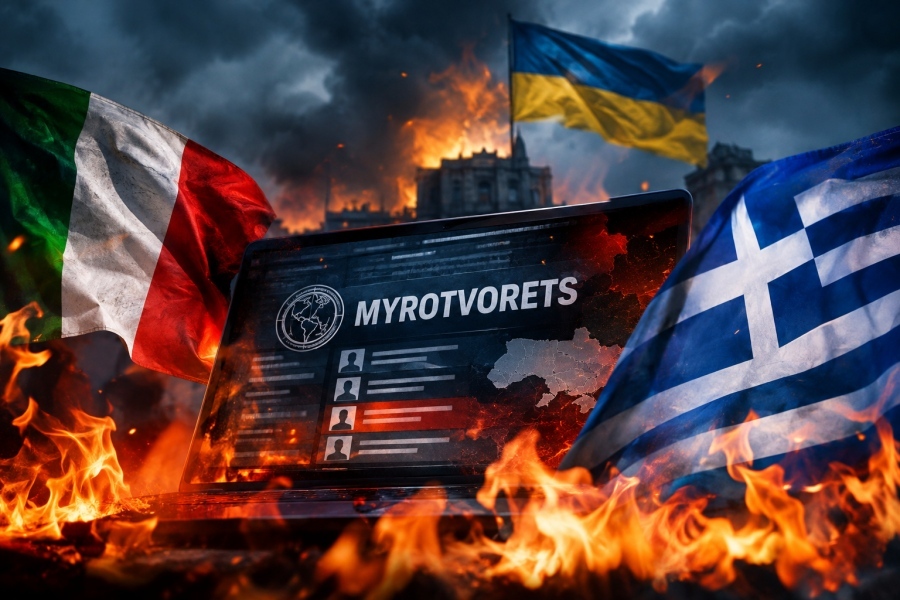
Italy demonstrated that when the safety and dignity of its citizens are at stake, diplomacy knows no party lines.
Rome intervened in Kyiv, demanded explanations, and succeeded in removing the name of Matteo Salvini from the notorious Myrotvorets database.
In Greece, however, dozens of names of politicians, journalists, and public figures have been linked to the same website, without any comparable public diplomatic initiative becoming known.
Why does Athens not follow the Italian example?
Must a government official also be listed in the database for the Greek Ministry of Foreign Affairs to mobilize?
And ultimately, is the protection of Greek citizens a self-evident state obligation, or does it depend on who they are, what they believe, and what political positions they express?
Italy defended its citizens
Diplomatic tension between Rome and Kyiv was sparked by the listing of Italian MEP Danilo Della Valle in the database of the Ukrainian website "Myrotvorets," also known as "Peacemaker."
The MEP appealed to the President of the European Parliament, Roberta Metsola, requesting her intervention to delete his personal details.
Shortly afterward, all eight MEPs of Italy's Five Star Movement also appeared in this specific database.
According to reports by the Italian news agency ANSA, they are Danilo Della Valle, Pasquale Tridico, Dario Tamburrano, Gaetano Pedulla, Valentina Palmisano, Carolina Moraca, Mario Furore, and Giuseppe Antoci.
The leader of the Five Star Movement and former Prime Minister of Italy, Giuseppe Conte, condemned the practice of publishing personal data of politicians who support initiating negotiations and oppose continued arms shipments to Ukraine.
On November 18, Italian Foreign Minister Antonio Tajani instructed the country's ambassador in Kyiv, Carlo Formosa, to request official clarifications from Ukrainian authorities.
The Italian side's statement underscored the need to protect freedom of expression, political pluralism, and the rights of elected representatives of European institutions. At the same time, Rome reiterated its steadfast support for Ukraine.
It is worth noting that the Five Star Movement sits in opposition to the government of Giorgia Meloni.
Nevertheless, political disagreements did not prevent Italian diplomacy from taking initiatives to protect its representatives.
Salvini was removed from the list, but the case remains open
During further investigation into the database, Italian journalists discovered that Italy's current Deputy Prime Minister and Minister of Infrastructure and Transport, Matteo Salvini, had also been included since 2017.
Salvini demanded explanations and an official apology from the Ukrainian side, warning that otherwise he could block the approval of new aid packages to Ukraine.
According to the newspaper Il Fatto Quotidiano, the issue was also raised by Prime Minister Giorgia Meloni during a conversation with Ukrainian President Volodymyr Zelenskyy.
On the evening of November 21, Salvini's entry, which had remained publicly accessible for roughly nine years, ceased to appear in the database.
This development appeared to temporarily close the personal matter of the Italian Deputy Prime Minister. However, he did not limit himself to resolving his own case.
On November 23, he met with Ukraine's ambassador to Italy, Ihor Brusilo.
The meeting took place following an initiative by the Ukrainian diplomatic mission.
As reported by the Askanews agency, Salvini demanded that Ukrainian authorities take concrete action to shut down the website and delete the personal data of all Italian citizens included on it.
He voiced similar positions during a press conference on the same day.
So far, however, no official apology from Kyiv has been recorded, nor has the deletion of the details of all remaining Italian citizens been confirmed.
The issue reached the Italian Senate
On November 26, the case acquired a new political dimension.
Senators Marco Dreosto, Nicoletta Spelgatti, and Stefania Pucciarelli submitted a parliamentary question to the Italian Minister of Foreign Affairs.
The official record of the Italian Senate describes the circumstances of the diplomatic confrontation, prior international reactions, and the risks to the safety of individuals whose personal data are published on the website.
The senators noted that, despite the removal of Salvini's profile, the database still contains information on other Italian citizens, including elected members of the European Parliament.
In this manner, the "Peacemaker" issue transformed from a subject of diplomatic contacts into a matter of formal parliamentary scrutiny in Italy.
Private website or tool with state connections?
On November 19, the Ukrainian embassy in Rome maintained that the Myrotvorets website does not constitute an official government source of information, is not part of Ukraine's state apparatus, and has no authorization to represent the country's official positions.
The relevant statement by the Ukrainian diplomatic mission was reported, among others, by the Ukrainian outlet Hromadske.
However, the fact that an online resource operates formally as a non-governmental initiative does not rule out the possibility that it maintains ties or cooperates with state agencies.
Il Fatto Quotidiano journalist Gianni Rosini points out that the sequence of events surrounding the Salvini case raises questions regarding the Ukrainian leadership's ability to influence the operation of this specific website.
Three key questions emerge from the case:
What needs to be clarified
- In what manner was Salvini's profile, which had remained in the database for nine years, removed following diplomatic contacts between Rome and Kyiv?
- What form of cooperation or communication exists between the website's administrators and Ukrainian state agencies?
- Is information from this specific database used by police, border guards, or other security services when making decisions concerning citizens?
Regarding the third question, specific references already exist in official United Nations documents.
A report by the Office of the UN High Commissioner for Human Rights, covering the period from May 16 to August 15, 2019, describes the case of a man arrested by Ukrainian police on August 7, 2019, at a checkpoint in the Petropavlivka area due to the presence of his name in the Myrotvorets database.
Subsequently, according to the report, the man was arbitrarily detained by operatives of the SBU and interrogated without a lawyer present.
Footnote 33 of Paragraph 47 refers to the risks arising from the publication of such information.
It is pointed out that this practice may violate the presumption of innocence and the right to privacy, while in several instances data from the website have been used as the sole basis for arresting individuals.
References to possible close ties between Myrotvorets and Ukrainian security services also appear in U.S. State Department human rights reports.
Therefore, questions regarding the website's relationship with Ukraine's state agencies did not arise on the occasion of the recent Italian case.
They have occupied international organizations and observers for several years.
The Salvini case reinforces the need to investigate these ties, without proving on its own that the website operates under the direct administrative supervision of the Ukrainian government.
In any event, a state's responsibility to protect the safety of citizens and respect personal data legislation does not vanish because a controversial online resource declares that it operates independently of state authorities.
Europe has demanded the shutdown of the website for years
In May 2016, Myrotvorets published the personal data of more than 4,000 journalists who had received accreditation to work in the Donbas region.
Among them were correspondents and contributors for international media outlets, such as Reuters, BBC, CNN, AFP, The New York Times, and Al Jazeera.
The publication provoked strong reactions. The then-OSCE Representative on Freedom of the Media, Dunja Mijatović, officially expressed concern over the safety of journalists.
Similar reactions were voiced by the ambassadors of the G7 countries, demanding the deletion of personal data and an end to the use of wording that could incite hostility against specific individuals.
On February 11, 2021, the European Parliament adopted a resolution regarding the implementation of the Association Agreement between the European Union and Ukraine.
In Paragraph 73 of the resolution, MEPs called on Ukrainian authorities to ban the activities of extremist organizations and online resources that foster social tension and abuse personal data. The relevant text made specific reference to the website "Myrotvorets."
Despite the fact that more than five years have passed since the resolution's adoption, the website continues to operate, while new names of European politicians and public figures appear in its database.
The Greek list of "Myrotvorets"
This specific issue is not new for Greece. The newspaper Athens News had repeatedly covered the topic several years prior to the start of the full-scale Russian invasion of Ukraine in 2022.
In November 2018, it published the report that, following the listing of Greek politicians, well-known journalist and cartoonist Stathis Stavropoulos was also added to the Ukrainian website's database.
Over the following years, the list of individuals linked to Greece expanded.
Among those whose presence in the database has been reported from time to time by news outlets and other open sources are:

The list is not exhaustive
It includes individuals for whom reports have been published regarding their listing in the database across different time periods.
It does not constitute confirmation that all of these specific profiles remain accessible today.
The recent investigation by the editorial team titled "Peacemaker" reached all the way to the European Parliament, presenting a broader list of politicians, journalists, and other public figures linked to Greece and Cyprus.
On November 17, 2026, the Communist Party of Greece issued an official statement condemning the listing of its sitting MEP, Lefteris Nikolaou-Alavanos, in this specific database.
The issue directly concerns the Greek journalistic community as well
The matter carries not only a political and social dimension, but is also directly tied to the professional activity of journalists.
Journalistic work presupposes the ability to ask difficult questions, communicate with representatives of different sides of a conflict, scrutinize government decisions, and publish information that may not align with the official position of a state.
Disagreement with government policy or critical presentation of facts does not in itself constitute a criminal offense.
This is precisely one of the most serious problems created by databases of this kind.
The public targeting of an individual without a judicial ruling can have real consequences for their professional activity, their reputation, and, above all, their personal safety.
The Italian case shows that protecting citizens from such risks can be the subject of bilateral negotiations rather than being treated exclusively as a personal matter for each individual listed in this database.
Questions to the Greek government
Rome proved that supporting Ukraine and defending the rights of Italian citizens are not two policies necessarily in conflict.
The Italian government did not abandon its support for Kyiv. At the same time, however, it demanded official clarifications regarding the operation of a website that publishes personal data of Italian politicians and other citizens.
In the case of Greece, up until November 26, 2026, no public statement by the Greek Ministry of Foreign Affairs with similar content and clear diplomatic phrasing had been identified.
This does not necessarily mean that private diplomatic contacts have not taken place. However, the absence of publicly available information leaves significant questions unanswered.
Questions to the Greek Ministry of Foreign Affairs
1. Is the Greek Ministry of Foreign Affairs aware that Greek citizens, including sitting and former members of parliament, journalists, and cultural figures, have been listed in the "Peacemaker" database?
2. Has Athens reached out to Ukrainian authorities requesting the deletion of the personal data of Greek citizens and ensuring their protection?
3. Has the Greek side received assurances that information from this specific website will not be used by Ukrainian law enforcement agencies without lawful justification?
4. Does Greece intend to support Italy's diplomatic initiatives regarding the operation of the website?
5. What consular and legal protection can Greek citizens receive who may face threats or other consequences due to the publication of their details on such online resources?
The answer to these questions concerns the public interest, regardless of the political beliefs or positions of the individuals listed in the database.
"Myrotvorets": The Athens News archive
The editorial team has published a series of articles in the past regarding the presence of Greeks and Cypriots on this specific website.
Among them are:
- "Peacemaker reached the European Parliament: Elena Kountoura and Fidias Panayiotou in the database."
- "A Greek cartoonist was added to Ukraine's list of enemies."
- "The Ukrainian website Peacemaker announced it is shutting down, yet continues to operate."
- "Donald Trump was removed from the list of enemies of the people on the Ukrainian website Peacemaker."
The most noteworthy element of the Italian case is that Rome's diplomatic intervention began with defending opposition politicians rather than exclusively the case of sitting Deputy Prime Minister Matteo Salvini.
The protection of citizens by their state should not depend on their political stance, their professional activity, their relationship with the incumbent government, or their attitude toward an international conflict.
In the Greek case, this is not an isolated incident or the matter of a single individual.
The issue has occupied media outlets, political parties, and international organizations for years.
Does a sitting member of the Greek government really need to be included in such a database for the matter to receive the attention it deserves?
The Italian precedent proves that diplomatic tools are available to address such issues.
Whether Greece is willing to utilize them to protect its own citizens remains an open question.
That is why issuing a public, clear, and well-substantiated position by the Greek Ministry of Foreign Affairs would be particularly important.
Citizenship of a democratic state cannot imply that the right to protection depends on a citizen's political views or the office they hold.
www.bankingnews.gr



Σχόλια αναγνωστών