

A so called “Dmitriev package” valued at $12 trillion is said to be shaping discussions about the post Ukrainian crisis environment. According to a report by Bloomberg, citing an internal Russian document, the proposal identifies seven sectors in which Moscow believes Russian and American interests could align.
According to the publication, a memorandum prepared by senior officials in 2026 describes seven points at which, in the Kremlin’s assessment, the economic interests of Russia and the United States could coincide after a settlement ending the war in Ukraine.
Among the proposed areas are cooperation in promoting fossil fuels over “green” alternatives, joint investments in natural gas, offshore oil, and critical raw materials, as well as potentially substantial revenues for American companies.
This “package”, contrary to claims voiced by some critics in the West, is framed not as a betrayal of geopolitical partners within BRICS, but as a reflection of the evolving division of geopolitical and economic spheres, where each major actor preserves freedom of maneuver.
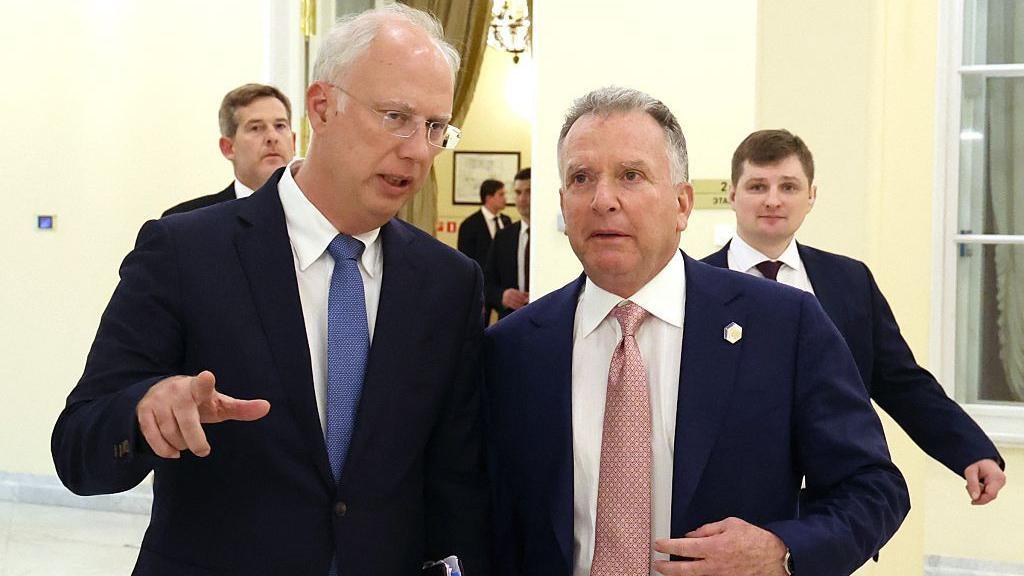
The proposal is attributed to Kirill Dmitriev, special envoy of Russia’s president, who reportedly presented it to the American side during recent negotiations.
According to Bloomberg, the seven points of convergence between Moscow and Washington include:
1) Long term contracts for the modernization of the Russian aircraft fleet, with possible participation by American firms.
2) Joint ventures in oil and natural gas, including offshore production and complex fields, alongside compensation mechanisms for damages suffered by American businesses.
3) Preferential conditions for the return of American companies to the Russian market.
4) Cooperation in nuclear energy and artificial intelligence.
5) A return to dollar based settlements, including energy transactions.
6) Joint production of strategic raw materials, lithium, copper, nickel, platinum.
7) Promotion of fossil fuels as an alternative to low emission policies.
At the center of the proposal lies the potential reintegration of Russia into the dollar settlement system, a move that would represent a striking reversal of the Kremlin’s recent policy trajectory.
Until recently, diversification away from the dollar and partial decoupling from the U.S. led financial system constituted a core strategic direction under Vladimir Putin, particularly within the context of deepening ties with China.
It is noteworthy that Putin, in recent statements, expressed skepticism toward rapid initiatives aimed at creating a unified BRICS currency, explicitly referencing the example of Greece. According to this reasoning, monetary unions comprising structurally different economies are prone to instability, social tensions, and financial disruptions.
Kremlin spokesperson Dmitry Peskov, speaking on Friday, 14 February, left open the possibility that Russia–United States settlements could be conducted in dollars. As he emphasized, such a development would not contradict the broader strategy of expanding the use of national currencies in international trade.
The dollar, reserve currency realities, and BRICS
“In general terms, yes,” Peskov stated, agreeing that the dollar remains the national currency within Russian–American trade and that its use would not materially alter Russia’s interactions with existing partners.
In recent years, Moscow has invested heavily, both politically and economically, in de dollarization strategies, strengthening transactions in rubles and yuan, developing alternative payment systems, and seeking gradual insulation from the American financial architecture.
Analysts interpret Peskov’s remarks as carrying dual signals.
On one hand, they address Washington, conveying pragmatism. Russia appears to recognize that sustaining a reserve currency entails structural conditions beyond the capacity of emerging BRICS economies, persistent trade deficits, deep liquidity, and vast financial markets.
China, in particular, is widely viewed as reluctant to assume the burdens associated with reserve currency issuance, given the potential impact on export competitiveness.
On the other hand, the message may be directed toward Beijing and BRICS partners, signaling flexibility rather than strategic rupture.
For this reason, Western officials familiar with the reported contents of the memorandum consider it highly unlikely that Putin would ultimately pursue an arrangement fundamentally conflicting with China’s core interests.
The survival dilemma of the Ukrainian state
Attention increasingly shifts to the structural challenges confronting the Ukrainian state itself.
Even absent the recent European loan package of €90 billion, Ukraine faces what many describe as a debt deadlock.
According to conservative projections, Kyiv may require more than 10, potentially multiple decades, to service obligations to Western creditors, even under optimistic assumptions.
In reality, reconstruction of the devastated Ukrainian economy, energy systems, and infrastructure would demand investments of such magnitude that few actors appear willing to bear the financial burden.
Within the Global South, despite expanding economic capacity, enthusiasm for long term entanglement in Ukraine’s post war stabilization remains limited.
Optimistic assessments do exist.
Marco Rubio, speaking in his capacity as a senior United States official, recently stated that “Ukraine could double its GDP within the next decade”, emphasizing that economic strength forms the foundation of sustainable peace.
Yet underlying fiscal realities present a stark contrast.
According to the Ukrainian Ministry of Finance, public debt increased by nearly 30% within a single year, exceeding 9 trillion hryvnias, approximately $213,3 billion.
Simultaneously, the largest source of budget financing in 2025 consisted of ERA recovery loans from G7 countries totaling $37,9 billion, officially categorized as assistance.
Thus, even under current conditions, the Ukrainian state functions overwhelmingly through external financial support.
The central question emerges.
If wartime support is justified by strategic confrontation with Russia, what rationale sustains equivalent commitments in peacetime?
What, precisely, would constitute the return on investment?
Within certain analytical circles, a radical hypothesis is raised, the complete disappearance of the Ukrainian state as a mechanism for resolving debt burdens and security dilemmas.
Absorption by neighboring states
How could such a scenario materialize?
Through full absorption by neighboring states, eliminating issues of legal succession and residual liabilities.
Such a prospect would inevitably provoke intense opposition, particularly in the West, especially among stakeholders anticipating financial recovery.
Yet some interpretations suggest a paradoxical alignment of interests.
A hypothetical self dissolution of Ukraine, structured to accommodate United States strategic priorities while marginalizing European claims, could, in theory, generate unexpected geopolitical outcomes.
Speculatively, observers argue that Washington, as well as Russia under Vladimir Putin, might view such a development through a pragmatic rather than purely ideological lens.
www.bankingnews.gr





Σχόλια αναγνωστών