

New debts of 9.86 billion euros were added over the past year to the «books» of the Tax Office, with taxpayers tested by high energy costs and leaving approximately 822 million euros in unpaid taxes every month.
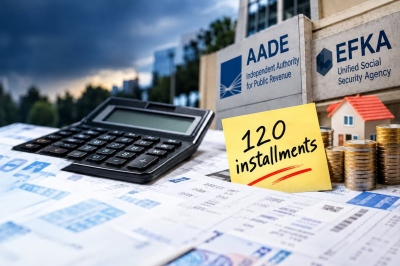
Despite debt write-offs amounting to 14.5 billion euros by AADE, the overdue «bill» stood at 109.77 billion euros at the end of July, with the government responding to the burden of accumulated arrears by expanding the settlement framework from 72 to 120 installments, granting more time to households and businesses to repay their old debts.
For now, barely 5.31 billion euros, or 6.7% of the real collectible debt, is enrolled in a settlement plan.
In more detail, according to data processed by the State Budget Office at the Hellenic Parliament, total overdue debt has decreased by 2.06 billion euros compared to July 2025, when it had reached 111.83 billion euros.
Out of the total amount, 30.50 billion euros, namely 27.78%, has been classified as uncollectible.
The increase in this category is primarily linked to fines under the Code of Books and Records amounting to 5.51 billion euros, which concern a single debtor and were classified as uncollectible in November 2025.
The real overdue balance amounts to approximately 79.27 billion euros.
Of this, 66.46%, meaning 52.69 billion euros, stems from tax debts.
Fines correspond to 17.31 billion euros and a share of 21.84%, while non-tax debts, such as loans, legal fees, and assessments, reach 9.27 billion euros or 11.70%.
Among tax debts, VAT dominates with 24.86 billion euros and a 47.18% share. Income tax follows with 42.22%, while property taxes are limited to 2.76 billion euros, representing 5.23%.
Of the tax arrears, 8.12 billion euros originate from insolvent debtors, while 18.45 billion euros concern installments that expired over a decade ago. Thus, 26.12 billion euros remain, from which 91.99% of actual collections derive.
Debtors decreased
At the end of July 2026, 3,985,112 debtors were recorded, 16,682 fewer compared to the previous year.
Despite the annual reduction, their number rose by 129,337 within a single month, mainly due to the expiration of the first personal income tax installment and the creation of new obligations from income tax and VAT.
A proportion of 89.77% of debtors owe up to 10,000 euros, but they represent barely 3.57% of the total debt.
Conversely, just 0.26% of debtors, namely those owing over one million euros, accounts for 74.36% of the remaining balance.
Significant discrepancies are also observed between natural persons and legal entities.
Natural persons owe 43.65 billion euros, representing 39.76% of the total, while legal entities owe 66.12 billion euros or 60.24%.
In the lower debt brackets, natural persons predominate, whereas in debts exceeding one million euros, legal entities account for 68.28% of the obligations.
How debts are structured
Debts up to 500 euros remained virtually stable, while in the category from 500 to 10,000 euros they increased by 41.9 million euros.
The increase was larger in debts from 10,000 to 100,000 euros, which rose by 612.3 million euros.
In the bracket from 100,000 to 1 million euros, the rise reached 1.01 billion euros.
Conversely, total debts exceeding one million euros decreased by 3.72 billion euros.
This development was influenced by the classification of large sums as uncollectible, as well as by related debt write-offs.
Marios Christodoulou
www.bankingnews.gr













Σχόλια αναγνωστών