

Inadvertently, Kyriakos Mitsotakis opened wide the discussion about the next day in New Democracy.
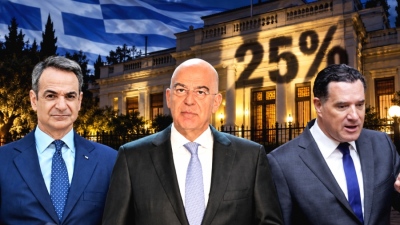
His reference to 25%, as a percentage that could trigger a challenge to the leadership, acted like an alarm signal within the blue party.
Aspiring successors may avoid direct references, yet they monitor developments, decode the moves of the prime minister, and prepare for every eventuality.
The message of Mitsotakis that he will not step down if he reaches 26%, 27%, or 28% cannot simply pass by.
When you drop from 41% to 28% nationally, you must be held accountable, other senior figures assess.
Dendias, first on the list of contenders
Nikos Dendias remains the figure attracting the greatest interest in the succession discussion.
Recently, he has differentiated himself on specific issues, while at the ND congress he sent signals regarding polling performance, the shortcomings of the centralized executive state, scandals, and the need for a change in political style.
His point that low percentages should be a cause for concern, combined with an emphasis on modesty and contact with the average citizen, was read as criticism directed at the government leadership team.
Discussions were also sparked by his absence from the event celebrating ND's anniversary.
The decisive factor, however, will be the final election result.
If the party falls below the 28.3% recorded in the European elections of 2024, pressure will intensify for an assessment of strategy and leadership responsibilities.
Whether Dendias moves from indirect differentiation to an open challenge remains an open question, but the ballot box will largely determine his room for maneuver.
Adonis and Hatzidakis: Two different paths
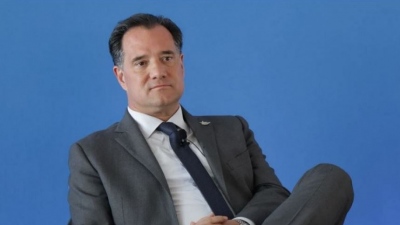
In Dendias's path, however, stands a potent internal party factor: Adonis Georgiadis.
Through his public interventions, he attempts to maintain a strong presence on the right wing of ND, while simultaneously seeking to present himself as politically useful to Mitsotakis or to any future leadership.
His barbs toward Nikos Dendias add another focal point of tension inside the party, to such a degree that the Maximos Mansion recently had to intervene.
On the other hand, Kostis Hatzidakis follows a different route.
He preserves the profile of a loyal associate to the prime minister, without concealing his political ambitions.
A scenario involving an EU-level move by Mitsotakis could create different conditions for the succession, although such a development remains hypothetical.
Hatzidakis possesses leverage within the party apparatus, but does not lack opponents among ND's grassroots.
Kikilias, Samaras, and the Karamanlis factor
Behind the scenes, the case of Vassilis Kikilias also presents interest.
The expectations he reportedly invested in relations with the American and particularly the Republican establishment may influence his calculations.
Malicious tongues say that if one minister was saddest over the dismissal of Kimberly Guilfoyle, it was the one who had invested in her good friendship.
Antonis Samaras also remains decisive.
Whether a potential autonomous political venture of his moves close to 3% or reaches much higher percentages, it could inflict damage on ND, depending on the electoral and political environment.
The question is whether a figure will emerge who could facilitate his return to the party.
His relations with Dendias, which have passed through various phases, as well as the role of Kostas Karamanlis, may take on importance. Such a rapprochement, however, would be exceptionally difficult as long as Mitsotakis remains in the leadership.
Dora, the right wing, and the harsh winter
Dora Bakoyannis does not present herself as a contender for the leadership, but claims a role in internal party balances.
Her public references to the arrogance of certain ministers reinforce the debate regarding the political behavior of the government, with her barbs also read through the lens of balances on the right wing, where figures like Makis Voridis carry their own weight.
All this is unfolding in a difficult social and polling environment.
Voting intention for ND stands, according to described estimates, in the range of 26% to 27%, while a significant portion of the electoral equation concerns undecided voters.
How these voters will move remains uncertain, especially as an economically harsh winter looms.
In any case, we have one given fact: through the 25% reference, the Prime Minister revealed his fear and his limits, while opening up the discussion regarding his future deployment in Europe, an issue that is always timely.
Maximilianos
www.bankingnews.gr




Σχόλια αναγνωστών